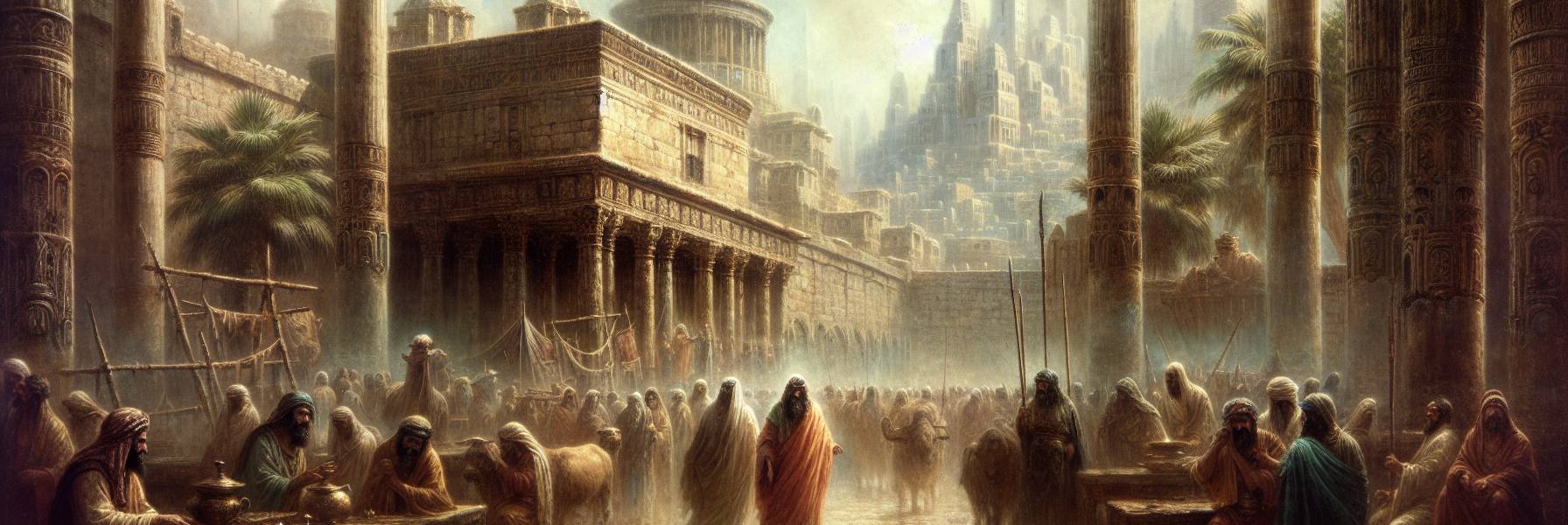

The air in the temple court was thick and still, heavy with the scent of old stone and the faint, greasy smell of recent sacrifices. It was a weight that pressed not just on the skin, but on the spirit. Jerusalem was a city holding its breath. The memory of the first exile, eight years past, was a fresh scar. The vessels of the Lord’s house, the king’s own sons, the skilled craftsmen—all gone, carried off to the sweltering, alien grandeur of Babylon. And the prophet Jeremiah walked among them, a living, breathing omen of worse to come, a yoke of wood upon his neck as a sign of the submission that was required.
It was in this charged silence that Hananiah son of Azzur, a prophet from Gibeon, chose to speak. He did not slink into the court; he entered it with the confidence of a man bearing good news he knew would be welcome. The priests and the people who lingered near the temple, their faces etched with a permanent anxiety, turned to him like sunflowers. He stood before them in the very house of the Lord, and his voice, clear and robust, cut through the oppressive quiet.
“This is what the Lord of Armies, the God of Israel, says,” Hananiah declared, his eyes sweeping over the gathered crowd, gathering them into his promise. “I have broken the yoke of the king of Babylon. Within two full years, I will bring back to this place all the vessels of the Lord’s house that Nebuchadnezzar king of Babylon took from this place and carried to Babylon. And I will bring back to this place Jeconiah son of Jehoiakim, king of Judah, and all the exiles from Judah who went to Babylon—for I will break the yoke of the king of Babylon.”
A murmur, hopeful and desperate, rippled through the crowd. It was the word they had been aching to hear. Two years. Not a generation, not a lifetime of servitude. Two years, and the nightmare would be over. The familiar weight of the temple vessels would be restored to their places, the king’s line would be re-established in Jerusalem, and the shadow of the eagle-standard of Babylon would recede from their lives. It was a sweet, intoxicating draft of hope, and the people drank it in.
Jeremiah the prophet had been standing at the edge of the court, the wooden yoke a familiar, grinding pressure on his shoulders. He did not rush to contradict. He did not raise his voice in immediate argument. He waited until the echo of Hananiah’s proclamation had settled, and then he walked forward, the yoke creaking faintly with his movement. The crowd parted for him, their expressions a mixture of reverence and unease.
He stood before Hananiah, and his voice was quieter, worn down by years of delivering messages no one wanted to hear. “Amen,” Jeremiah said. The word was a sigh. “May the Lord indeed do so. May he fulfill the words you have prophesied and bring back the vessels of the Lord’s house and all the exiles from Babylon to this place.”
He paused, letting his own surprising agreement hang in the air. The people looked confused; Hananiah allowed a small, triumphant smile to touch his lips. But Jeremiah was not finished.
“Nevertheless,” he continued, the word dropping like a stone into still water, “listen now to this word that I speak in your hearing and in the hearing of all the people: The prophets who came before you and me from ancient times prophesied war, famine, and plague against many countries and great kingdoms. As for the prophet who prophesies peace—when the word of that prophet comes true, then it will be known that the Lord has truly sent that prophet.”
It was not a rebuke, not yet. It was a lesson from history, a quiet, sobering reminder that the pleasant message is not always the true one. The role of a prophet was not to be a cheerleader for the nation, but a mouthpiece for the Lord, whatever the cost. Jeremiah then turned and walked away, the yoke still upon him, a silent, stubborn testament to a harder, longer road.
But Hananiah could not let the challenge stand. The approval of the crowd was a heady thing, and the dissent of Jeremiah was a stain on his moment of glory. He watched Jeremiah’s retreating back, the symbol of submission, and a hot flush of defiance rose in him. He strode after Jeremiah, and the people, sensing a confrontation, pressed in closer.
Before the priests and all the people, Hananiah reached out, his hands gripping the smooth, worn wood of the yoke upon Jeremiah’s neck. With a sharp, dramatic crack, he broke it. The sound was shockingly loud in the sacred space. He held the two pieces aloft, a victor with his spoils.
“This is what the Lord says,” Hananiah announced again, his voice ringing with conviction. “Even so will I break the yoke of Nebuchadzzar king of Babylon from the neck of all the nations within two years.”
This time, Jeremiah offered no immediate reply. He simply stood, the weight gone from his shoulders, feeling the strange, unsettling lightness. He looked at the broken pieces of wood on the ground, then at the exultant face of Hananiah, and then he turned and walked away, his steps slow and heavy. He did not look back at the hopeful, murmuring crowd.
Days passed. The city buzzed with the story. Hananiah was the hero of the hour, the prophet of liberation. Jeremiah was a ghost, a reminder of a pessimism they desperately wanted to forget. But the word of the Lord, when it is true, will not be silenced by popular opinion or broken yokes.
The message came to Jeremiah again, a fire in his bones that demanded to be spoken. He went and found Hananiah, not in the grand court of the temple, but perhaps in a narrower street, where the sunlight was cut into sharp slices by the overhanging buildings.
“Listen, Hananiah,” Jeremiah said, his voice low but carrying a terrible finality. “The Lord has not sent you, yet you have persuaded this people to trust in a lie. Therefore, this is what the Lord says: ‘I am about to remove you from the face of the earth. This very year you are going to die, because you have preached rebellion against the Lord.’”
The sentence was absolute. There was no appeal, no period of probation. The man who had prophesied freedom within two years would not see the end of one.
And so it happened. The summer heat baked the stones of Jerusalem, the same heat, the same stones. The hope that Hananiah had ignited flickered and guttered out as the days turned into months and the political situation did not change. And in the seventh month of that very year, a sickness took hold of Hananiah son of Azzur, and he died.
His death was a quieter thing than his prophecy. There was no dramatic crack of wood, only the slow, solemn tolling of a life ended. The people who had cheered him now looked at one another with a dawning, fearful understanding. The broken yoke on the temple floor was not a symbol of liberation, but a piece of a dead man’s folly. And the silence that returned to the city was deeper and more profound than before, filled now with the grim knowledge that the true word of the Lord, however heavy it was to bear, was the only one that would stand. Jeremiah’s unbroken message of a necessary exile, a necessary refining fire, remained. The true yoke was still upon them, and it was not made of wood.