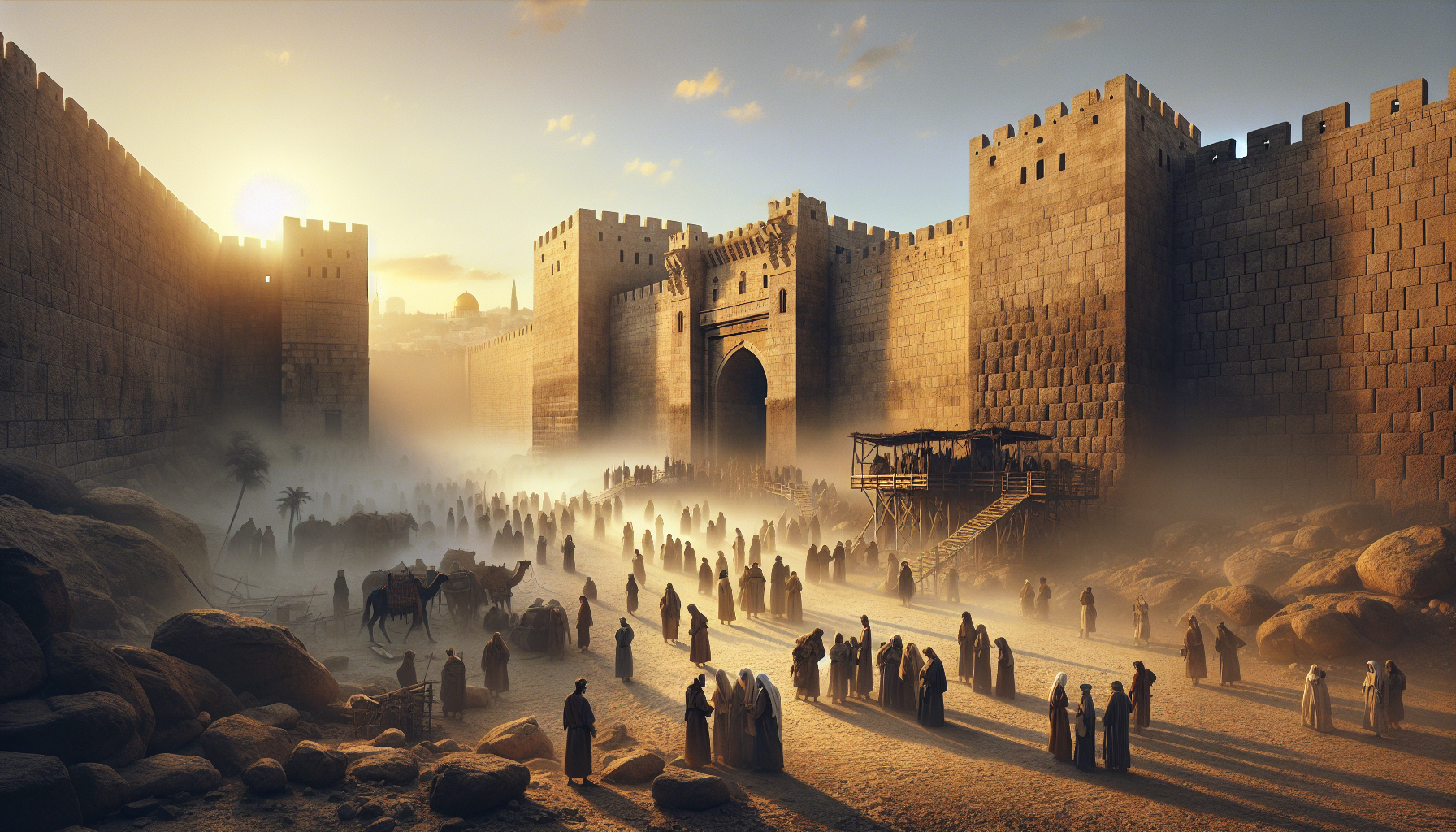
The people gathered as one man in the broad place before the Water Gate. They did not come because Nehemiah summoned them or because Ezra commanded it. They came because they asked for the book. They spoke to Ezra the scribe and told him to bring the Book of the Law of Moses, which the Lord had commanded to Israel. The initiative belonged to them, the assembly, the men and women and all who could hear with understanding. It was the first day of the seventh month, a day already marked by the calendar as sacred, but the people themselves turned it toward the law.
Ezra the priest brought the law before the assembly. He stood on a wooden pulpit built for this purpose, and beside him stood thirteen men—Mattithiah, Shema, Anaiah, Uriah, Hilkiah, and Maaseiah on his right hand; Pedaiah, Mishael, Malchijah, Hashum, Hashbaddanah, Zechariah, and Meshullam on his left. Ezra opened the book in the sight of all the people. Because he stood above them, every eye could see the scroll open. When he opened it, all the people stood up. They did not sit and listen. They rose and remained standing while Ezra read from early morning until midday.
Before he read, Ezra blessed the Lord, the great God. The people answered with two Amens, lifted their hands, bowed their heads, and worshiped the Lord with their faces to the ground. The response was not murmured or scattered. It was unified, physical, and audible. The lifting of hands and the bowing to the ground were not ritual gestures performed from memory. They were the immediate reply to the blessing of the God whose law they had demanded to hear.
The Levites—Jeshua, Bani, Sherebiah, Jamin, Akkub, Shabbethai, Hodiah, Maaseiah, Kelita, Azariah, Jozabad, Hanan, Pelaiah—caused the people to understand the law. They read from the book, the law of God, distinctly. They gave the sense, so that the people understood the reading. The text does not say they translated it into another language or paraphrased it into a sermon. They read it clearly and explained what it meant. The people stood in their places and listened until they understood.
When the people heard the words of the law, they wept. The weeping was not quiet. It was the sound of a whole assembly confronted with what they had not kept, what they had forgotten, what they were. Nehemiah the governor, Ezra the priest and scribe, and the Levites who taught the people all spoke to stop the weeping. They said, This day is holy to the Lord your God. Do not mourn. Do not weep. Then Nehemiah told them to go their way, eat the fat, drink the sweet, and send portions to those who had nothing prepared. The joy of the Lord is your strength, he said. The Levites repeated the command: Hold your peace, for the day is holy. Do not grieve.
The people obeyed. They went away to eat and drink and send portions and make great mirth. The reason for the mirth was not that they had forgotten the law. It was that they had understood the words that were declared to them. Understanding produced joy, not because the law was easy, but because it was no longer distant. They knew what it said, and they knew what it meant.
On the second day, the heads of fathers' houses of all the people, the priests, and the Levites gathered to Ezra the scribe to give attention to the words of the law. This was not a public reading. It was a deliberate study by those responsible for the households and the worship. In the law they found a command the Lord had given through Moses: that the children of Israel should dwell in booths during the feast of the seventh month. They had not kept this feast since the days of Joshua son of Nun. The text states it plainly: from those days until that day, the children of Israel had not done so.
The people went out to the mount and brought olive branches, wild olive branches, myrtle branches, palm branches, and branches of thick trees. They made booths on their roofs, in their courts, in the courts of the house of God, in the broad place of the Water Gate, and in the broad place of the Gate of Ephraim. All the assembly of those who had returned from captivity made booths and dwelt in them. The text repeats the word: very great gladness. The joy of the feast was not manufactured. It came from doing what was written, exactly as it was written, after understanding what was written.
Day by day, from the first day to the last day, Ezra read from the book of the law of God. They kept the feast seven days, and on the eighth day they held a solemn assembly according to the ordinance. The reading did not stop when the feast began. It continued through the feast. The law was not a preparation for worship. It was the content of the worship itself. The people listened, understood, obeyed, and rejoiced. The cycle was complete: they asked for the book, they heard it, they wept, they were told not to weep, they feasted, they searched the law again, they built booths, they kept the feast, and they heard the reading every day. The joy of the Lord was their strength, and the strength came from the words they had demanded to hear.