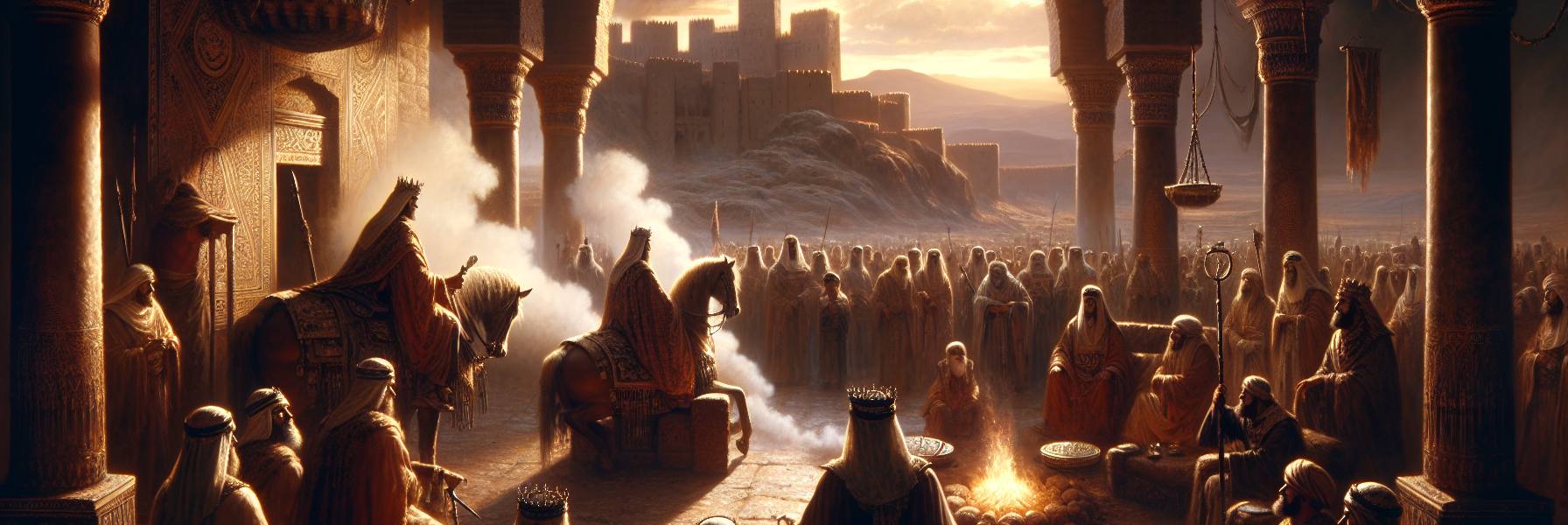

The heat lay thick over Rabbah, a heavy wool blanket soaked in the dust of the high plains. In the royal chambers, the air was still, smelling of cedar and myrrh and the faint, metallic tang of fear. King Hanun, his father Nahash newly cold in the tomb, felt the weight of the crown as a physical ache. It was in this stifling quiet that the news arrived, brought by a captain whose face was slick with sweat and apprehension.
“Men approach from the west, my king. Envoys from Hebron. From David.”
A murmur rippled through the circle of princes and advisors gathered around the young king. Nahash had shown kindness to David, they knew. When David was an outlaw, a fugitive from Saul, Nahash had offered him sanctuary, a rare gesture between a Philistine lord and a Hebrew champion. But Nahash was dead. The world had shifted.
“What is their purpose?” Hanun’s voice was higher than he wished, betraying his youth.
“To console you in your grief, they say. To honor the memory of your father.”
One of the princes, a man with a thin, cruel mouth and eyes that missed nothing, stepped forward. His name was Shobi, and his influence had grown like a weed in the shadow of the old king’s death. “Do not be deceived, my lord,” he hissed, the sound like sand shifting. “We all know of David’s ambitions. Since he unified the tribes of Judah and Israel, his gaze has turned east. Do you think he sends these men out of the goodness of his heart? No. They are spies. They have come to search out the land, to learn the weaknesses of our defenses, so that they may overthrow it.”
The words fell into the silence, seeding doubt that sprouted instantly. Hanun looked from the anxious face of his captain to the cunning eyes of his advisor. The crown felt heavier still. To trust was to be vulnerable. To be a king was to be suspicious. The legacy of his father’s kindness felt like a dangerous inheritance, a chain linking him to a potential conqueror.
“Seize them,” Hanun commanded, his voice gaining a brittle strength.
What followed was not a battle, but a calculated, profound humiliation. David’s envoys, men of rank and dignity, were dragged from the palace. Their beards, symbols of their manhood and their covenant with their God, were not merely trimmed. They were shaved off completely, leaving their faces raw, exposed, and alien. Then, in a final act of contempt, their robes were cut away to the waist, exposing their buttocks. They were thrown from the city gates, half-naked, their dignity stripped from them as cleanly as their beards.
They did not go back to Hebron. Shame is a heavier burden than any message. They found a place to hide in Jericho, a city of ruins, its broken walls a fitting backdrop for their own shattered honor, and they waited there until their beards had begun to grow back.
When the report finally reached David, he did not rage. He met the men himself, saw the lingering humiliation in their downcast eyes, the new, coarse growth on their faces that could not yet cover their disgrace. His anger was a cold, deep current, not a flash flood. He sent messengers to meet the envoys, telling them, “Remain at Jericho until your beards have grown, then return.” It was an act of profound understanding, a king tending to the wounds of the spirit before drawing the sword.
But David knew the consequences of such an insult. An apology would not come. War would. The Ammonites knew it, too. The shame they had inflicted was a declaration. They saw the storm gathering and knew they were not strong enough to weather it alone. They sent a thousand talents of silver—a king’s ransom—to hire chariots and horsemen from Aram-Naharaim, Aram-Maacah, and Zobah. A vast, mercenary army began to coalesce, a metal tide flowing from the north: thirty-two thousand men, with shimmering coats of scale armor, creaking war chariots, and commanders whose loyalty was bought and paid for.
The Ammonites themselves marched out and formed their battle lines at the entrance to their city gate, a solid wall of shields and spears. Their hired swords, the Arameans, took up positions in the open fields, a separate, professional force of overwhelming strength.
From the heights of his palace in Hebron, Joab, commander of David’s host, surveyed the mustered might of the enemy. He saw the two-pronged threat: the native Ammonites fortified at the city, and the glittering, mobile Aramean army in the field. It was a classic pincer in the making. He turned to the hardened veterans around him, his brother Abishai among them.
“You see it,” Joab said, his voice gravelly and calm. “If the Arameans prove too strong for me, you must come to my rescue. And if the Ammonites prove too strong for you, I will come to yours.” He paused, letting the simple, brutal logic of their predicament settle. Then he looked each man in the eye, his gaze like flint. “Be strong, and let us fight bravely for our people and for the cities of our God. The Lord will do what is good in his sight.”
It was not a rousing speech of certain victory, but a grim acknowledgment of their duty and their faith. They would do their part; the outcome belonged to a higher authority.
The battle was joined with a roar that tore the sky. Joab and his picked troops advanced against the Arameans in the field. The clash was horrific—the shriek of metal on metal, the guttural cries of men, the screaming of horses. The Arameans, for all their reputation and their pay, were not prepared for the ferocity of Joab’s assault. These were not mercenaries fighting for silver; they were Israelites fighting for their king, their land, and their God. The Aramean line buckled, then broke. They fled, a chaotic river of men and panicked horses, abandoning their fine chariots in the mud.
Seeing their mighty hired army routed, the spirit went out of the Ammonites. Their confidence, bought so expensively, evaporated in an instant. They turned and fled back through the city gate, barring it shut against the vengeance they knew would follow. Joab did not press the siege immediately. He had broken the main threat. He returned to Jerusalem, his army bloodied but victorious, the field littered with the wreckage of Aram’s pride.
But the Arameans were not so easily dismissed. Their king, Hadadezer, far to the north, was enraged that a paid contingent of his army had been so thoroughly thrashed. He sent for the Arameans from beyond the Euphrates River, mustering an even greater host under his commander, Shobach.
David received the news. This was no longer a border skirmish or a punitive expedition. This was a challenge to the sovereignty of Israel itself. He crossed the Jordan with his entire army, a force honed by years of wilderness warfare and civil strife. He met the massed Aramean army at Helam.
The two forces faced each other across the plain. The Arameans, reinforced and vengeful, drew up their lines against David. The battle was a sprawling, chaotic affair, a test of will as much as strength. David’s men, fighting on foot against chariots and cavalry, used the terrain, their agility, and a fierce, cohesive spirit the mercenaries could not match.
The Israelite lines held, then advanced. They broke through, and the Aramean army disintegrated into a rout. In the midst of the slaughter, David’s men sought out Shobach, the commander of the Aramean host. They found him, a giant of a man in his ornate chariot, and they cut him down there on the field. His death was the final blow.
Seeing their commander fall, the last vestige of Aramean courage vanished. The lords and captains who had come with Shobach, the veterans of a hundred battles, made their submission to David. They served him from that day forward, and they never again came to the aid of the Ammonites. The alliance of silver was shattered, replaced by the hard-won loyalty of the defeated.
The war was over. The Ammonites, having seen their last hope trampled into the dust of Helam, remained behind their walls in Rabbah, isolated and waiting for a reckoning that was, for a time, postponed. But the message had been sent across the kingdoms of the east, carried on the wind that swept the blood-soaked plains: the God of David does not ignore the shame of his servants, and a king who rules in His name is not to be provoked.