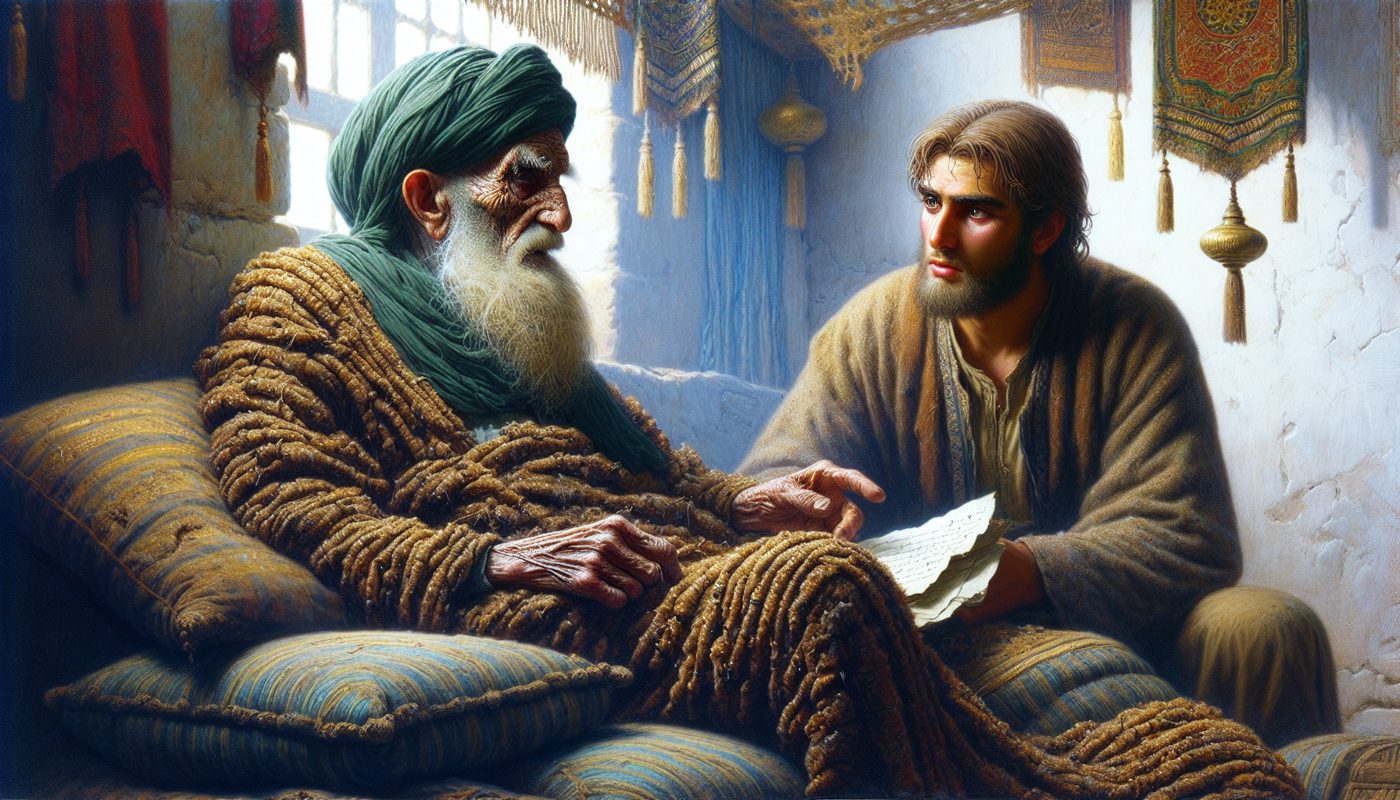
The deathbed of David was not a quiet place. The old king, his voice a dry rustle, gave Solomon a charge that mixed piety with political bloodwork. He told his son to walk in the ways of the Lord, to keep the statutes and commandments written in the law of Moses, so that the Lord might establish his word and keep a man on the throne of Israel. But then David turned to unfinished business.
He spoke of Joab, the commander who had shed blood in peace, killing Abner and Amasa under truce. David had never punished him, and now he told Solomon not to let Joab's gray head go down to Sheol in peace. He spoke of Barzillai the Gileadite, who had fed David when he fled from Absalom, and he told Solomon to show kindness to Barzillai's sons and let them eat at the king's table. Then he spoke of Shimei, the Benjamite who had cursed David bitterly when the king fled to Mahanaim. David had sworn not to kill him, but he told Solomon that a wise man would know how to bring Shimei's gray head down to Sheol with blood.
David slept with his fathers and was buried in the city of David. He had reigned forty years—seven in Hebron and thirty-three in Jerusalem. Solomon sat on the throne, and his kingdom was established greatly.
But the establishment did not happen by itself. Adonijah, Solomon's older brother, came to Bathsheba with a request. He said that all Israel had set their faces on him to reign, but the kingdom had turned to Solomon from the Lord. Now he asked only for Abishag the Shunammite, David's nurse in his old age, to be his wife. Bathsheba agreed to speak to Solomon on his behalf.
Solomon rose to meet his mother, bowed to her, and set a throne for her at his right hand. When she made the request, Solomon saw through it. He asked why she asked only for Abishag, and then he named Adonijah's allies: Abiathar the priest and Joab the son of Zeruiah. He swore by the Lord that Adonijah had spoken against his own life, and he sent Benaiah to execute him that same day.
Solomon then dealt with Abiathar. He did not kill him, because Abiathar had carried the ark of the Lord before David and had shared David's afflictions. Instead, he banished him to his fields in Anathoth, removing him from the priesthood. This fulfilled the word the Lord had spoken against the house of Eli in Shiloh.
Joab heard the news and fled to the Tent of the Lord, grasping the horns of the altar. Solomon sent Benaiah to strike him there. Joab refused to come out, saying he would die where he stood. Benaiah reported this, and Solomon ordered him to strike Joab down and bury him, so that the blood Joab had shed without cause would be removed from David's house. Benaiah went up and killed Joab, and the Lord's peace was declared over David and his throne forever.
Solomon then appointed Benaiah over the army and put Zadok in Abiathar's place as priest. He called for Shimei and gave him a house in Jerusalem, commanding him not to cross the brook Kidron on pain of death. Shimei agreed and lived in Jerusalem for three years.
But when two of Shimei's servants ran away to Gath, Shimei saddled his donkey and went after them, bringing them back. Solomon heard of it and called Shimei to account. He reminded Shimei of the oath he had sworn by the Lord, and he declared that the Lord would return Shimei's wickedness upon his own head. Solomon commanded Benaiah to strike Shimei down, and he died.
The kingdom was established in the hand of Solomon. The chapter does not celebrate this as a simple success. It shows a young king who understood that a throne built on unpunished blood and unkept oaths would not stand. He acted with the wisdom his father had urged, and the Lord established his reign.
Comments
Comments 0
Read the discussion and add your voice.
Members only
Sign in to join the conversation
We keep comments tied to real accounts so the discussion stays clean and trustworthy.
No comments yet. Be the first to add one.