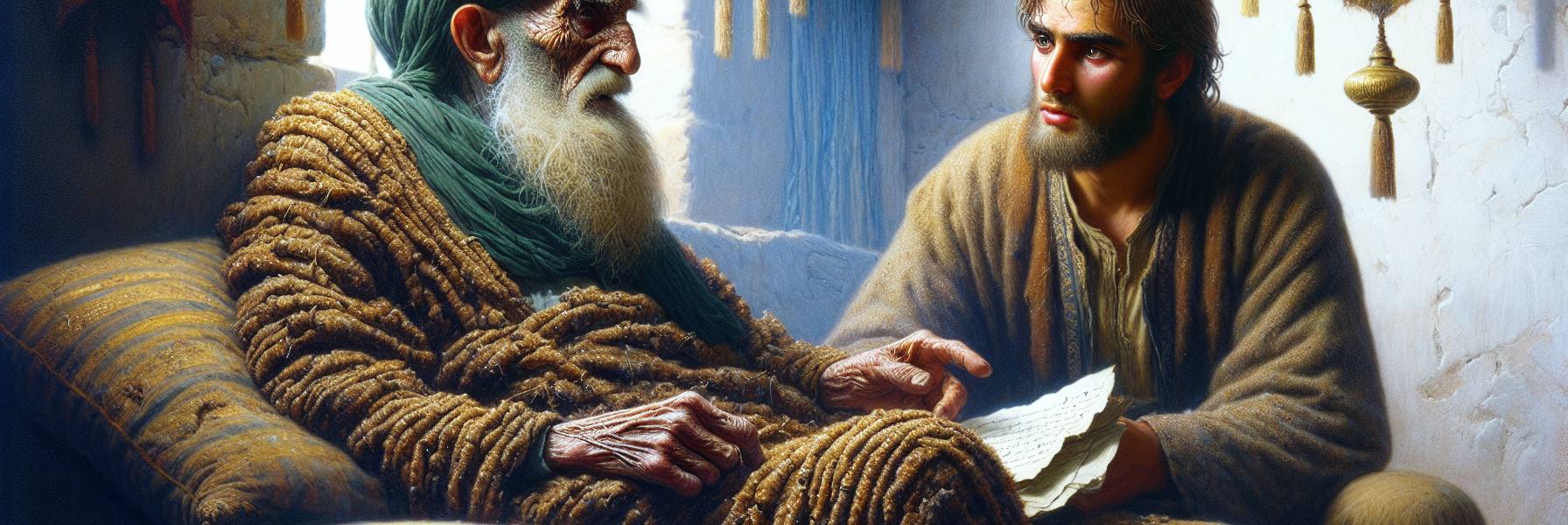

The chamber smelled of crushed mint and myrrh, the air thick and still. King David lay propped on a mound of cushions, his skin like old parchment stretched over bone. The great strength that had felled giants and built a kingdom had dwindled to a faint warmth beneath the woolen blankets. At his side, his son Solomon sat, the young man’s face a mask of solemn attention, but his eyes—his eyes missed nothing.
“I am going the way of all the earth,” David said, his voice a dry rustle. “Be strong, and show yourself a man. Keep the charge of the Lord your God, walking in his ways and keeping his statutes, his commandments, and his testimonies, as it is written in the Law of Moses.”
Solomon nodded, the weight of the words settling on his shoulders not as a burden, but as a mantle he had long been waiting to feel.
David’s hand, trembling, gestured weakly. “Moreover, you know also what Joab the son of Zeruiah did to me.” The old king’s eyes clouded, not with tears, but with the memory of bloodstains that no amount of royal purple could ever truly conceal. He spoke of the two commanders of the armies of Israel, Abner and Amasa, men cut down not in the heat of battle, but in the deceptive peace of a truce, slaughtered by Joab’s treacherous hand. “Do not let his gray head go down to Sheol in peace.”
There was more. A debt of kindness, not vengeance. “Deal loyally with the sons of Barzillai the Gileadite. Let them be among those who eat at your table.” The memory of a desperate, fleeing king, sustained by a old man’s loyalty, was a jewel David wished to pass on.
Then his voice hardened again, like cooling iron. “And behold, there is Shimei the son of Gera, the Benjaminite from Bahurim. He cursed me with a grievous curse on the day I went to Mahanaim. But he came down to meet me at the Jordan, and I swore to him by the Lord, ‘I will not put you to death with the sword.’ Now therefore, do not hold him guiltless, for you are a wise man; you will know what you ought to do to him, and you shall bring his gray head down with blood to Sheol.”
With these final, fractured pieces of statecraft and memory, David’s breath stilled. He slept with his fathers, and was buried in the City of David. The days of mourning were a great, collective sigh across the nation. And Solomon sat upon the throne of his father, and his kingdom was firmly established.
But the shadows his father had named began to stir.
Adonijah, Solomon’s older brother, who had once presumptuously declared himself king, came to Bathsheba, Solomon’s mother. His approach was all deference, but ambition glittered in his eyes like a shard of glass.
“You know that the kingdom was mine,” he said to her, his voice smooth as oil, “and that all Israel fully expected me to reign. However, the kingdom has turned about and become my brother’s, for it was his from the Lord. And now I have one request to make of you; do not refuse me.”
Bathsheba, wary, agreed to hear it.
“Please, ask King Solomon—for he will not refuse you—to give me Abishag the Shunammite as my wife.”
The request hung in the air, innocent to the ear, but laden with the poison of old claims. Abishag had been the virgin who warmed the old king David in his final days. To take a king’s concubine was, in the language of power, to lay claim to his throne.
Bathsheba, perhaps sensing the danger, perhaps not, carried the request to her son. Solomon rose to meet her, bowing deeply, and had a throne brought for the queen mother. He listened as she presented Adonijah’s plea.
The young king’s reaction was immediate and volcanic. “And why do you ask Abishag the Shunammite for Adonijah?” he said, his voice low and sharp. “Ask for him the kingdom also! For he is my older brother!” The courtiers nearby flinched at the fury in his tone. “As the Lord lives, who has established me and placed me on the throne of David my father, and who has made me a house as he promised, Adonijah shall be put to death this day.”
The sentence was not mere anger; it was the necessary, brutal surgery of a new king cutting away a festering limb. Benaiah, the commander of the royal bodyguard, a man of grim efficiency, went out and struck Adonijah down.
The purge had begun.
Solomon’s gaze then turned to the high priest Abiathar, who had thrown his lot in with Adonijah. “Go to Anathoth, to your estate,” the king told him, his voice now cold and measured. “For you deserve death. But I will not at this time put you to death, because you carried the ark of the Lord God before David my father, and because you shared in all the affliction of my father.” It was a sentence of exile, not death, a nod to past service that tempered present judgment. So Solomon removed Abiathar from being priest to the Lord, fulfilling the old prophecy against the house of Eli.
When the news reached Joab, the old lion understood its meaning. He fled to the tent of the Lord and took hold of the horns of the altar, the ancient place of sanctuary. His strength was still that of a warrior, but his hope was now that of a cornered animal.
Word was brought to Solomon: “Joab has fled to the tent of the Lord and is beside the altar.”
The king did not hesitate. He summoned Benaiah. “Go, strike him down.”
Benaiah, a man who revered the sanctuary, hesitated. “My lord the king, should I do this thing? He is at the altar.”
Solomon’s reply was inexorable, echoing his father’s dying charge. “Do as he has said, and strike him down and bury him, and thus take away from me and from my father’s house the guilt for the blood that Joab shed without cause.” He spoke of the innocent blood, the blood of Abner and Amasa, that clung to Joab’s hands and, by extension, to the house of David. “Their blood shall come back on the head of Joab and on the head of his descendants forever. But for David and for his descendants and for his house and for his throne there shall be peace from the Lord forevermore.”
So Benaiah went. He found Joab clinging to the horns, his eyes wide, not with fear of man, but with the sudden, stark fear of a God whose justice he could no longer outrun. Benaiah’s sword ended the life of the man who had been the sword of David for so long. He was buried in his own house in the wilderness. In his place, Solomon appointed Benaiah over the army, and Zadok the priest took Abiathar’s place.
One shadow remained: Shimei, the Benjaminite who had cursed a fleeing king.
Solomon summoned him. “Build yourself a house in Jerusalem and dwell there, and do not go out from there to any place whatever. For on the day you go out and cross the brook Kidron, know for certain that you shall die. Your blood shall be on your own head.”
Shimei, perhaps believing he had escaped with his life, bowed low. “What you say is good; as my lord the king has said, so will your servant do.” He built a house in Jerusalem and lived there, a prisoner in the holy city.
For three years, he stayed. Then two of his servants ran away to Gath, to Achish. A flicker of the old, careless Shimei returned. He saddled a donkey and went to Gath to retrieve his property, crossing the Kidron without a second thought.
It was reported to Solomon: “Shimei has gone from Jerusalem to Gath and has returned.”
The king summoned him once more. “Did I not make you swear by the Lord and solemnly warn you, saying, ‘Know for certain that on the day you go out and go to any place whatever, you shall die’? And you said to me, ‘What you say is good; I obey.’ Why then have you not kept your oath to the Lord and the commandment with which I commanded you?”
He saw the answer in Shimei’s face—a man who thought the king’s word had an expiration date, a man who believed his own business more important than a royal decree.
Solomon finished, his voice final as a sealed tomb. “The Lord will bring back your evil on your own head. But King Solomon shall be blessed, and the throne of David shall be established before the Lord forever.”
He nodded to Benaiah, who went out and struck Shimei down.
And so the kingdom was established in the hand of Solomon. The last echoes of the old rebellions and old hatreds were silenced. The blood that had been shed in the shadows was finally accounted for, the debts of vengeance and loyalty paid in full. A new era, one of wisdom and building, could finally begin, its foundation stone not merely laid in ceremony, but set in place with the hard, unflinching justice of a king determined to rule a united house.