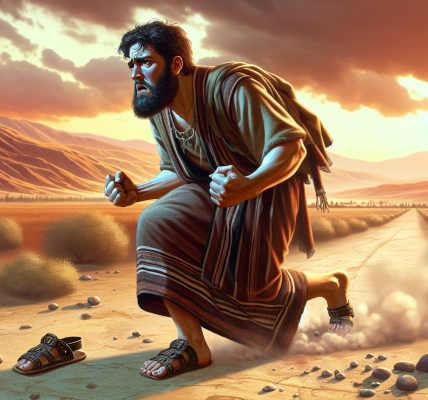

The road dust rose in pale clouds around their sandals, five men walking with the grim purpose of those sent to find something they could not yet name. They were Danites, from the tribe squeezed thin between the sea and the mountains, their inheritance choked by Philistine iron and their own dwindling spirit. Their journey north was one of desperation, a search for land, for breathing room, for a future not dictated by the strength of others.
As evening draped its purple cloak over the hill country of Ephraim, they saw the lights of a small settlement clinging to the slopes. The air was cool, carrying the scent of woodsmoke and baking bread. Needing shelter, they turned their steps toward the house of a man named Micah. They had heard whispers of him, a man of means and peculiar piety.
A young Levite, his face still soft with youth but his eyes holding a certain weary calculation, answered their knock. He was not the master of the house, but he carried himself with the authority of one who ministers to the divine.
“You are travelers?” the Levite asked, his voice careful.
“We are,” their spokesman, a man named Palti with a beard streaked with grey, replied. “Seeking a place to rest our heads for the night. We are of Dan, searching out the land.”
The Levite nodded, a slow, solemn motion. “This is the house of Micah, who has hired me to be his priest. You are welcome here. There is room, and food.”
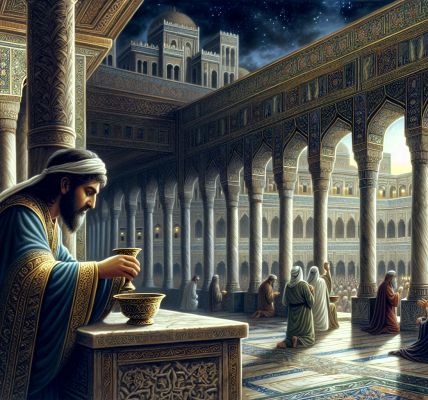
They entered the courtyard. The house was prosperous, clean, and orderly. But their eyes were drawn past the Levite, past the simple hearth, to a small, curtained alcove. Within it, they could make out the glint of silver and the smooth, dark contours of carved wood. A sacred ephod hung nearby, and beside it stood a household idol, a teraphim, its sightless eyes seeming to watch them.
They ate in silence mostly, the Danites stealing glances at the shrine. The food was good, the wine strong, but a tension hung in the air, a silent, humming question. After the meal, they pressed the young Levite.
“Who brought you here?” Palti asked, his tone casual, but his eyes sharp. “What are you doing in this place? What is your business?”
The Levite, whose name was Jonathan, son of Gershom, seemed to swell with a sense of importance. “Micah has done a great thing for me,” he explained. “He hired me, and I have become his priest. I serve before the graven image and the ephod. I inquire of the Lord for him. It is a good arrangement.”
The Danites exchanged looks. A Levite, a descendant of Moses, serving as a private priest for a man’s personal shrine? It was unorthodox, a fracture from the tabernacle at Shiloh, but it was also… functional. It held a power they could sense.
In the deep of the night, while the household slept, the five men spoke in hushed, urgent tones.
“Did you see it?” one whispered. “The ephod, the teraphim? We must know if our journey will prosper.”
“Ask him,” another urged Palti. “In the morning, ask the priest to inquire of God for us.”
At first light, they stood before Jonathan the Levite. “Please,” Palti said, his voice low and earnest, “inquire of God for us. We need to know if the journey we are on will be a success.”
Jonathan nodded, his movements practiced and solemn. He withdrew into the alcove. They heard the faint jingle of the ephod, the murmur of his voice. Time stretched. When he emerged, his face was placid, assured.
“Go in peace,” he declared, his voice taking on a formal, oracular tone. “The journey you are on is under the eye of the Lord.”
It was what they needed to hear. A divine sanction, however obtained. They thanked him, paid him for his service, and continued on their way, their steps lighter, their resolve hardened.
They traveled further north, beyond the lands of their kin, until they came to Laish. They saw its people living in quiet security, after the manner of the Sidonians, a people peaceful and unsuspecting. There were no oppressive rulers in the land, no alliances with powerful kings. They were isolated, vulnerable. The men from Dan watched from the wooded ridges, seeing the smoke from their hearths rise into a clear, untroubled sky.
They returned to Zorah and Eshtaol, to their people who waited in anxious clusters. The report they gave was not one of gentle discovery, but of predatory opportunity.
“Arise!” Palti cried out to the assembled Danites. “For we have seen the land, and behold, it is very good. And you sit idle? Do not be slow to go in and take possession of the land. When you go, you will come to a people secure and to a large land. For God has given it into your hands, a place where there is no lack of anything on earth.”
The words were a spark on dry tinder. Six hundred men, a fighting force girded with weapons of war, set out from the camp of Dan. They were not a grand army, but a determined one, a people on the move, their families and possessions trailing behind them.
On their way north, they passed again by the house of Micah in the hill country of Ephraim. The five scouts who knew the way spoke to the warriors.
“Do you know that in these houses there are an ephod, teraphim, a graven image, and a metal idol? Now therefore consider what you should do.”
It was not really a question. It was a suggestion. A tribe without a center, about to seize a land, needed more than territory. It needed a symbol. It needed a priest.
The six hundred men turned from the road and surrounded Micah’s homestead. The five scouts, knowing the layout, went straight for the shrine. They entered the house and took the carved image, the ephod, the teraphim, and the metal idol. The Levite priest, hearing the commotion, came out and stood in the courtyard, his face a mask of confusion and dawning fear.
“What are you doing?” he demanded, his voice rising. “You cannot take these things!”
The armed men looked at him, their expressions unreadable. Then Palti spoke, his voice calm and firm, stripping the Levite of his identity with a few short sentences.
“Be quiet,” he said. “Put your hand over your mouth. Come with us. Be to us a father and a priest. Is it better for you to be priest to the house of one man, or to be priest to a tribe and a family in Israel?”
The young man’s eyes widened. The calculation he had made when Micah hired him was now being recalibrated on a grander scale. A tribe versus a single patron. His heart was stirred, not with righteousness, but with ambition. He nodded silently. He gathered his own belongings and fell in with the Danites, becoming their possession as surely as the idols they had stolen.
They had not gone far when Micah, returning from some errand, discovered the plunder. His shrine was empty, his priest gone. He gathered his neighbors, his voice cracking with a rage born of violation. “They have taken my gods which I made, and the priest, and have gone away! What do I have left?”
He armed his men and they pursued the Danites, their shouts echoing in the narrow valley. They caught up to them, a small, angry band facing a small army.
The Danites turned, their faces hard. The leader of the six hundred stepped forward.
“What is the matter with you,” he called out to Micah, his voice cold and carrying, “that you have gathered a company and come out after us?”
Micah, breathing heavily, pointed an accusing finger. “You take my gods which I made, and the priest, and go away. What is left for me? How can you say, ‘What is the matter with you?’”
The Danite commander did not flinch. His reply was not an argument of law or morality, but of pure, unvarnished power.
“Let your voice not be heard among us,” he said, the warning clear and sharp as flint. “Lest angry fellows fall upon you, and you lose your life, with the lives of your household.”
Micah looked at the six hundred armed men. He looked at their set jaws and their hands on their sword hilts. The fire of his outrage guttered and died, extinguished by the cold water of reality. He saw that they were too strong. He turned, his shoulders slumping, and led his men back home, defeated and bereft.
The Danites continued their journey unmolested. They came to Laish, to that peaceful, unsuspecting people. They fell upon them with the sword, a storm of violence against a community that had known no war. They burned the city to the ground. There was no one to deliver them, for they were far from Sidon and had no dealings with anyone.
On the ashes of Laish, they built their own city, and called it Dan, after their father. They set up the carved image for themselves, and Jonathan, son of Gershom, son of Moses, and his sons after him, became priests to the tribe of Dan, until the day the land went into captivity.
So the graven image of Micah, born of stolen silver and personal devotion, became the god of a tribe. It stood in the new city of Dan, a silent witness to a journey that began in desperation, was guided by stolen divinity, and was fulfilled in bloodshed. It was a monument not to the glory of the Lord, but to the grim, pragmatic, and wayward heart of a people who fashioned their own god to suit their own purposes, and in doing so, stored up a legacy of rebellion that would echo through the ages.