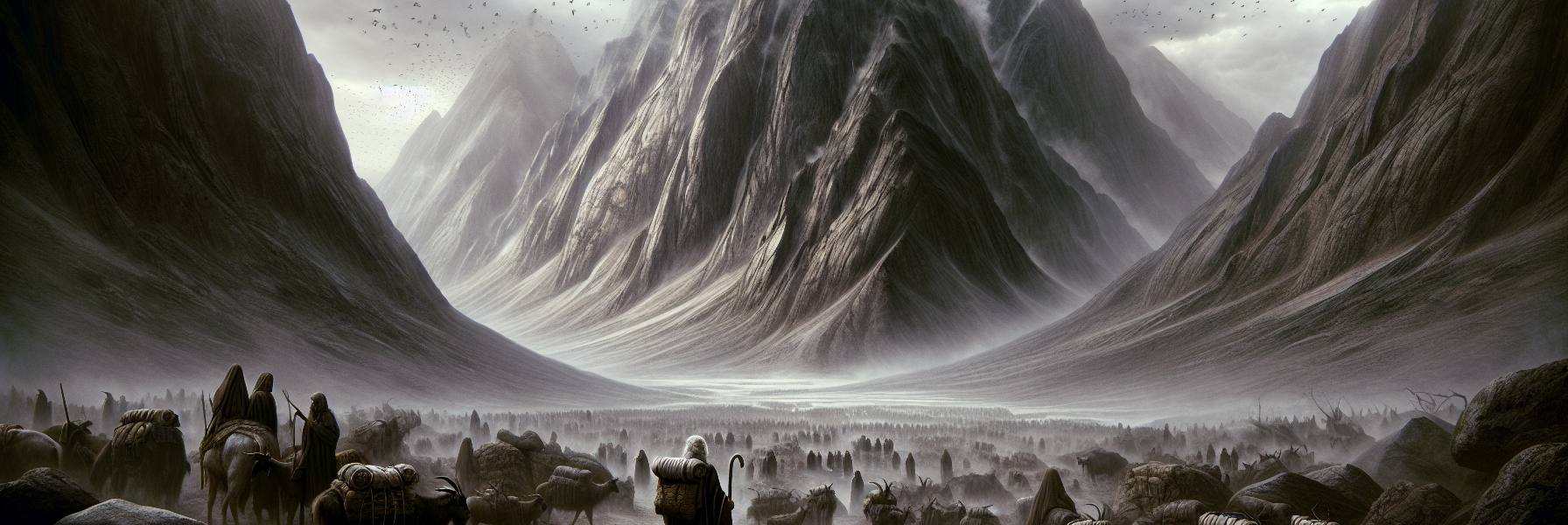

The third new moon after leaving Egypt found them camped in the wilderness. The dust of Rephidim was behind them, the memory of Amalek’s attack a fading scar. Now, they sprawled before a mountain that rent the sky, a brute of black granite and seared rock called Sinai. It was not a welcoming place. The air was thin and carried a chill that had nothing to do with the temperature.
Moses felt the weight of them all—the thousands, the livestock, the tangled web of hope and complaint. He moved through the camp in the grey dawn, the smell of dung fires and baking bread a familiar shroud. He climbed away from the stir of life, his feet finding a path known only to the mountain goats and, he hoped, to God. The higher he went, the quieter it became, until the only sound was the scuff of his sandals and the wind hissing through clefts in the stone.
He did not hear a voice so much as feel a pressure, a presence that made the hair on his arms stand erect. It was in the silence between the gusts of wind.
*Thus you shall say to the house of Jacob, and tell the people of Israel: You have seen what I did to the Egyptians, and how I bore you on eagles’ wings and brought you to myself.*
The words were not audible, but they formed in his mind with the clarity of chiseled stone. An eagle’s wings. He remembered the sight of them over the cliffs of Midian, the immense, effortless power, the terrifying gentleness with which they carried their young. The image lodged in his chest, a truth almost too vast to hold.
*Now therefore, if you will obey my voice and keep my covenant, you shall be my treasured possession among all peoples, for all the earth is mine. And you shall be to me a kingdom of priests and a holy nation.*
Moses stood for a long time, the wind plucking at his robe. A kingdom of priests. Not a nation of slaves. A treasured possession. The words were a seed of fire. He turned and descended, his mind rehearsing the message, shaping the syllables that could carry such a weight of promise.
He called for the elders first, their faces lined with the dust of decades of bondage. He spoke the words slowly, watching their eyes. He saw not jubilation, but a slow, dawning awe, a fear that was closer to reverence than terror. They did not cheer. They nodded, a silent, grave acceptance. The message spread from them, through the tribes, from the tents of Judah to the far outskirts of Dan. A murmur ran through the camp, a sound like the stirring of a great forest before a storm. And the people, as one, answered, “All that the Lord has spoken we will do.”
He brought their words back up the mountain, the collective voice of a people stepping into an identity they could not yet comprehend. The presence was there again, waiting in the stark solitude.
*Behold, I am coming to you in a thick cloud, that the people may hear when I speak with you, and may also believe you forever.*
God was not asking for blind faith. He was offering a encounter. A proof.
The instructions that followed were meticulous, a divine pedagogy for a people unaccustomed to holiness. They were to consecrate themselves for two days. They were to wash their garments, a simple, physical act to signify an inner preparation. They were to be ready by the third day. And there was a boundary. A line, drawn not in the sand but in the very consciousness of the people. The mountain was to be set apart, its lower slopes declared forbidden. Whoever touched it, beast or man, was to be stoned or shot through; no hand was to be laid on them, for the holiness of the place was a lethal fire.
The eve of the third day was taut with anticipation. The washing was done. The camp was quieter than it had ever been. Conversations were hushed. Children were held close. When the dawn of the third day came, it was not with a gentle light.
First, there was the sound. It began as a low rumble deep within the earth, a vibration that climbed up through the soles of their feet. Then it broke into the air—thunder, not from the sky, but from the mountain itself, great peals that shook the vessels of water and made the tent pegs hum. A thick, swirling cloud descended, not of water vapour, but of something darker, more substantial, and it settled over the summit, blotting out the sun. And with the cloud came fire—a searing, divine fire that did not consume the rock but played across its peaks, a light so intense it hurt to look upon, casting long, dancing shadows that seemed alive.
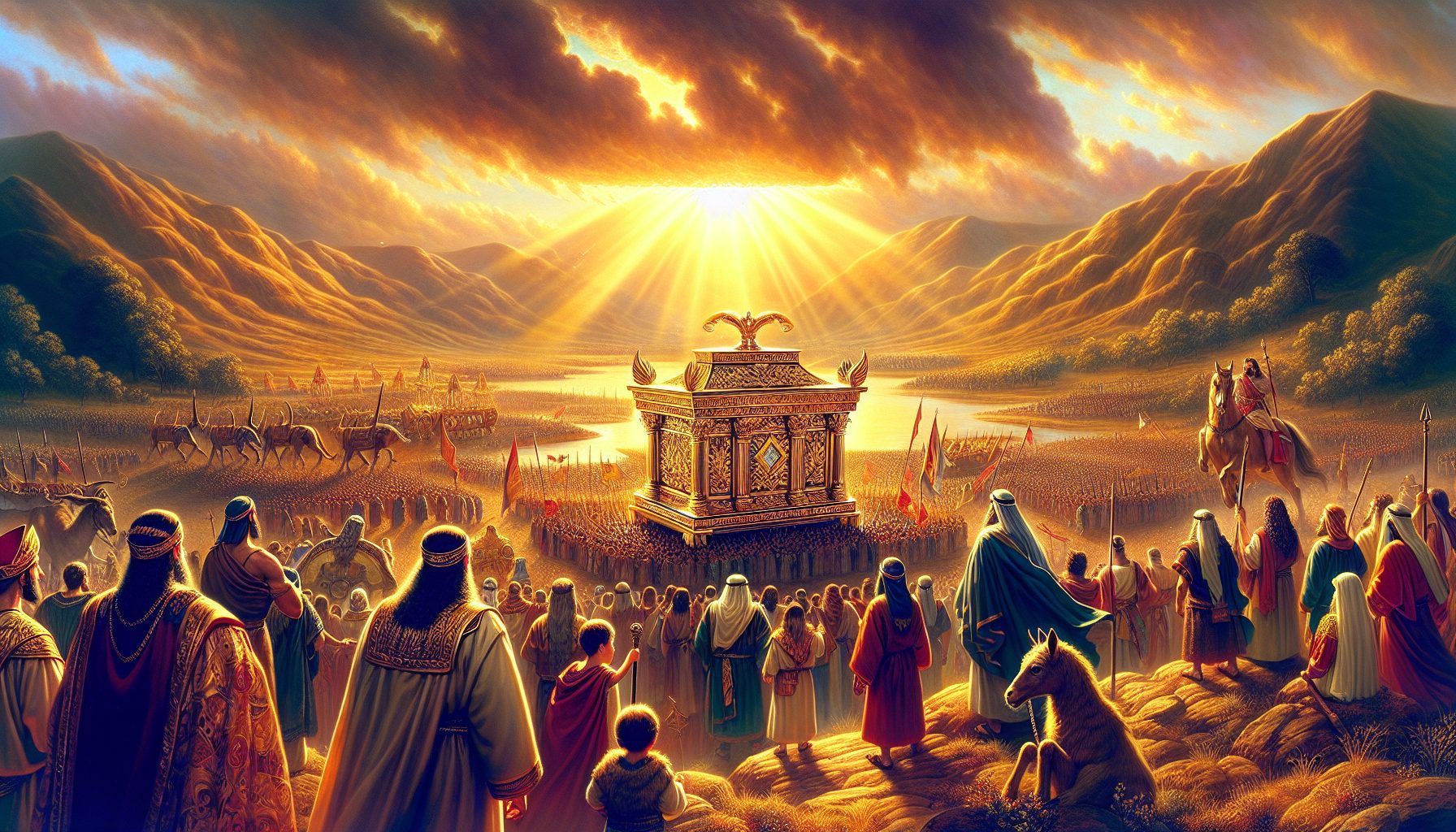
The whole mountain quaked, a great beast stirring from its sleep. The sound of a trumpet began, not the silver note of a ram’s horn blown by human lips, but a blast that swelled of its own accord, growing louder and louder until it felt it would split the world open. The people in the camp trembled. They did not merely feel fear; they were inhabited by it. It was a physical force that clutched at their throats and made their knees weak. They moved to the foot of the mountain, a vast, silent multitude, and stood facing the smoking, quaking, fiery peak.
Moses led them out from the camp to meet God, and they took their stand at the boundary, the line between the profane and the holy. The trumpet blast did not cease. It was a long, unending note of summons and warning.
And then, from the heart of the fire and the cloud, God spoke. The voice that answered Moses was not a single voice, but the convergence of all the sounds they heard—the thunder was its bass, the trumpet its clarion call, the cracking of the mountain its percussion. It was a voice that could be understood, forming words that seared themselves into memory, yet it was a sound that could shatter stone.
*I am the Lord your God, who brought you out of the land of Egypt, out of the house of slavery.*
The words did not just enter their ears; they resonated in their bones. The people recoiled. They saw the thunder and the lightning, the mountain smoking, and they heard the voice from the midst of the fire, and they shook. They moved back, a collective step away from the terrible, beautiful majesty before them.
They said to Moses, his face pale and illuminated by the unearthly glow, “You speak to us, and we will listen; but do not let God speak to us, lest we die.”
The terror of the Lord was upon them. It was not the fear of a taskmaster’s whip, but the awe-inspiring dread of raw, unmediated holiness. They understood, in that moment, the chasm between the Creator and the created.
Moses looked at their faces, pale and strained in the flickering light. “Do not fear,” he said, his own voice barely a whisper against the divine cacophony. “For God has come to test you, that the fear of him may be before you, that you may not sin.”
But the people stood far off, their earlier boldness gone, replaced by a primal caution. Only Moses drew near to the thick darkness where God was. He turned his back on the camp, on the safe, familiar world of men, and walked toward the roaring silence, the burning shadow, to receive the rest of the words that would shape them, and through them, the world. The mountain waited.