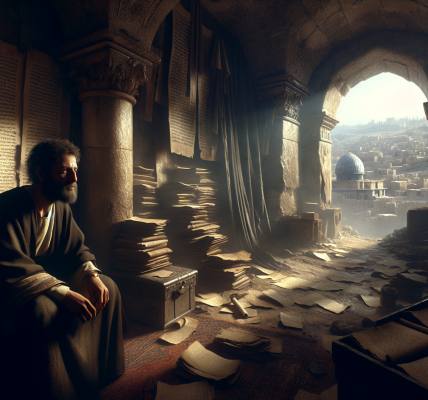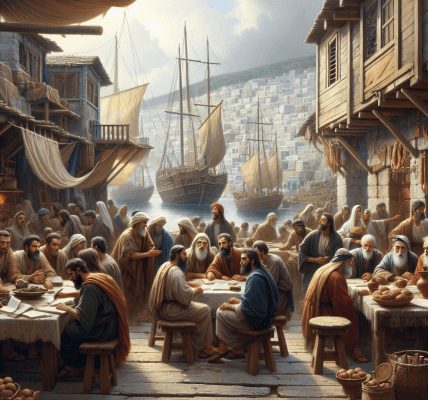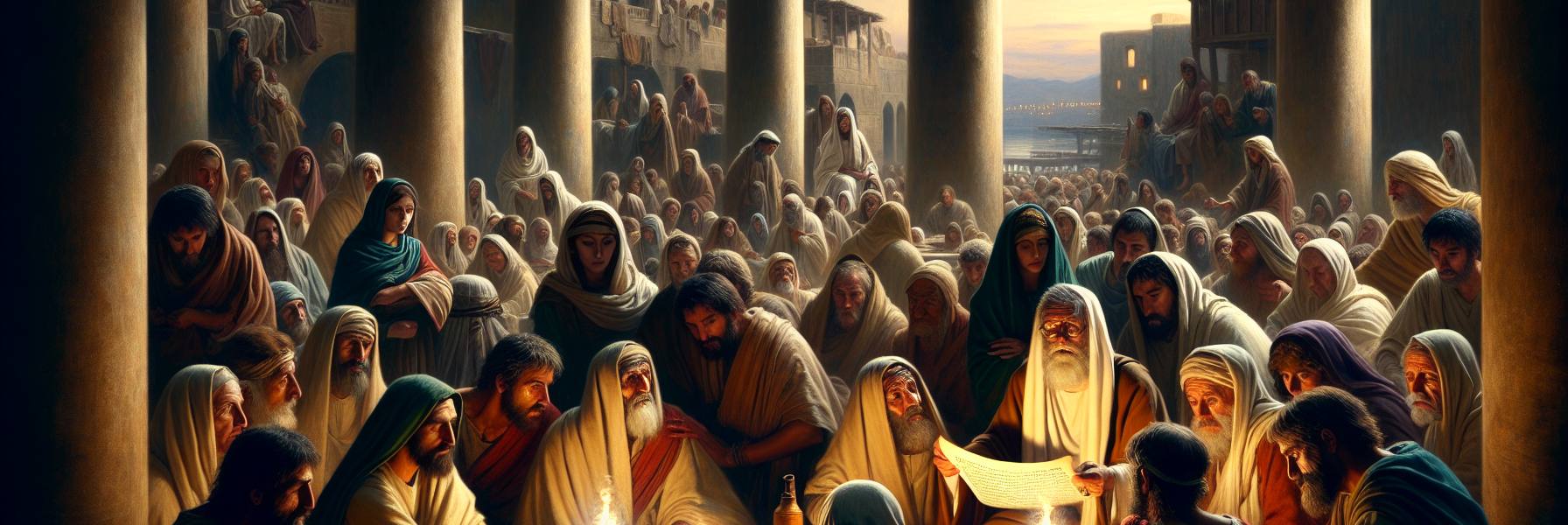

In the days when the early church was scattered like seeds upon the winds of persecution, there gathered in the shadowed corners of a bustling Roman port a small assembly of believers. Among them was an aged teacher named Silas, whose hands trembled not from frailty but from the weight of divine wisdom he carried. The flickering oil lamps cast dancing shadows upon faces marked by both hardship and hope as Silas unrolled a scroll bearing words that would anchor their souls.
“Let brotherly love continue,” Silas began, his voice a low rumble that silenced the distant cries of gulls and merchants. His eyes swept across the room—where Lydia the purple-seller sat beside Marcus the former legionary, where Jewish converts broke bread with Gentiles who once worshipped pagan idols. “This love is not mere affection,” he explained, “but the very bond knit by Christ Himself, stronger than blood, enduring beyond trial.”
He recounted how just days earlier, Priscilla and Aquila had taken in a fugitive believer from Corinth, washing his travel-stained feet though their own storeroom stood nearly empty. “See how they entertain strangers,” Silas declared, “for some have thereby entertained angels unawares, just as Abraham did in the plains of Mamre when three visitors brought promise of a son.”
The assembly leaned forward as Silas described those bound in chains for righteousness’ sake. “Remember those in prison,” he urged, “as though imprisoned with them.” Young Timothy, whose own father languished in a Roman dungeon, felt tears warm his cheeks as hands reached to shoulder his burden. “And remember those mistreated,” Silas continued, “since you yourselves are in the body—when one member suffers, all suffer together.”
Then his tone deepened, becoming as solemn as temple incense. “Let marriage be held in honor among all,” he instructed, fixing his gaze on newlywed couples whose hands were intertwined. “Let the marriage bed be undefiled, for God will judge the sexually immoral and adulterous.” He spoke of the sacred mystery where husband and wife reflected Christ’s covenant with His church—a holy tapestry woven with threads of fidelity and sacrifice.
“Keep your life free from love of money,” Silas warned, his eyes resting on a wealthy merchant recently converted. “Be content with what you have, for He has said, ‘I will never leave you nor forsake you.'” The man later confessed how he’d lain awake counting coins, but now found richer treasure in sharing his abundance with widows and orphans.
Silas’s voice swelled like tidewaters as he proclaimed their unshakable confidence: “The Lord is my helper; I will not fear; what can man do to me?” Outside, the clatter of soldiers’ armor echoed, but within, hearts stood fortified like Zion’s mountain.
“Remember your leaders,” the elder continued, nodding toward worn-out shepherds who’d guided them through heresies and hardships. “Consider the outcome of their way of life, and imitate their faith.” He recounted how Stephen, their first martyred pastor, had gazed into heaven while stones rained upon him, his final breath praying forgiveness for his killers.
Then Silas unveiled the crowning jewel of their faith: “Jesus Christ is the same yesterday and today and forever.” Murmurs of wonder rippled through the room as they grasped this anchor in their storm-tossed existence. The Christ who walked Galilee’s shores, who bled upon Golgotha’s cross, who triumphed over death—He remained unchanged, His promises as sure as the dawn.
“Do not be led away by diverse and strange teachings,” Silas cautioned, his brow furrowing. He described Egyptian mystics peddling secret knowledge and Judaizers demanding old covenant rituals. “It is good for the heart to be strengthened by grace, not by foods which have not benefited those devoted to them.” He lifted a piece of unleavened bread, reminding them that true nourishment flowed not from dietary laws but from Christ’s broken body.
Now Silas rose, his shadow falling across the wall like a prophet of old. “We have an altar from which those who serve the tent have no right to eat.” He painted a vivid contrast: the temple in Jerusalem where priests offered endless sacrifices, versus their simple gathering where Christ’s once-for-all sacrifice was remembered. “For the bodies of those animals whose blood is brought into the holy places by the high priest as a sacrifice for sin are burned outside the camp. So Jesus also suffered outside the gate in order to sanctify the people through his own blood.”
A hush fell as they visualized Calvary—the scorned place of skulls where their Savior bore shame beyond the city walls. “Therefore let us go to him outside the camp,” Silas implored, “bearing his reproach.” He spoke of the cost of discipleship—the severed family ties, the forfeited social standing, the mockery they endured for claiming a crucified Messiah.
“For here we have no lasting city,” he declared, gesturing toward the bustling port with its transient riches and crumbling temples. “But we seek the city that is to come.” Eyes lifted toward the ceiling as if glimpsing beyond it the New Jerusalem descending, whose architect and builder was God.
Then Silas called them to tangible holiness: “Through him then let us continually offer up a sacrifice of praise to God, that is, the fruit of lips that acknowledge his name.” The assembly erupted in spontaneous psalms—Hebrew hymns blending with Greek poetry, all rising as fragrant incense before the Throne.
“Do not neglect to do good and to share what you have,” he concluded, “for such sacrifices are pleasing to God.” Even as he spoke, believers were already moving—Titus gathering alms for famine-stricken churches, Phoebe preparing to host the Lord’s Supper, Barnabas organizing care for the aging.
Finally, Silas exhorted obedience to their shepherds: “Obey your leaders and submit to them, for they are keeping watch over your souls, as those who will have to give an account.” He prayed they might do this with joy, not groaning, that their ministry would be a blessing rather than a burden.
The service ended as it began—with brotherly love made tangible in warm embraces and shared provisions. Silas watched them disperse into the twilight, these living stones being built into a spiritual house, their ordinary lives transformed into holy offerings. And he whispered the benediction that would sustain them through coming trials: “Now may the God of peace who brought again from the dead our Lord Jesus, the great shepherd of the sheep, by the blood of the eternal covenant, equip you with everything good that you may do his will, working in us that which is pleasing in his sight, through Jesus Christ, to whom be glory forever and ever.”