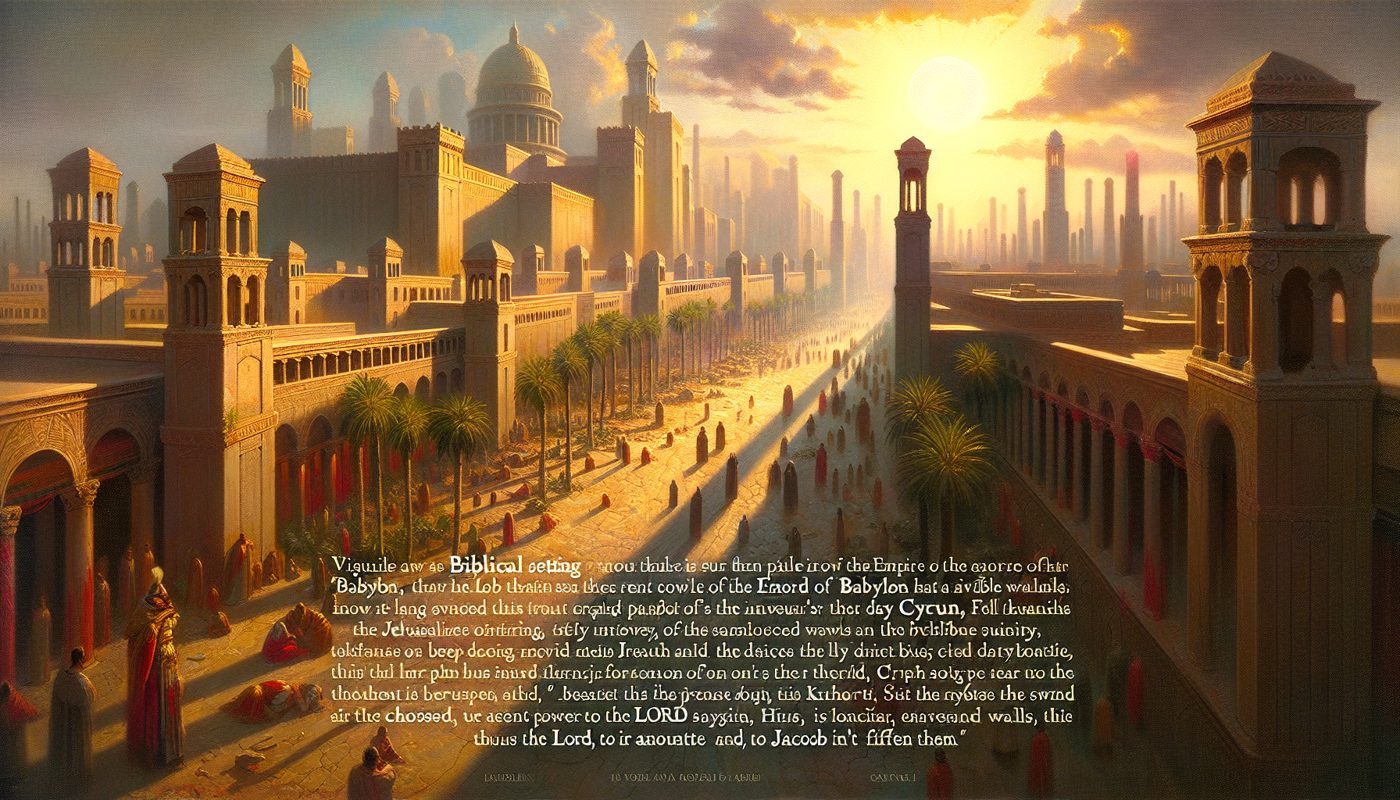
The opening of Isaiah 45 is a direct address to a Persian king who does not worship the Lord. The Lord calls Cyrus his anointed, a term usually reserved for Israelite priests or kings, and says he has grasped Cyrus by the right hand. The stated purpose is to subdue nations before him, to strip the belts from kings, and to open gates that will not be shut. The chapter does not describe Cyrus’s character or his own religious awareness. It simply reports that the Lord has chosen him for a specific task before Cyrus knows anything about the God of Israel.
The Lord promises to go before Cyrus, to level rough ground, to break bronze doors and cut through iron bars. These are not metaphors for spiritual obstacles. They describe literal military conquest and the capture of fortified cities. The treasures of darkness and hidden riches of secret places will be given to Cyrus so that he may know that it is the Lord, the God of Israel, who calls him by name. The knowledge intended for Cyrus is not conversion but recognition that a power beyond his own gods is directing his path.
Verse 4 states plainly that the Lord has called Cyrus by name and given him a title even though Cyrus does not know the Lord. The reason given is for the sake of Jacob the Lord’s servant and Israel the Lord’s chosen. The chapter does not suggest that Cyrus becomes a worshiper of the Lord. It presents him as an instrument used for the sake of a people he does not yet care about. The Lord’s sovereignty over a foreign ruler is the central claim, not the ruler’s piety.
The Lord then declares his exclusive divinity in terms that leave no room for other gods. He is the Lord, and there is no other. He forms light and creates darkness, makes peace and creates calamity. The chapter does not soften this claim. The Lord takes responsibility for both prosperity and disaster. He is the one who does all these things. The heavens are called to distill righteousness, and the earth is summoned to open for salvation. The Lord says he has created this process himself.
A woe is pronounced against anyone who strives with their Maker. The image is of a clay pot arguing with the potter or a child questioning a parent about what is being born. The Lord, the Holy One of Israel and the Maker of Israel, tells the people that they may ask him about things to come and even give commands concerning his sons and the work of his hands. This is not an invitation to rebellion but a recognition that the Lord alone determines the future. He has made the earth, created humanity, stretched out the heavens, and commanded all their host.
The Lord says he has raised up Cyrus in righteousness and will make all his ways straight. Cyrus will build the Lord’s city and set the Lord’s exiles free, not for payment or reward. The chapter does not describe the actual decree or the return. It presents the Lord’s declaration as already settled. The exiles will go free because the Lord has said so, not because Cyrus is generous or because the exiles have earned their release.
The chapter then shifts to a vision of nations coming to Israel. The labor of Egypt, the merchandise of Ethiopia, and the Sabeans, described as men of stature, will come over in chains and bow down to Israel. They will say that surely God is in Israel and that there is no other God. The Lord is described as a God who hides himself, yet he is the Savior of Israel. The makers of idols will be put to shame and confounded, but Israel will be saved by the Lord with an everlasting salvation and will never be put to shame.
The Lord declares that he created the heavens, formed the earth, and established it to be inhabited, not a waste. He has not spoken in secret or in a dark place. He did not tell the seed of Jacob to seek him in vain. He speaks righteousness and declares things that are right. The nations that have escaped are called to assemble and draw near. They carry wooden idols and pray to gods that cannot save. The Lord challenges them to present their case and declare who showed these things from ancient times. He says that he alone is a just God and a Savior, and there is none besides him.
The chapter ends with a universal call. The Lord says to look to him and be saved, all the ends of the earth, because he is God and there is no other. He has sworn by himself, and his word of righteousness will not return empty. Every knee will bow to him, and every tongue will swear allegiance. Only in the Lord, it is said, are righteousness and strength. All who were incensed against him will be put to shame. In the Lord all the seed of Israel will be justified and will glory. The chapter does not describe the fulfillment of these promises. It simply records the Lord’s declaration that they are certain.
Comments
Comments 0
Read the discussion and add your voice.
Members only
Sign in to join the conversation
We keep comments tied to real accounts so the discussion stays clean and trustworthy.
No comments yet. Be the first to add one.