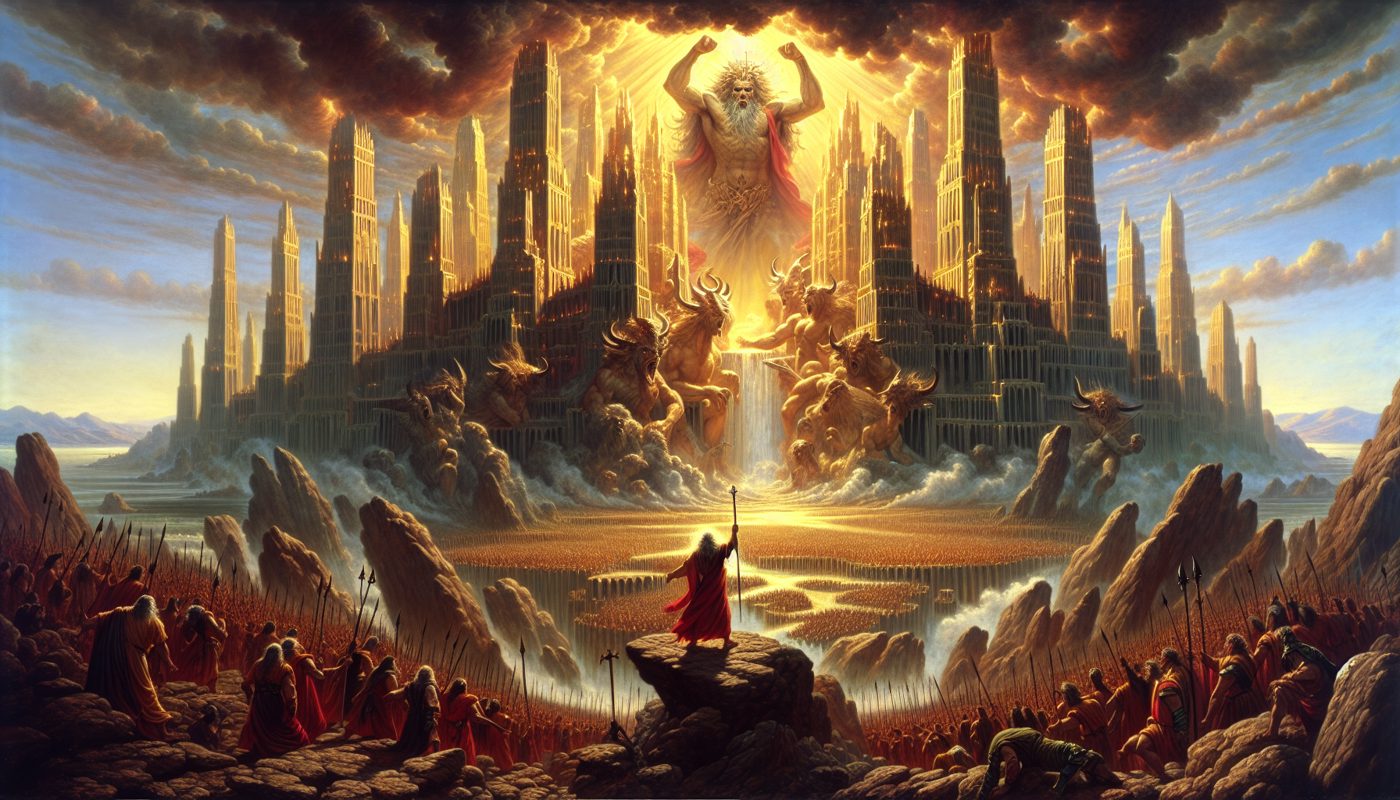
Isaiah the son of Amoz saw a burden, and the word he saw was not gentle. It was a decree of destruction aimed at Babylon, and the prophet recorded it with the blunt force of a command from heaven. There is no introduction of the prophet’s feelings, no trembling heart described in the text itself. What the chapter gives is a vision of an army being summoned, and the summons comes directly from the Lord.
The Lord commands that an ensign be set up on a bare mountain, that a voice be lifted up, that a hand be waved so that the army may enter the gates of the nobles. The language is urgent, almost military in its precision. The Lord says he has commanded his consecrated ones, his mighty men for his anger, his proudly exulting ones. These are not mercenaries or hired soldiers. They are called, set apart, and driven by divine wrath.
Then the noise begins. The chapter describes a multitude in the mountains, the sound of a great people, the tumult of the kingdoms of the nations gathered together. The Lord of hosts is mustering the host for battle. The army comes from a far country, from the uttermost part of heaven, carrying the weapons of his indignation. The purpose is stated plainly: to destroy the whole land.
The cry goes out for the people to wail, because the day of the Lord is at hand. It will come as destruction from the Almighty. The effect on those who face it is total collapse. All hands become feeble, every heart melts, and the people are dismayed. Pangs and sorrows take hold of them like a woman in travail. They look at one another in amazement, their faces like flames of fire. There is no resistance, only shock and terror.
The day of the Lord is described as cruel, with wrath and fierce anger. Its purpose is to make the land a desolation and to destroy its sinners out of it. The cosmos itself participates in the judgment. The stars of heaven and their constellations do not give their light. The sun is darkened in its going forth, and the moon does not cause its light to shine. The heavens tremble, and the earth is shaken out of its place in the wrath of the Lord of hosts.
The Lord declares that he will punish the world for its evil and the wicked for their iniquity. He will cause the arrogancy of the proud to cease and lay low the haughtiness of the terrible. The result is a depopulation so severe that a man becomes more rare than fine gold, more scarce than the pure gold of Ophir. The judgment is not selective; it is sweeping and absolute.
Then the chapter names the instrument of this judgment: the Medes. The Lord stirs them up against Babylon. They are a people who do not regard silver and do not delight in gold. Their bows dash young men in pieces, and they have no pity on the fruit of the womb. Their eye does not spare children. The description is brutal, and it is given without softening or moral commentary. The Medes are simply the weapon the Lord uses.
Babylon, called the glory of kingdoms and the beauty of the Chaldeans’ pride, is overthrown like Sodom and Gomorrah. The city is never to be inhabited again, from generation to generation. No Arabian pitches a tent there, no shepherd makes his flock lie down there. Instead, wild beasts of the desert lie there, doleful creatures fill the houses, ostriches dwell there, and wild goats dance there. Wolves cry in the castles, and jackals howl in the pleasant palaces. The chapter ends with a note of certainty: her time is near to come, and her days shall not be prolonged.
The prophecy does not explain why Babylon is judged beyond the mention of arrogancy and pride. It does not describe the sins of the city in detail. It does not offer a timeline or a historical fulfillment. It simply declares that the Lord has summoned his army, that the day of the Lord is coming, and that Babylon will become a haunt for wild animals. The weight of the chapter is in the sovereignty of the one who musters the nations and darkens the heavens.
Comments
Comments 0
Read the discussion and add your voice.
Members only
Sign in to join the conversation
We keep comments tied to real accounts so the discussion stays clean and trustworthy.
No comments yet. Be the first to add one.