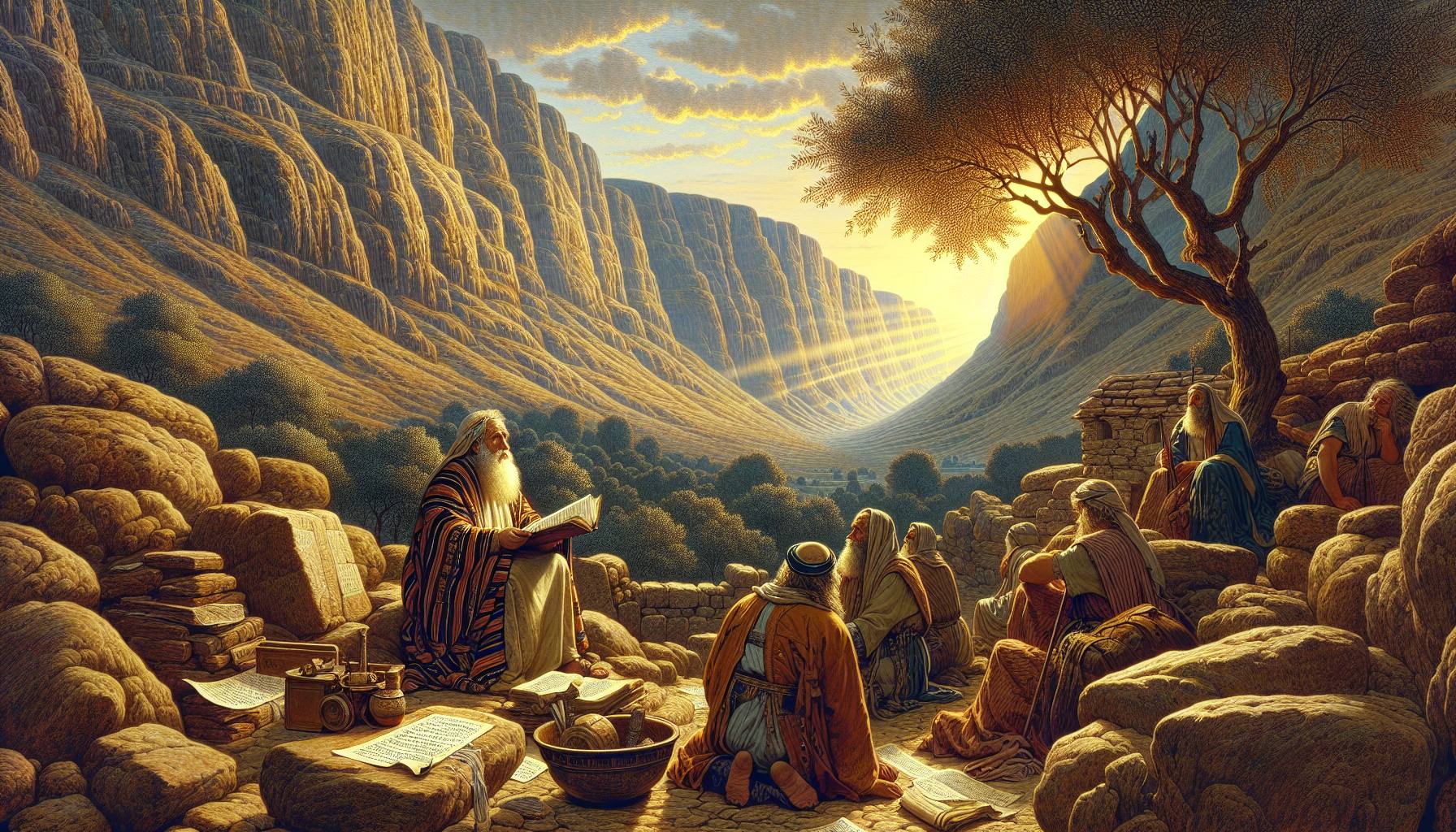

In the days of the righteous King Hezekiah, there lived an elderly man named Elimelech in the hill country of Judah. Each morning before the sun had fully chased the shadows from the valleys, he would climb the stone steps to his rooftop, where he kept a small clay altar and a worn scroll of the psalms.
One particular Sabbath morning, as the first golden rays touched the Mount of Olives, Elimelech unrolled the sacred text and began to read aloud the words that had been given to the sweet psalmist of Israel: “It is a good thing to give thanks unto the Lord, and to sing praises unto thy name, O most High.”
His voice, though weathered by years, carried across the still morning air as he continued: “To shew forth thy lovingkindness in the morning, and thy faithfulness every night.” Below in the courtyard, his granddaughter Miriam paused her bread-making to listen, the dough resting in her hands as the ancient words washed over her.
Elimelech’s mind traveled back through the seasons of his life as he recited the psalm. He remembered the ten-stringed instrument and the solemn sound of the harp that once accompanied these very words in the temple courts. He recalled mornings when gratitude came easily—the birth of his first son, the abundant harvests, the joy of his wedding day. But he also remembered nights when only discipline made him proclaim God’s faithfulness—the year the locusts came, the season his wife fell ill, the day the Assyrian army appeared on the horizon.
“The senseless man doth not know, neither doth the fool understand this,” he continued, his voice growing stronger. He thought of the arrogant Assyrian commander who had stood outside Jerusalem’s walls, boasting of his gods and his conquests. Yet the Lord had struck down 185,000 of their warriors in a single night. The wicked had flourished like grass for a moment, but were ultimately destroyed forever.
Miriam climbed the steps now, drawn by the power of her grandfather’s declaration. She sat at his feet as he reached the triumphant conclusion: “But thou, Lord, art most high for evermore. For lo, thine enemies shall perish; all the workers of iniquity shall be scattered.”
Elimelech looked out over the land coming to life in the morning light. The olive trees in the valley were putting forth new shoots. The date palms along the Kidron stream stood straight and tall. The cedars of Lebanon that Solomon had planted generations ago still reached toward the heavens.
He placed a hand on Miriam’s shoulder. “See, my child,” he said, his eyes moist with understanding. “The righteous shall flourish like the palm tree; he shall grow like a cedar in Lebanon. Those that be planted in the house of the Lord shall flourish in the courts of our God.”
He pointed to an ancient olive tree near their home, its gnarled trunk testimony to countless seasons. “They shall still bring forth fruit in old age; they shall be fat and flourishing. To shew that the Lord is upright; he is my rock, and there is no unrighteousness in him.”
Miriam looked from the old tree to her grandfather’s wrinkled face, both bearing the marks of time, both still productive. She understood now why he rose each morning to give thanks and each evening to proclaim faithfulness—not because every day was easy, but because the Lord remained unchanging in His character.
The sun had fully risen now, bathing Jerusalem in brilliant light. From the temple mount, the morning sacrifice smoke began to rise. Elimelech raised his hands toward the holy place and finished the psalm with a renewed conviction that echoed through the hills: “To shew that the Lord is upright; he is my rock, and there is no unrighteousness in him.”
Below them, the city awakened to another day of God’s faithfulness. The old man and the young woman descended the stairs together, carrying the truth of the psalm in their hearts—that gratitude in the morning and faithfulness at night were the rhythms that sustained the righteous through all of life’s seasons.