
In the annals of the tribe of Benjamin, a lineage of warriors and leaders unfolded, tracing its roots to the patriarch Jacob’s beloved son. From the city of Gibeon, where the sun stood still for Joshua, emerged a family whose deeds would echo through generations, their names etched into the sacred scrolls of Israel’s memory.
The chronicle begins with Bela, the firstborn, whose strength was like the oaks of Bashan. His son Ard bore the countenance of his father, a man of steadfast heart, while Abihud carried the legacy forward with hands skilled in both plow and sword. Abishua, whose name meant “father of salvation,” grew in wisdom beneath the palm trees of the Jordan Valley, his voice a calm river in times of strife. Then came Naaman, whose loyalty to the God of Abraham never wavered, and Ahoah, a keeper of covenants, whose tent was always open to the weary traveler.
But it was Gera, the father of Ehud, who would see his son’s name blaze like a torch in the dark days of the judges. Ehud, the left-handed deliverer, forged a dagger with a keen edge and hid it upon his thigh. With cunning as sharp as the blade, he entered the palace of Eglon, king of Moab, in the coolness of the stone chambers. The king, obese and languid, sat alone in his summer parlor. Ehud spoke a word from God, and as the king rose, Ehud’s left hand drove the dagger deep into the king’s belly, so that the fat closed over the hilt. Thus, Ehud escaped through the sculpted pillars and rallied the sons of Benjamin at Mount Ephraim, leading them to victory with the blast of a ram’s horn.
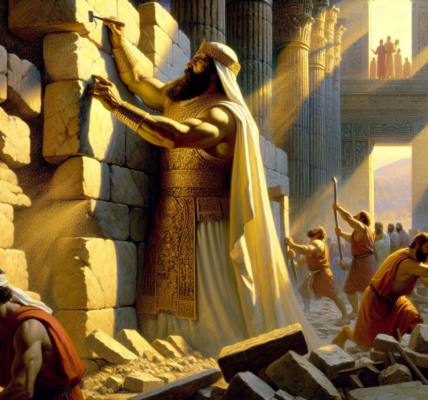
Generations passed, and the house of Benjamin multiplied like the sands of the sea. Shaharaim, a man of two wives, Hushim and Baara, dwelt in the plains of Moab. But his heart turned, and he sent them away, taking another, Hodesh, by whom he bore Jobab, Zibia, Mesha, Malcam, Jeuz, Sachia, and Mirmah—mighty men of valor, each with faces like lions and hearts attuned to the law of Moses. They built villages and fortified cities, their walls rising like the shoulders of the hills.
From the loins of Elpaal came Eber, Misham, Shemed, and Beriah, who drove out the inhabitants of Gath, their chariots thundering like storm clouds. Their sister, Sherah, a woman of ingenuity, built both Lower and Upper Beth-horon, shaping terraces in the stony slopes where vineyards would flourish, her hands blessed with the skill of Bezalel.
Then arose the house of Shashak, whose sons were bright as morning stars in the council of the tribes. Jeroham, men of renown, dwelled in Jerusalem, their houses of hewn stone standing beside the tabernacle of David. Ibneiah, a judge whose words carried the weight of Urim and Thummim, resolved disputes beneath the tamarisk trees. Eliel, a commander whose shield reflected the noonday sun, guarded the passes against the Ammonites.
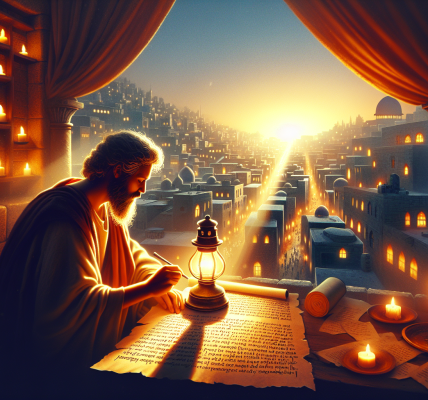
But none shone brighter than the lineage of Mikloth, who begat Shimeah. These dwelt in Jerusalem with their kinsmen, their loyalty to the house of Saul and later to David, the anointed of Hebron. Their deeds were recorded by the scribes, for they understood the times and knew what Israel ought to do.
The chronicle culminates in the family of Azel, sixth son of Berechiah, whose six sons—Azrikam, Bocheru, Ishmael, Sheariah, Obadiah, and Hanan—were all valiant men, archers who could hit the mark from a hundred paces. Their sons and grandsons multiplied, a forest of warriors, until the days of the exile, when Nebuchadnezzar’s shadow fell over the land. Yet even in Babylon, the seed of Benjamin endured, their hope anchored to the promise of the prophets, their eyes toward Jerusalem, the city of their fathers.
Thus the genealogy of Benjamin stands as a testament to God’s faithfulness—a tribe once diminished after the tragedy of Gibeah, now restored like a phoenix from ashes, their names woven into the tapestry of redemption, awaiting the Lion of Judah who would spring from their midst.