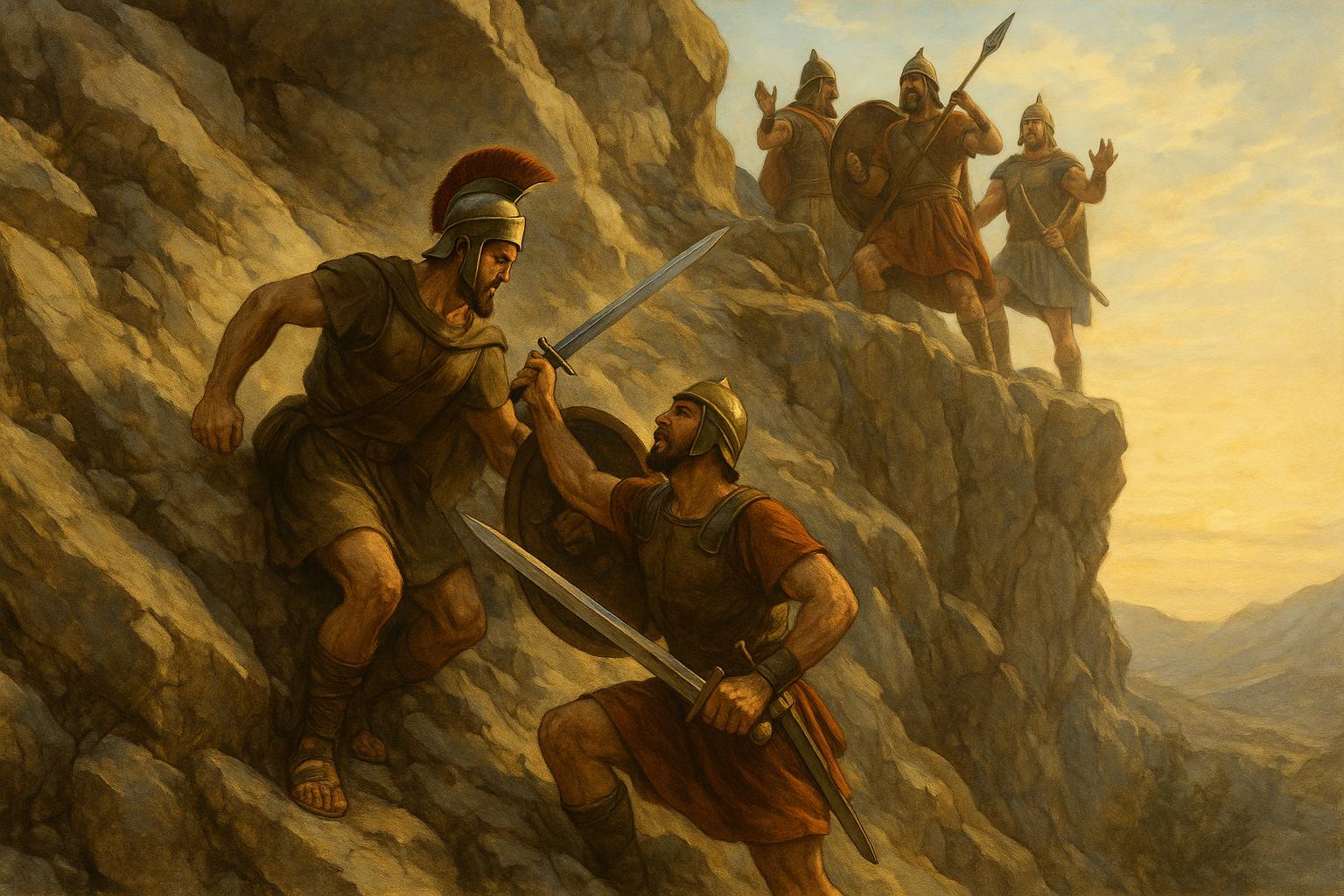
Jonathan moved without telling his father. He crossed the pass between the rocky crags named Bozez and Seneh, taking only his armor-bearer. The Philistine garrison sat on the far side, and Jonathan saw no reason to wait for Saul's permission or the army's formation. He told the young man carrying his gear that the Lord could save by many or by few, and the armor-bearer answered that he would follow whatever Jonathan decided.
Jonathan set a sign. He would show himself to the Philistines. If they called down for him to wait, he would stay. If they invited him up, he would climb, taking that as the Lord's signal that the enemy had been handed over. The Philistines saw the two men and mocked them, shouting that the Hebrews were crawling out of hiding holes. Then they called up, daring Jonathan to come and receive a lesson. Jonathan took the words as the sign he had asked for.
He climbed on hands and feet up the crag, and his armor-bearer followed. When they reached the garrison, Jonathan struck, and the armor-bearer finished the fallen. The first slaughter amounted to about twenty men, within half a furrow's length of ground. Then the earth itself trembled, and a great panic spread through the Philistine camp, the field, and the raiding parties. The ground quaked, and the terror was overwhelming.
Saul's watchmen in Gibeah saw the Philistine multitude melting away, men scattering in confusion. Saul ordered a count and discovered Jonathan and his armor-bearer missing. He called for Ahijah the priest, who wore the ephod, and told him to bring the ark of God. But while Saul was still speaking to the priest, the noise in the Philistine camp grew louder. Saul told the priest to withdraw his hand, and he gathered the six hundred men to join the battle.
The Philistines turned on each other in the disarray. Hebrews who had been serving with the Philistines switched sides and joined Saul and Jonathan. Men who had hidden in the hill country of Ephraim came out when they heard the Philistines were fleeing, and they joined the pursuit. The Lord saved Israel that day, and the fighting moved past Beth-aven.
But the day was not clean. Saul had placed the army under an oath, cursing any man who ate food before evening, when he would be avenged on his enemies. No one tasted food. They entered a forest where honey lay on the ground, dripping from the comb, but the people feared the oath and did not touch it. Jonathan had not heard the oath. He dipped the end of his rod into the honeycomb, ate, and his eyes brightened.
A soldier told Jonathan that his father had strictly charged the people with the oath. Jonathan answered that his father had troubled the land. He pointed out that his own eyes had been enlightened by a little honey, and he argued that if the people had eaten freely from the spoil, the slaughter of the Philistines would have been far greater. The army had struck the Philistines from Michmash to Aijalon, but the men were faint with hunger.
When the people were faint, they flew upon the spoil, took sheep, oxen, and calves, and slaughtered them on the ground, eating the meat with the blood. Saul was told that the people were sinning against the Lord by eating with the blood. He ordered a large stone rolled to him and commanded the people to bring their animals and slaughter them properly on the stone, so they would not sin. That night Saul built an altar to the Lord, the first altar he had built.
Saul wanted to pursue the Philistines through the night and leave no man alive. The people agreed. But the priest said they should draw near to God first. Saul asked the Lord whether he should go down after the Philistines and whether they would be delivered. The Lord did not answer him that day. Saul called the chiefs together and declared that someone had sinned, swearing by the living Lord that even if the sinner were Jonathan his son, he would die. No one answered him.
Saul cast lots between himself and Jonathan, and the lot fell on Jonathan. Jonathan admitted he had tasted a little honey with the end of his rod. Saul said he must die. But the people refused. They said Jonathan had wrought this great salvation in Israel, and as the Lord lived, not a hair of his head would fall. They rescued Jonathan, and he did not die. Saul stopped pursuing the Philistines, and the Philistines returned to their own place.
The chapter closes with a summary of Saul's wars. He fought Moab, Ammon, Edom, the kings of Zobah, and the Philistines, and wherever he turned he put them to the worse. He did valiantly, struck the Amalekites, and delivered Israel from those who despoiled them. The names of his sons and daughters are listed, along with his wife and his uncle Abner, the captain of his host. And the writer notes that there was sore war against the Philistines all the days of Saul, and that whenever Saul saw a mighty or valiant man, he took him into his service.