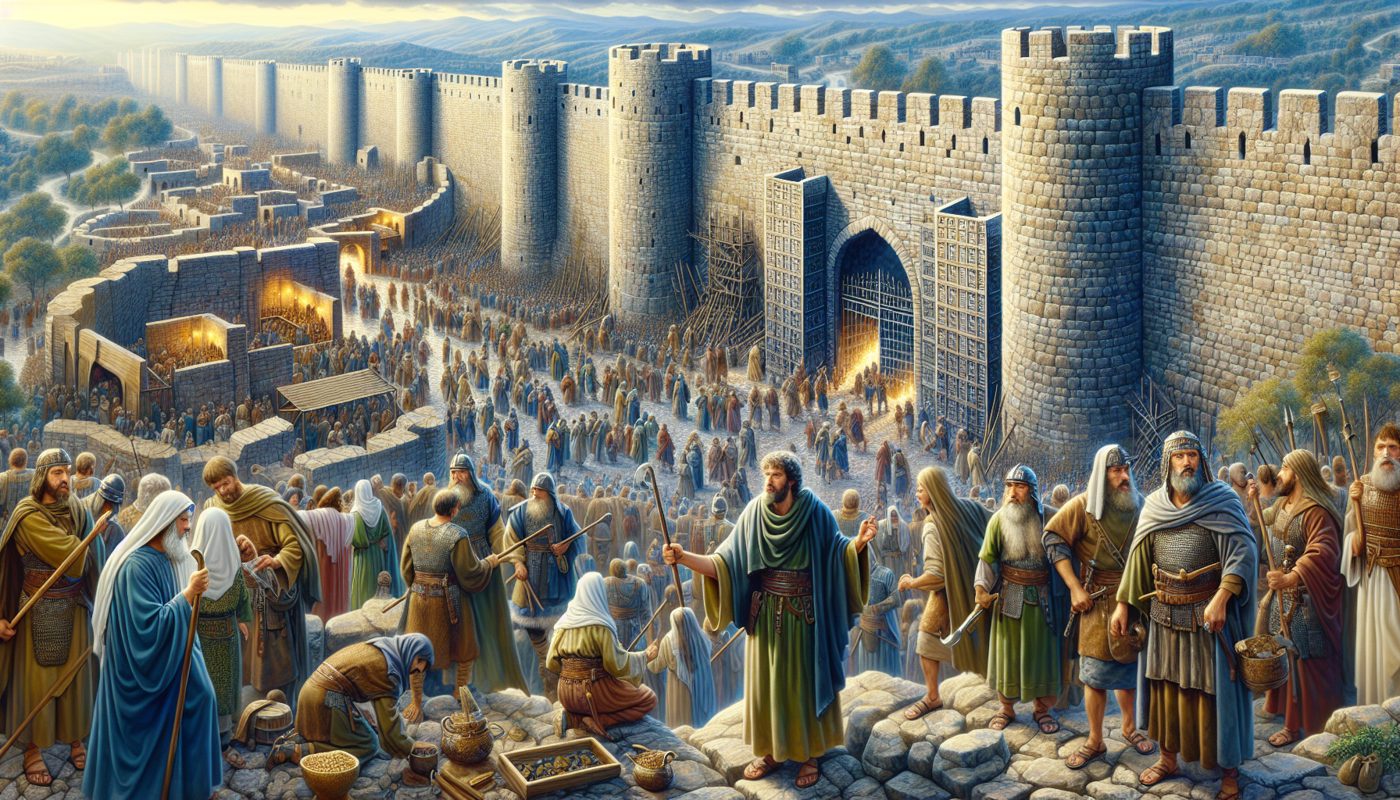
The wall was finished. The doors were set. The porters, singers, and Levites had been appointed. But Nehemiah did not stop to celebrate. He gave his brother Hanani and Hananiah, the governor of the castle, charge over Jerusalem. His reason was plain: Hananiah was a faithful man and feared God above many. That was the qualification that mattered more than rank or family name.
Nehemiah issued a direct order about the gates. They were not to be opened until the sun was hot—no early morning vulnerability. While the guards stood on duty, the doors were to be shut and barred. And he commanded watches of the inhabitants of Jerusalem, each man in his watch, each man over against his own house. The defense of the city was not left to professionals alone; every household had its post.
The city itself was wide and large, but the people were few, and the houses were not yet built. A great wall around a sparse population created its own kind of danger. Empty space invited trouble. Nehemiah needed to know who was actually there, who belonged, and how the city could be repopulated with order.
Then Nehemiah said that God put into his heart to gather the nobles, the rulers, and the people to be reckoned by genealogy. He found the book of the genealogy of those who came up at the first, the return from the captivity that Nebuchadnezzar had carried away. The list he found became the record of the province, every family counted by its ancestral town.
The list begins with the leaders who came with Zerubbabel and Jeshua: Nehemiah, Azariah, Raamiah, Nahamani, Mordecai, Bilshan, Mispereth, Bigvai, Nehum, Baanah. Then the families are numbered, clan by clan, from the children of Parosh, two thousand one hundred seventy-two, down through the children of Senaah, three thousand nine hundred thirty. The total of the whole assembly was forty-two thousand three hundred sixty, besides seven thousand three hundred thirty-seven servants and maidservants, and two hundred forty-five singers, male and female.
The list does not stop with the people. It records livestock: seven hundred thirty-six horses, two hundred forty-five mules, four hundred thirty-five camels, six thousand seven hundred twenty donkeys. These were the assets of the returning community, the practical wealth that sustained life in the land.
Among the priests, some could not prove their lineage. The children of Hobaiah, Hakkoz, and Barzillai sought their register but it was not found. They were deemed polluted and put from the priesthood. The governor told them they could not eat of the most holy things until a priest stood up with Urim and Thummim. The integrity of the priesthood depended on verifiable descent, not on presumption.
The chapter closes with a record of gifts. The governor gave to the treasury a thousand darics of gold, fifty basins, and five hundred thirty priests' garments. The heads of fathers' houses gave twenty thousand darics of gold and two thousand two hundred pounds of silver. The rest of the people gave twenty thousand darics of gold, two thousand pounds of silver, and sixty-seven priests' garments. Then the priests, Levites, porters, singers, some of the people, the Nethinim, and all Israel dwelt in their cities. When the seventh month came, the children of Israel were in their cities.
Comments
Comments 0
Read the discussion and add your voice.
Members only
Sign in to join the conversation
We keep comments tied to real accounts so the discussion stays clean and trustworthy.
No comments yet. Be the first to add one.