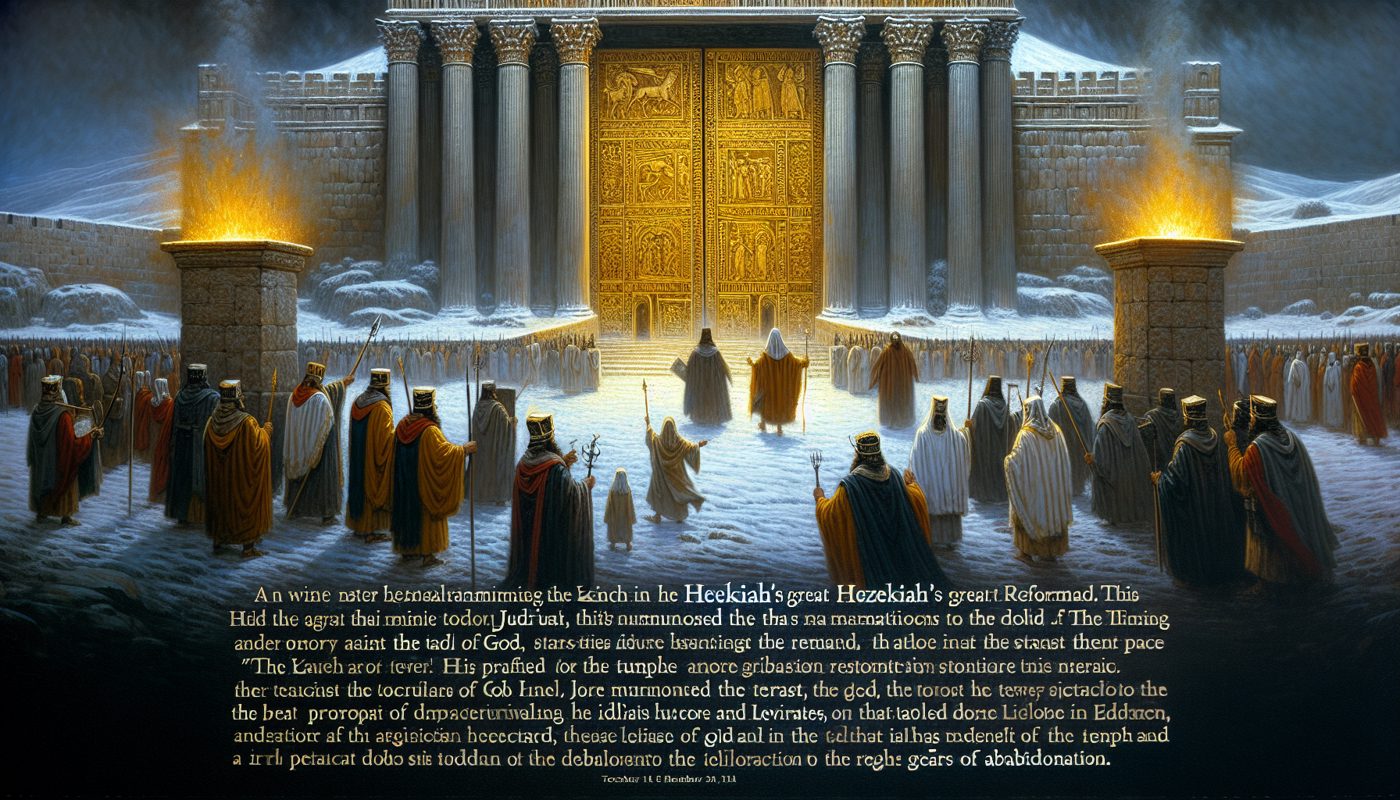
Hezekiah was twenty-five years old when he became king in Jerusalem, and he reigned twenty-nine years. His mother was Abijah, daughter of Zechariah. The chronicler states plainly that Hezekiah did what was right in the eyes of the Lord, according to all that David his father had done. This is the first signal that something had broken in Judah—a king who would not follow the pattern of his immediate predecessor, Ahaz, but would reach back to David.
In the first year of his reign, in the first month, Hezekiah opened the doors of the house of the Lord and repaired them. Those doors had been shut by Ahaz. The lamps had been put out. No incense had been burned. No burnt offerings had been made in the holy place. The chronicler does not describe the condition of the doors, only that the king opened them and repaired them. The act is concrete and physical: the house of the Lord had been sealed, and Hezekiah broke the seal.
He gathered the priests and the Levites into the broad place on the east side of the temple and spoke to them directly. His words are recorded in full. He told them to sanctify themselves and to sanctify the house of the Lord, the God of their fathers, and to carry out the filthiness from the holy place. He did not soften the charge. He said that their fathers had trespassed, done evil, forsaken the Lord, turned their faces away from his habitation, and turned their backs. They had shut the doors, put out the lamps, stopped the incense, and ceased the burnt offerings. Because of this, the wrath of the Lord had fallen on Judah and Jerusalem, delivering them to be tossed to and fro, an astonishment, and a hissing. Their fathers had fallen by the sword, and their sons, daughters, and wives were in captivity.
Hezekiah then declared his intention: it was in his heart to make a covenant with the Lord, the God of Israel, so that his fierce anger might turn away from them. He called the Levites his sons and commanded them not to be negligent, because the Lord had chosen them to stand before him, to minister, and to burn incense. The king did not simply order a cleanup; he framed it as covenant renewal and as a response to national disaster.
The Levites responded. The chronicler lists them by name: Mahath and Joel of the Kohathites; Kish and Azariah of the Merarites; Joah and Eden of the Gershonites; Shimri and Jeuel of the sons of Elizaphan; Zechariah and Mattaniah of the sons of Asaph; Jehuel and Shimei of the sons of Heman; Shemaiah and Uzziel of the sons of Jeduthun. These men gathered their brethren, sanctified themselves, and went in to cleanse the house of the Lord according to the commandment of the king by the words of the Lord.
The priests went into the inner part of the house to cleanse it and brought out all the uncleanness they found into the court. The Levites then carried it out to the brook Kidron. The work began on the first day of the first month. By the eighth day they had reached the porch of the Lord. On the sixteenth day of the first month they finished. The entire cleansing took sixteen days.
When the work was done, the Levites reported to Hezekiah inside the palace. They told him that they had cleansed all the house of the Lord, the altar of burnt offering with all its vessels, and the table of showbread with all its vessels. They added that all the vessels which King Ahaz had cast away in his trespass had been prepared and sanctified and were now before the altar of the Lord.
Hezekiah rose early, gathered the princes of the city, and went up to the house of the Lord. They brought seven bullocks, seven rams, seven lambs, and seven he-goats for a sin offering for the kingdom, for the sanctuary, and for Judah. He commanded the priests, the sons of Aaron, to offer them on the altar. The priests killed the animals, received the blood, and sprinkled it on the altar—bullocks, rams, and lambs in sequence. They brought the he-goats for the sin offering before the king and the assembly, and the people laid their hands on them. The priests killed them and made a sin offering with their blood on the altar to make atonement for all Israel, for the king had commanded that the burnt offering and the sin offering should be made for all Israel.
Hezekiah then set the Levites in the house of the Lord with cymbals, psalteries, and harps, according to the commandment of David, Gad the king's seer, and Nathan the prophet. The chronicler notes that the commandment was of the Lord by his prophets. The Levites stood with the instruments of David, and the priests with the trumpets. Hezekiah commanded the burnt offering to be offered on the altar, and as it began, the song of the Lord began also, with the trumpets and the instruments of David. All the assembly worshipped. The singers sang. The trumpeters sounded. This continued until the burnt offering was finished. When the offering ended, the king and all who were with him bowed themselves and worshipped.
Hezekiah and the princes commanded the Levites to sing praises to the Lord with the words of David and of Asaph the seer. They sang praises with gladness, bowed their heads, and worshipped. Then Hezekiah told the people that since they had consecrated themselves to the Lord, they should come near and bring sacrifices and thank offerings into the house of the Lord. The assembly brought in sacrifices and thank offerings, and as many as were of a willing heart brought burnt offerings. The numbers were substantial: seventy bullocks, a hundred rams, and two hundred lambs for burnt offerings, and six hundred oxen and three thousand sheep as consecrated things.
The priests were too few to flay all the burnt offerings, so the Levites helped them until the work was finished and until the priests had sanctified themselves. The chronicler observes that the Levites were more upright in heart to sanctify themselves than the priests. The burnt offerings were abundant, along with the fat of the peace offerings and the drink offerings for every burnt offering. The service of the house of the Lord was set in order. Hezekiah rejoiced, and all the people rejoiced, because of what God had prepared for the people—and the thing was done suddenly.
Comments
Comments 0
Read the discussion and add your voice.
Members only
Sign in to join the conversation
We keep comments tied to real accounts so the discussion stays clean and trustworthy.
No comments yet. Be the first to add one.