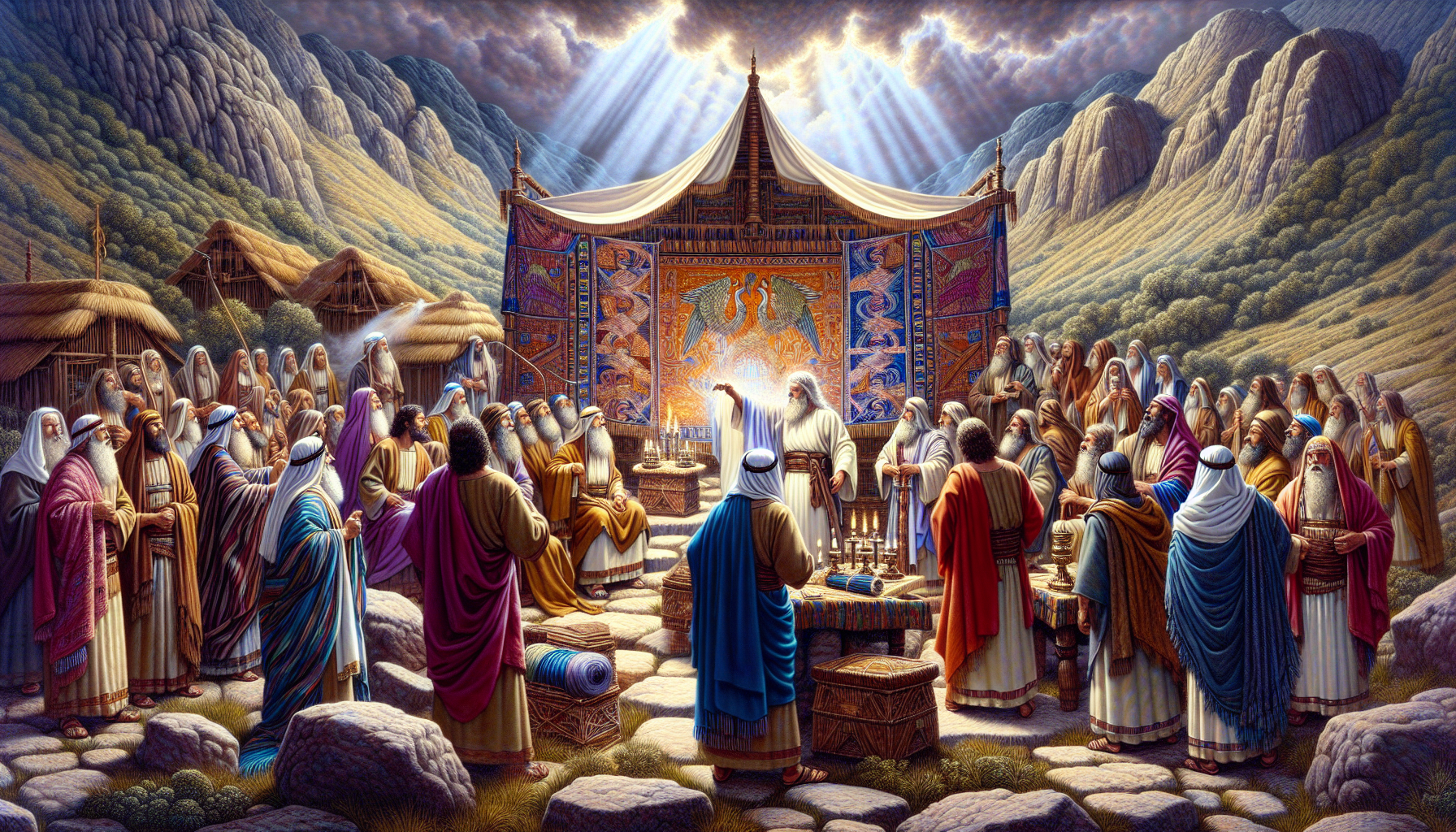
The Lord gave Moses the dimensions and materials for the tabernacle with a precision that leaves no room for improvisation. The instructions begin with ten curtains of fine twined linen, woven with blue, purple, and scarlet yarn, and embroidered with cherubim by skilled workmen. Each curtain was to be twenty-eight cubits long and four cubits wide, all of the same measure. Five curtains were coupled together, and five were coupled separately, with fifty loops of blue on the edge of the outermost curtain of each set, and fifty gold clasps to join them into one tabernacle. This was not decorative suggestion; it was a binding command.
Over these linen curtains, the Lord ordered a tent of goats' hair curtains, eleven in number, each thirty cubits long and four cubits wide. Five of these were coupled together, and six by themselves, with the sixth curtain doubled over at the front of the tent. Fifty loops were placed on the edge of the outermost curtain of each set, and fifty bronze clasps were used to couple the tent together as one. The overhanging half curtain was to hang over the back of the tabernacle, and the extra cubit on each side was to hang over the sides to cover it. Above this, a covering of rams' skins dyed red and a covering of sealskins completed the roof.
The structure itself required boards of acacia wood, set upright. Each board was ten cubits long and a cubit and a half wide, with two tenons joined to one another. For the south side, twenty boards were set into forty silver sockets, two sockets per board. For the north side, another twenty boards with forty silver sockets. For the west or hinder part, six boards were made, plus two boards for the corners, double beneath and entire to the top with one ring. In total, eight boards for the west side with sixteen silver sockets, two under each board.
Bars of acacia wood were made to hold the boards together: five bars for the south side, five for the north side, and five for the west side. The middle bar was to pass through from end to end. The boards were overlaid with gold, with gold rings for the bars, and the bars themselves were overlaid with gold. The entire tabernacle was to be erected according to the pattern shown to Moses on the mountain.
A veil was to be made of blue, purple, scarlet, and fine twined linen, with cherubim worked into it by a skilled workman. This veil was hung on four pillars of acacia wood overlaid with gold, with gold hooks and four silver sockets. The veil was placed under the clasps, and inside it was brought the ark of the testimony. The veil served to separate the holy place from the most holy place, where the mercy-seat was set upon the ark.
Outside the veil, the table was set on the north side of the tabernacle, and the lampstand opposite it on the south side. For the entrance of the tent, a screen was made of the same materials—blue, purple, scarlet, and fine twined linen—the work of an embroiderer. This screen was hung on five pillars of acacia wood overlaid with gold, with gold hooks and five bronze sockets. Every detail, from the loops to the clasps to the sockets, was specified with a concreteness that leaves no ambiguity: the tabernacle was a structure built not by human imagination but by divine instruction.