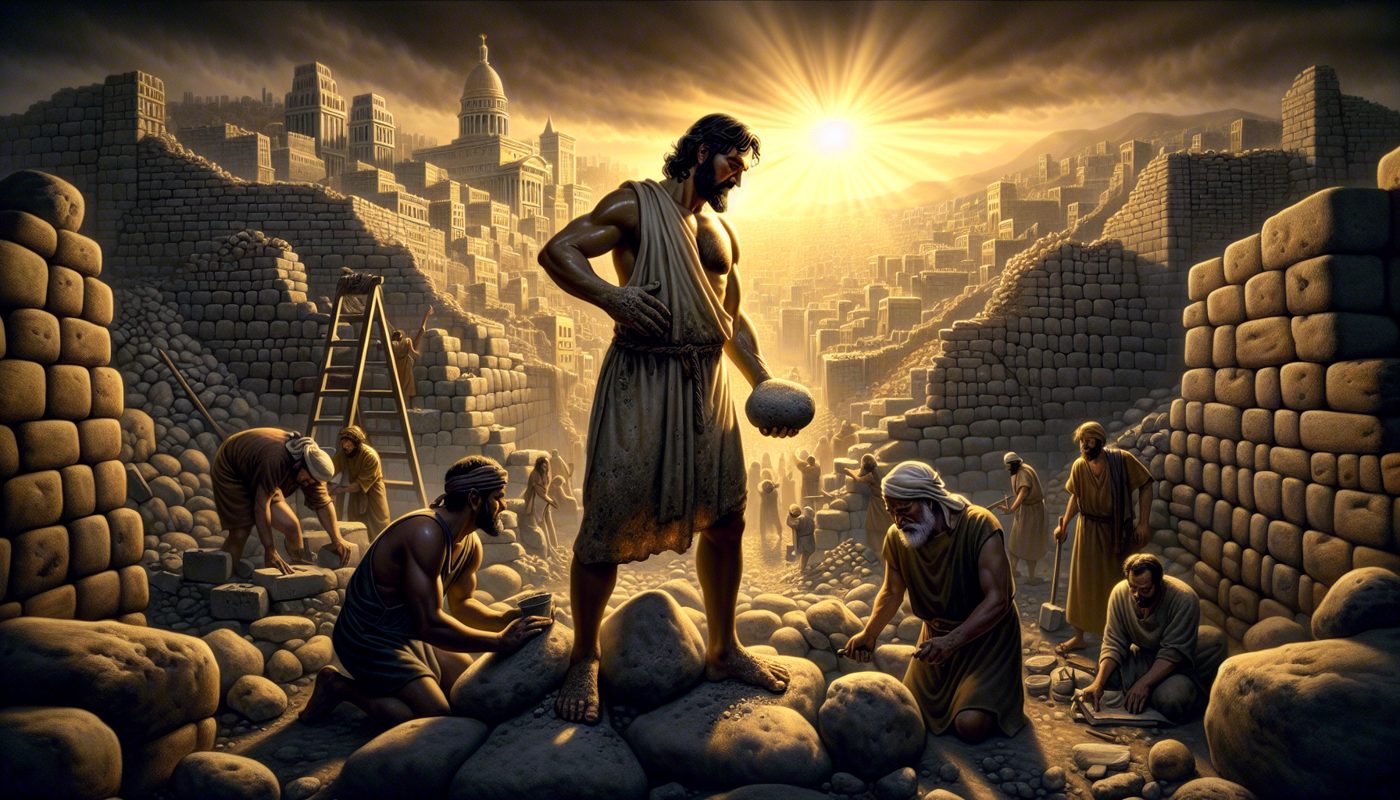
The wall of Jerusalem was going up, and Sanballat heard about it. He was angry, and he mocked the Jews openly, speaking before his allies and the army of Samaria. He called them feeble. He asked whether they thought they could finish in a day or revive stones from heaps of burned rubbish. Tobiah the Ammonite stood beside him and added that even a fox could break down whatever they built.
Nehemiah did not answer the mockers directly. He prayed. He asked the Lord to hear how they were despised and to turn the reproach back on the heads of the enemies. He did not soften the prayer. He asked that their iniquity not be covered and that their sin not be blotted out, because they had provoked the Lord before the builders.
The people kept working. The wall was joined together to half its height, because the people had a mind to work. That phrase matters. It was not skill or resources that drove the work. It was a settled will.
When Sanballat, Tobiah, the Arabians, the Ammonites, and the Ashdodites heard that the breaches in the wall were being stopped, they grew furious. They conspired together to come and fight against Jerusalem and cause confusion. Nehemiah responded with two actions: he made prayer to God, and he set a watch against them day and night.
Then Judah spoke. The strength of the bearers of burdens was decaying, they said. There was much rubbish. They were not able to build the wall. The adversaries were saying that they would come into the midst of the workers, slay them, and cause the work to cease. And the Jews who lived near the enemies came ten times from all places, saying, “You must return to us.”
Nehemiah did not ignore the fear. He set people in the lowest parts of the space behind the wall, in the open places, arranged by families, with swords, spears, and bows. Then he looked, rose up, and spoke to the nobles, the rulers, and the rest of the people. He told them not to be afraid. He told them to remember the Lord, who is great and terrible, and to fight for their brothers, sons, daughters, wives, and houses.
When the enemies heard that their plan was known and that God had brought their counsel to nothing, they stopped. The people returned to the wall, every one to his work.
From that time on, half of Nehemiah’s servants worked and half held spears, shields, bows, and coats of mail. The rulers were behind all the house of Judah. The builders built with one hand and held a weapon with the other. Every builder had his sword girded by his side as he worked. The man who sounded the trumpet stayed near Nehemiah.
Nehemiah told the nobles, rulers, and people that the work was great and large and that they were separated along the wall, far from one another. He gave a simple signal: wherever they heard the sound of the trumpet, they were to gather there. And he said, “Our God will fight for us.”
So they worked from the rising of the morning until the stars appeared. Nehemiah told the people to lodge inside Jerusalem with their servants, so that they could be a guard at night and labor in the day. Neither Nehemiah nor his brothers nor his servants nor the men of the guard took off their clothes. Every one went with his weapon even to the water.
Comments
Comments 0
Read the discussion and add your voice.
Members only
Sign in to join the conversation
We keep comments tied to real accounts so the discussion stays clean and trustworthy.
No comments yet. Be the first to add one.