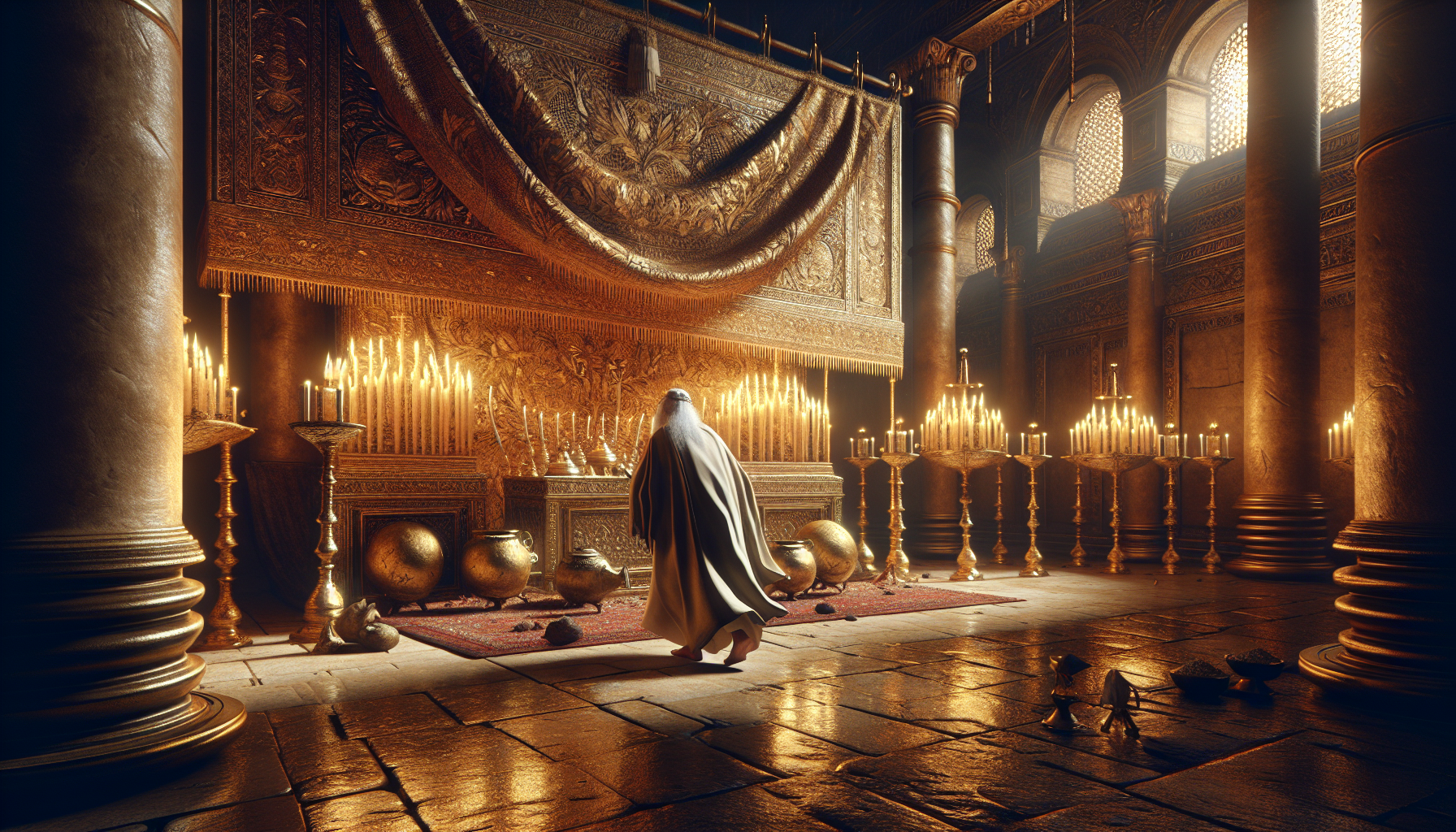
The writer of Hebrews does not soften the force of the argument. The first covenant had its own sanctuary, a sanctuary of this world, with a lampstand, a table, and the bread of the Presence in the Holy Place. Behind the second veil stood the Holy of Holies, where the golden altar of incense and the ark of the covenant rested, the ark containing the golden pot of manna, Aaron’s rod that budded, and the tablets of the covenant. Above the ark, the cherubim of glory overshadowed the mercy seat. The writer deliberately stops short of describing these things in detail, as if the sheer weight of the old arrangement is enough to make the point: this was a system of barriers, of blood, and of limitation.
Into the first tabernacle the priests went continually, performing their daily services. Into the second, only the high priest entered, and only once a year, and never without blood, which he offered for his own sins and for the errors of the people. The Holy Spirit signified by this arrangement that the way into the holy place had not yet been made manifest while the first tabernacle still stood. The old system was a figure for the present time, a pattern that could not, as touching the conscience, make the worshiper perfect. It was a regime of external ordinances—meats, drinks, divers washings—imposed until a time of reformation.
Then the writer pivots. Christ came as a high priest of the good things to come, through a greater and more perfect tabernacle not made with hands, not of this creation. He did not enter by the blood of goats and calves, but by his own blood, and he entered once for all into the holy place, having obtained eternal redemption. The contrast is not merely quantitative—better blood, better tabernacle—but qualitative. The old blood could sanctify the flesh; Christ’s blood cleanses the conscience from dead works to serve the living God.
The logic is relentless. If the blood of goats and bulls and the ashes of a heifer could sprinkle those defiled and make them clean in the flesh, how much more will the blood of Christ, who through the eternal Spirit offered himself without blemish to God, cleanse the conscience? The old sacrifices touched the body; the new sacrifice reaches the inner life. The writer does not let the reader forget that Christ offered himself, and that he did so through the eternal Spirit, a detail that ties the sacrifice to the very life of God.
For this reason Christ is the mediator of a new covenant. A death has taken place for the redemption of the transgressions that were under the first covenant, so that those who are called may receive the promise of the eternal inheritance. The writer draws on the legal force of a testament: where a testament is, there must be the death of the one who made it. A testament is in force only after death; it has no effect while the testator lives. The first covenant itself was not dedicated without blood. When Moses had spoken every commandment to the people, he took the blood of calves and goats, with water and scarlet wool and hyssop, and sprinkled both the book and all the people, saying, “This is the blood of the covenant which God commanded you.” He sprinkled the tabernacle and all the vessels of the ministry in the same way.
The writer then states a principle that undergirds the entire argument: according to the law, almost all things are cleansed with blood, and apart from the shedding of blood there is no remission. This is not a metaphor. The old system was built on the literal shedding of animal blood, and it pointed forward to a shedding that would be once and for all. The copies of the things in the heavens had to be cleansed with these sacrifices, but the heavenly things themselves required better sacrifices.
Christ did not enter a holy place made with hands, a copy of the true one. He entered heaven itself, now to appear before the face of God for us. He did not offer himself repeatedly, as the high priest entered year by year with blood not his own. If that were the case, he would have had to suffer many times since the foundation of the world. But now, once at the end of the ages, he has been manifested to put away sin by the sacrifice of himself.
The writer grounds the finality of Christ’s work in the human condition itself. It is appointed for men to die once, and after that comes judgment. So Christ, having been offered once to bear the sins of many, will appear a second time, not to deal with sin, but to bring salvation to those who wait for him. The structure is clean: one death, one judgment, one offering, one return. The old system, with its repeated sacrifices and its annual entry into the Holy of Holies, has been replaced by a single, sufficient act.
The writer does not sentimentalize the blood. He does not soften the fact that the old covenant required the death of animals, or that the new covenant required the death of Christ. The blood of the covenant is not a symbol; it is the price of remission. The conscience is cleansed not by ritual but by the actual offering of the Son. The writer keeps the reader’s attention on the concrete: a tabernacle, a veil, a mercy seat, a high priest, and a death. The shadows have given way to the substance, and the substance is Christ.