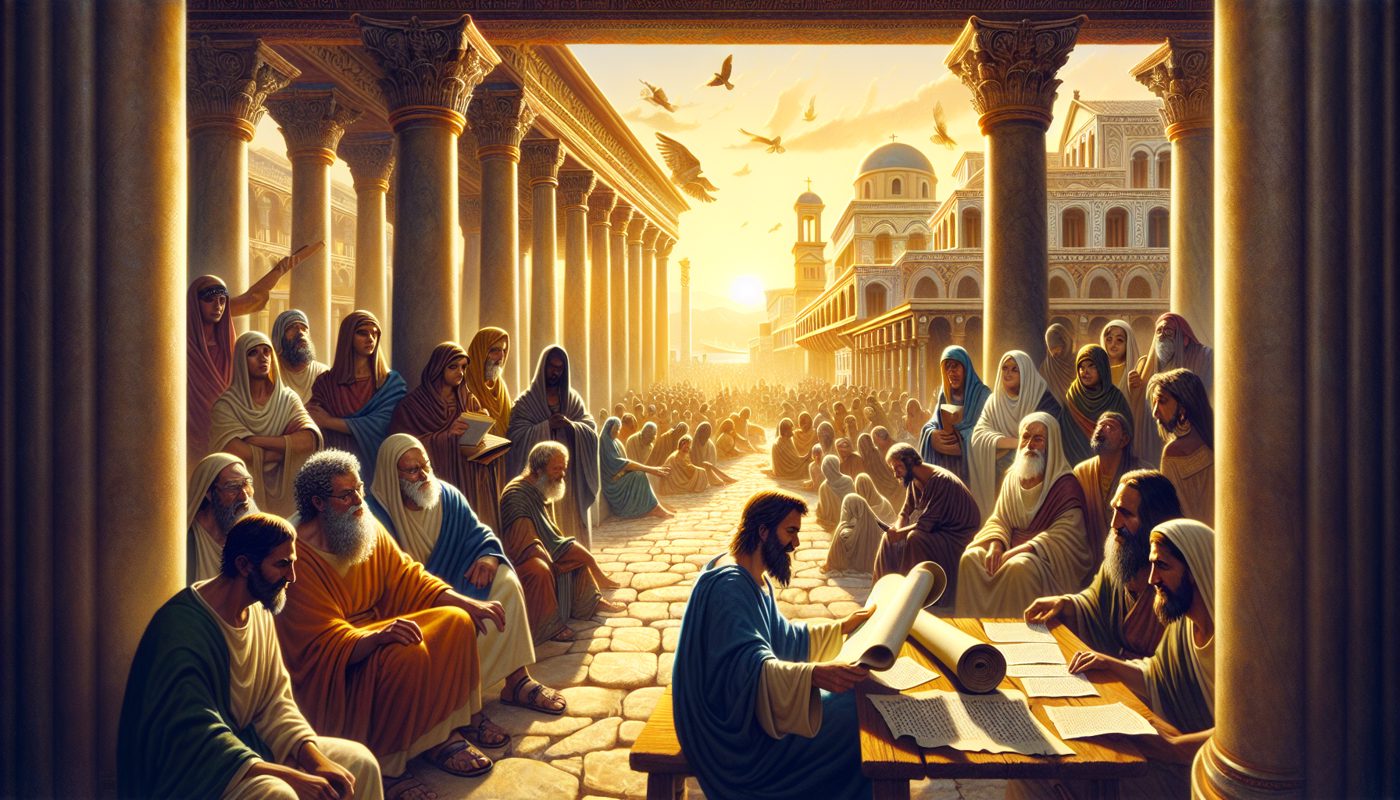
Paul closes his first letter to the Corinthians with a flurry of final instructions that are less a gentle farewell than a set of sharp, concrete commands. He opens with the collection for the saints in Jerusalem, and he does not treat it as an afterthought. He gives a direct order: on the first day of every week, each believer is to set something aside, storing it up according to how he has prospered. The purpose is plain—no collections should be needed when Paul himself arrives. This is not spontaneous charity; it is disciplined, regular provision, tied to the weekly gathering of the church.
Paul then turns to his travel plans, and the tone shifts from financial logistics to personal intention. He will pass through Macedonia first, and he may stay in Corinth for a while, perhaps even through the winter, so that the Corinthians can help him on his way wherever he goes next. But he is careful to qualify everything: he hopes to tarry with them, if the Lord permits. He will remain in Ephesus until Pentecost, because a great door for effective work has opened to him—and there are many adversaries. The door and the opposition are mentioned together, as if Paul sees them as two sides of the same coin.
Timothy is coming, and Paul’s instructions about him are blunt. The Corinthians are to see that Timothy is with them without fear, because he does the Lord’s work just as Paul does. No one is to despise him. They are to send him on his way in peace so that he can return to Paul, who expects him along with the other brothers. The warning is pointed: Timothy is young, and the Corinthians might be tempted to dismiss him. Paul will not have it.
Apollos is a different matter. Paul says he urged Apollos strongly to go to Corinth with the brothers, but it was not Apollos’s will to come now. He will come when he has opportunity. There is no pressure, no rebuke, only a straightforward report. The Corinthians had their factions around Apollos and Paul earlier in the letter, but here Paul simply notes the facts and moves on.
Then come four short, dense commands: Watch. Stand firm in the faith. Act like men. Be strong. And let all that you do be done in love. These are not abstract virtues; they are the posture of a church under pressure. The Corinthians had divisions, sexual immorality, lawsuits among believers, confusion about spiritual gifts, and denial of the resurrection. Paul’s final exhortation is for them to stay alert, hold their ground, and let love govern every action.
Paul singles out the household of Stephanas. He calls them the firstfruits of Achaia, meaning they were among the first converts in that region. They have devoted themselves to serving the saints, and Paul tells the Corinthians to submit to such people—to everyone who helps in the work and labors at it. This is not a general call to submit to all leaders; it is a specific recognition of those who have proven themselves by their labor.
Paul rejoices that Stephanas, Fortunatus, and Achaicus have come to him, because they have supplied what was lacking on the Corinthians’ part. They refreshed his spirit and theirs. Paul tells the church to acknowledge such men. These are not famous names in the broader Christian story, but Paul insists they be recognized.
The letter ends with greetings. The churches of Asia send their greetings. Aquila and Prisca—Paul’s fellow tentmakers and hosts of a house church—greet them warmly in the Lord. All the brothers send greetings. Paul tells the Corinthians to greet one another with a holy kiss. Then he takes the pen himself: the salutation is in his own hand. This marks the letter as genuinely from him, distinguishing it from forgeries.
Paul closes with a severe warning and a blessing. If anyone does not love the Lord, let him be accursed. Maranatha—an Aramaic phrase meaning “Our Lord, come.” It is a cry of hope and judgment. Then the grace of the Lord Jesus Christ be with them. And Paul’s own love, with all of them in Christ Jesus. Amen.
Comments
Comments 0
Read the discussion and add your voice.
Members only
Sign in to join the conversation
We keep comments tied to real accounts so the discussion stays clean and trustworthy.
No comments yet. Be the first to add one.