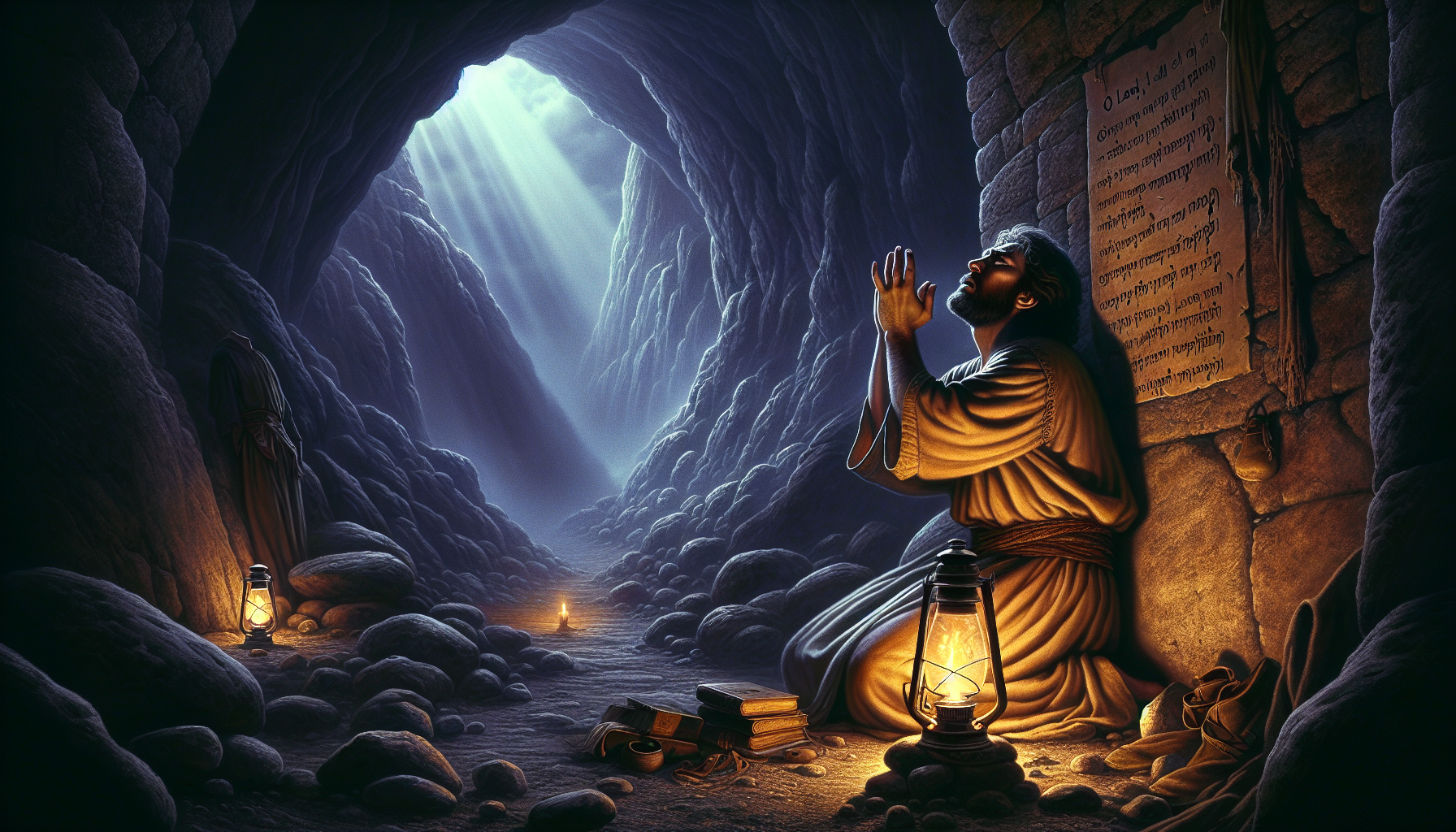
The psalm opens with a man calling urgently. David does not begin with praise or confession but with a demand: Make haste. Give ear. The pressure is immediate, and the Lord is the only one who can answer. The poet does not describe his enemies in detail, only the speed with which he needs the Lord to act.
He asks that his prayer be treated like incense, and the lifting of his hands like the evening sacrifice. These are not metaphors about worship in general. They are specific: incense rose in the sanctuary, and the evening sacrifice was a fixed ritual. David wants his desperate cry treated with the same regularity and acceptance as the temple liturgy, even though he is not in the temple.
Then the prayer turns inward. He does not ask for protection from enemies first. He asks for a guard on his mouth. The door of his lips must be watched. This is not a request for eloquence but for restraint. David knows that words can ruin a man before any sword reaches him.
He asks the Lord to keep his heart from inclining toward evil, from practicing wicked deeds with men who work iniquity. He does not want to share their dainties. The danger is not just external attack but internal corruption. The table of the wicked is a real temptation, and David wants no part of it.
He then makes a strange request: let the righteous smite him, and let it be counted as kindness. Let reproof be like oil on the head, and do not let his head refuse it. David is willing to be struck by a good man if it keeps him from the path of the wicked. He would rather be corrected than flattered into ruin.
Even in the wickedness of his enemies, David says, his prayer will continue. He does not stop praying when the pressure is on. He keeps praying even when the wicked are active. This is not a fair-weather prayer but a persistent one.
He describes the fate of the wicked judges: they are thrown down by the sides of the rock. Their bones are scattered at the mouth of Sheol, like earth broken by a plow. The image is violent and final. The wicked do not simply fall; they are shattered and dispersed.
But David's eyes are on the Lord. He takes refuge in him and asks that his soul not be left destitute. He asks to be kept from the snare laid for him, from the traps of the workers of iniquity. The danger is specific: nets and gins, hidden devices meant to catch him unaware.
The final verse is a prayer for reversal: let the wicked fall into their own nets while David escapes. He does not ask to destroy them directly. He asks that their own schemes collapse on them. Justice is not vengeance but the collapse of the trap on the trapper.
The psalm ends without a vow of praise or a declaration of victory. It ends with a man still in danger, still watching, still trusting that the Lord will see him through. The prayer is not finished, but it is complete enough to leave in the hands of the one who hears incense and evening sacrifice.