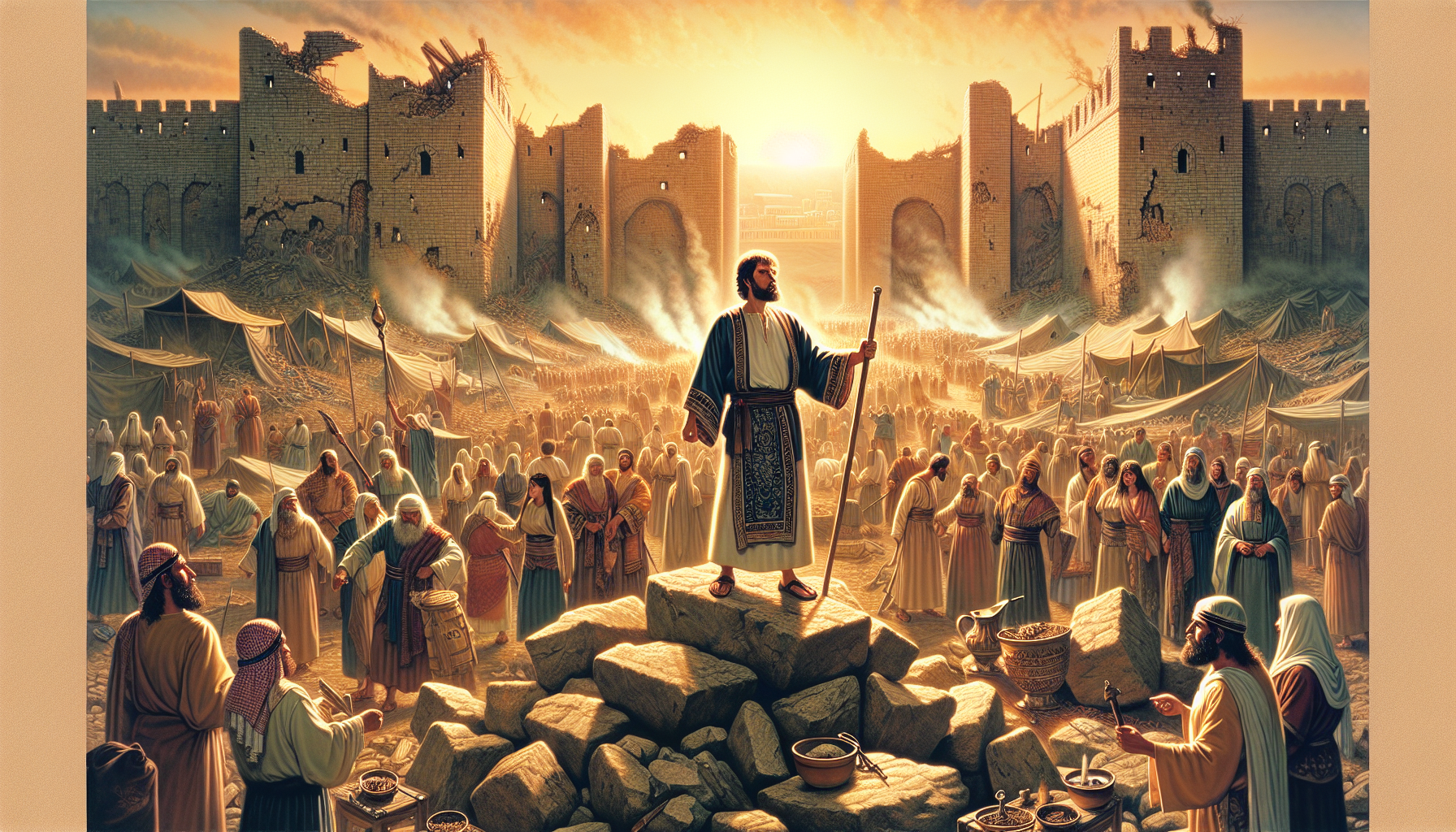
Nehemiah 3 is not a chapter of speeches or dramatic confrontations. It is a ledger of labor: a wall, a gate, a bolt, a bar, and the names of the people who put them in place. The chapter moves methodically from the Sheep Gate to the Sheep Gate again, tracking every repaired section and every responsible party. It is a record of coordinated work, not a story of heroics, and the text insists on naming those who did it.
The high priest Eliashib began at the Sheep Gate, the place where sacrifices entered the temple precincts. He and his fellow priests built it, sanctified it, and set up its doors. Their work extended as far as the Tower of Hammeah and the Tower of Hananel—two fortifications that anchored the northern wall. The men of Jericho worked next to them, and Zaccur the son of Imri after that. The pattern was set: each group took a section, and the wall rose in stages.
The Fish Gate was rebuilt by the sons of Hassenaah. They laid its beams, set up its doors, and installed its bolts and bars. Then came Meremoth, Meshullam, and Zadok—each repairing a portion. The Tekoites also worked, but the text notes something unusual: their nobles refused to put their necks to the work of the Lord. The chapter does not explain their refusal; it simply records it.
The Old Gate was repaired by Joiada and Meshullam, who also laid beams and set up doors, bolts, and bars. Melatiah the Gibeonite and Jadon the Meronothite worked next, along with the men of Gibeon and Mizpah. Uzziel the goldsmith repaired another section, and Hananiah the perfumer fortified the wall as far as the Broad Wall. Rephaiah, ruler of half the district of Jerusalem, repaired the next portion, and Jedaiah repaired the section opposite his own house.
Malchijah and Hasshub repaired another portion, including the Tower of the Furnaces. Then came Shallum, ruler of half the district of Jerusalem, and his daughters. The chapter does not elaborate on their presence; it simply lists them among the builders. Hanun and the inhabitants of Zanoah rebuilt the Valley Gate, setting up its doors, bolts, and bars, and then repaired a thousand cubits of wall as far as the Dung Gate.
Malchijah the son of Rechab rebuilt the Dung Gate, and Shallun the son of Col-hozeh rebuilt the Fountain Gate. Shallun’s work included covering the gate, setting up its doors, bolts, and bars, and repairing the wall of the Pool of Shelah by the king’s garden, down to the stairs descending from the City of David. Nehemiah the son of Azbuk repaired the next section, up to the sepulchres of David and the Pool That Was Made.
The Levites repaired under Rehum and Hashabiah. Bavvai and Ezer each took portions. Baruch the son of Zabbai repaired earnestly—the only emotional descriptor in the chapter—from the turning of the wall to the door of Eliashib’s house. Meremoth then repaired another portion from Eliashib’s door to the end of his house. The priests of the Plain repaired next, followed by Benjamin, Hasshub, and Azariah, each working opposite their own houses.
Binnui repaired another portion, Palal repaired opposite the turning of the wall and the tower by the king’s upper house, and Pedaiah repaired after him. The Nethinim—temple servants—dwelt in Ophel and repaired up to the Water Gate and the projecting tower. The Tekoites repaired a second portion, from the great tower to the wall of Ophel. The priests repaired above the Horse Gate, each opposite his own house. Zadok, Shemaiah, Hananiah, Hanun, Meshullam, and Malchijah the goldsmith all took their sections. Finally, the goldsmiths and merchants repaired the last stretch from the ascent of the corner to the Sheep Gate.
The chapter does not pause to interpret the work. It does not moralize about unity or faith. It simply records that the wall was rebuilt by a specific list of people—priests, goldsmiths, perfumers, rulers, daughters, and temple servants—each assigned a portion, each named. The wall rose because people took their sections seriously, and the text honors that by writing down their names.