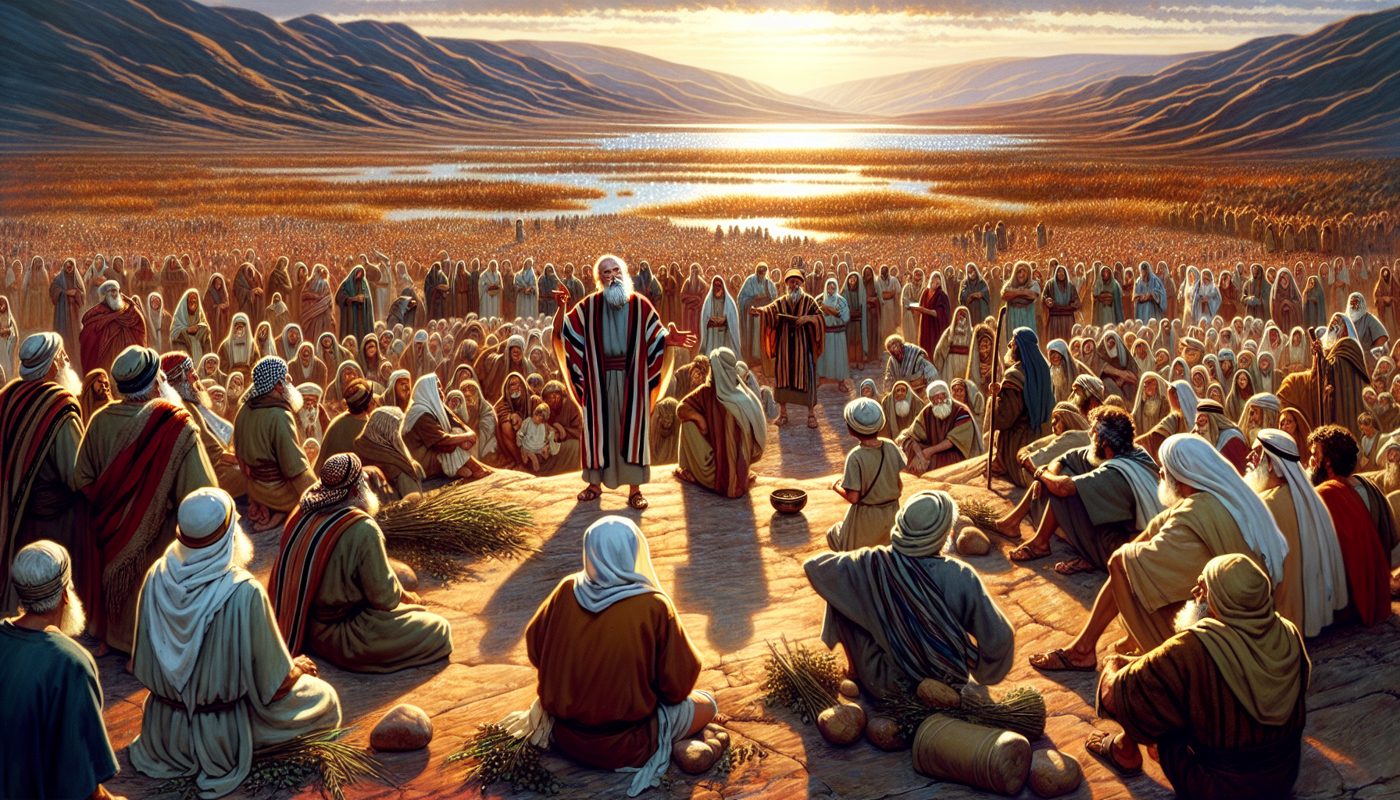
The Lord speaks in Deuteronomy 7 with a directness that leaves no room for negotiation. He tells Israel what will happen when they enter the land: He will cast out seven nations—Hittites, Girgashites, Amorites, Canaanites, Perizzites, Hivites, and Jebusites—peoples greater and mightier than Israel. The command that follows is absolute. Israel is to destroy them utterly, make no covenant with them, and show no mercy.
Marriage with these nations is forbidden. The reason is not ethnic purity but religious allegiance. A son or daughter who marries into these peoples will be turned away from following the Lord to serve other gods. The anger of the Lord would then kindle against Israel, and He would destroy them quickly. The chapter does not soften this warning with exceptions.
The physical objects of these nations are to be treated the same way. Their altars must be broken down, their sacred pillars dashed to pieces, their Asherim hewn down, and their graven images burned with fire. Nothing is to be salvaged. The reason rests on Israel’s identity: they are a holy people, chosen by the Lord as His own possession above all peoples on the earth.
This choice did not come because Israel was numerous. The chapter states plainly that they were the fewest of all peoples. The Lord set His love on them because He loved them and because He would keep the oath He swore to their fathers. The exodus from Egypt, with its mighty hand and outstretched arm, was the proof of that commitment.
The chapter then turns to the character of the Lord. He is the faithful God who keeps covenant and lovingkindness with those who love Him and keep His commandments, to a thousand generations. But He also repays those who hate Him to their face, destroying them without delay. The warning and the promise are bound together in the same sentence.
Obedience to the commandments, statutes, and ordinances is the condition for the covenant to hold. If Israel hearkens and does them, the Lord will keep the covenant and lovingkindness sworn to the fathers. He will love, bless, and multiply them—fruit of the body, fruit of the ground, grain, wine, oil, cattle, and flocks. There will be no barrenness among them, and the evil diseases of Egypt will be put on their enemies instead.
The command to consume the peoples is repeated, and the chapter anticipates the fear that will rise in Israel’s heart. The nations are many; Israel is small. The answer is not strategy but memory. They are to remember what the Lord did to Pharaoh and all Egypt—the great trials, signs, wonders, the mighty hand, and the outstretched arm. The same Lord will do the same to all the peoples they fear.
A specific detail appears: the Lord will send the hornet among the nations until those who remain hide themselves and perish. The conquest will not happen all at once, but little by little, so that the wild beasts do not multiply against Israel. The Lord will discomfit the nations with a great discomfiture until they are destroyed, and their kings will be delivered into Israel’s hand so that no man can stand before them.
The final instruction returns to the graven images. They must be burned with fire. The silver and gold on them must not be coveted or taken, for that would be a snare. Those objects are an abomination to the Lord, and to bring an abomination into one’s house is to become a devoted thing like it. The chapter ends with a command to utterly detest and abhor such things, because they are devoted to destruction.
Comments
Comments 0
Read the discussion and add your voice.
Members only
Sign in to join the conversation
We keep comments tied to real accounts so the discussion stays clean and trustworthy.
No comments yet. Be the first to add one.