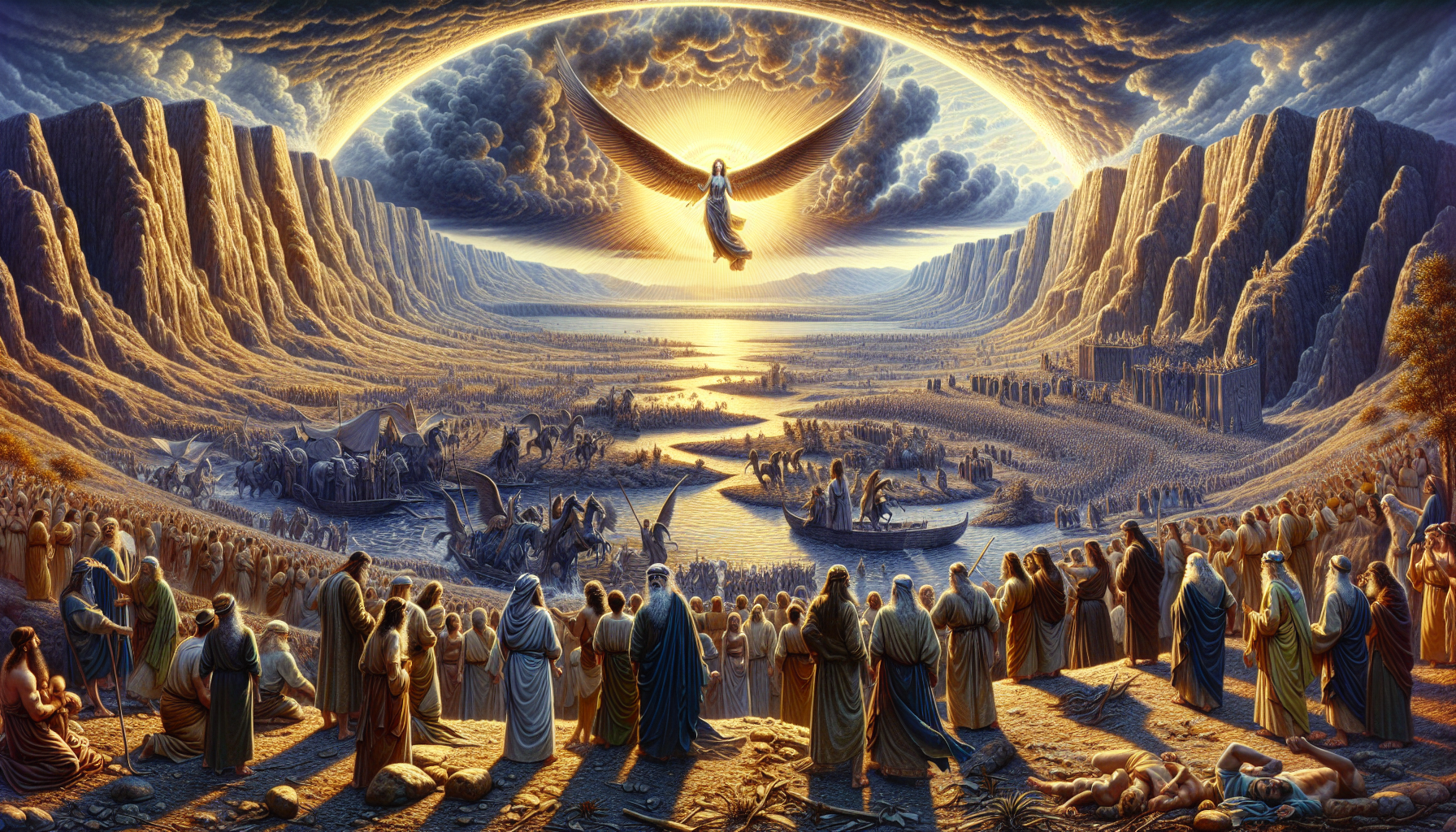
The angel of the Lord came up from Gilgal to Bochim, and the words he spoke were not a blessing. He reminded Israel that he had brought them out of Egypt and into the land sworn to their fathers, and that he had said he would never break his covenant with them. But they had broken the terms: they were to make no covenant with the inhabitants of the land and were to break down their altars. They had not listened. The angel asked plainly, “Why have you done this?”
Then the angel declared the consequence. Because Israel had disobeyed, the Lord would not drive out those nations before them. They would become thorns in Israel’s sides, and their gods would be a snare. The people lifted up their voices and wept. They called that place Bochim, which means weepers, and they sacrificed there to the Lord. But the weeping did not undo what had been set in motion.
The chapter then steps back to explain how this happened. Joshua had sent the people away, each man to his inheritance, and the people served the Lord all the days of Joshua and all the days of the elders who outlived him—those who had seen the great work the Lord had done for Israel. Joshua died at a hundred and ten years old and was buried in the hill country of Ephraim, at Timnath-heres, north of Mount Gaash.
Then that whole generation was gathered to their fathers. And there arose another generation after them that did not know the Lord, nor the work he had wrought for Israel. This is the hinge of the entire cycle. The knowledge was not inherited. The works were not passed down as living memory. The new generation had not seen the Jordan part or the walls fall, and they did not know the God who had done those things.
So the children of Israel did what was evil in the sight of the Lord. They served the Baalim. They forsook the Lord, the God of their fathers, who had brought them out of Egypt, and they followed other gods—the gods of the peoples around them—and bowed down to them. They provoked the Lord to anger. They forsook him and served Baal and the Ashtaroth.
The anger of the Lord was kindled against Israel. He delivered them into the hands of spoilers who despoiled them. He sold them into the hands of their enemies round about, so that they could no longer stand before them. Wherever they went out, the hand of the Lord was against them for evil, just as he had spoken and sworn. They were sore distressed.
Yet the Lord did not abandon them entirely. He raised up judges, and those judges saved Israel out of the hand of the spoilers. When the judge was alive, the Lord was with that judge and saved them all the days of the judge, because the Lord relented at their groaning under oppression and vexation.
But as soon as the judge died, they turned back and dealt more corruptly than their fathers. They followed other gods to serve them and bow down to them. They did not cease from their own doings or from their stubborn way. The pattern was not a gentle oscillation; it was a downward spiral, each generation worse than the last.
So the anger of the Lord was kindled again. He said that because this nation had transgressed his covenant and had not listened to his voice, he would no longer drive out any of the nations that Joshua had left when he died. He would leave them to prove Israel—to see whether they would keep the way of the Lord as their fathers had kept it, or not. The Lord left those nations without driving them out hastily, and he did not deliver them into the hand of Joshua.
The chapter does not offer a resolution. It ends with the nations still in the land, the covenant broken, and the test ongoing. The weeping at Bochim was real, but it did not change the fact that the generation that knew the Lord was gone, and the generation that did not know him had chosen other gods. The cycle was set, and the judges had not yet come to break it.