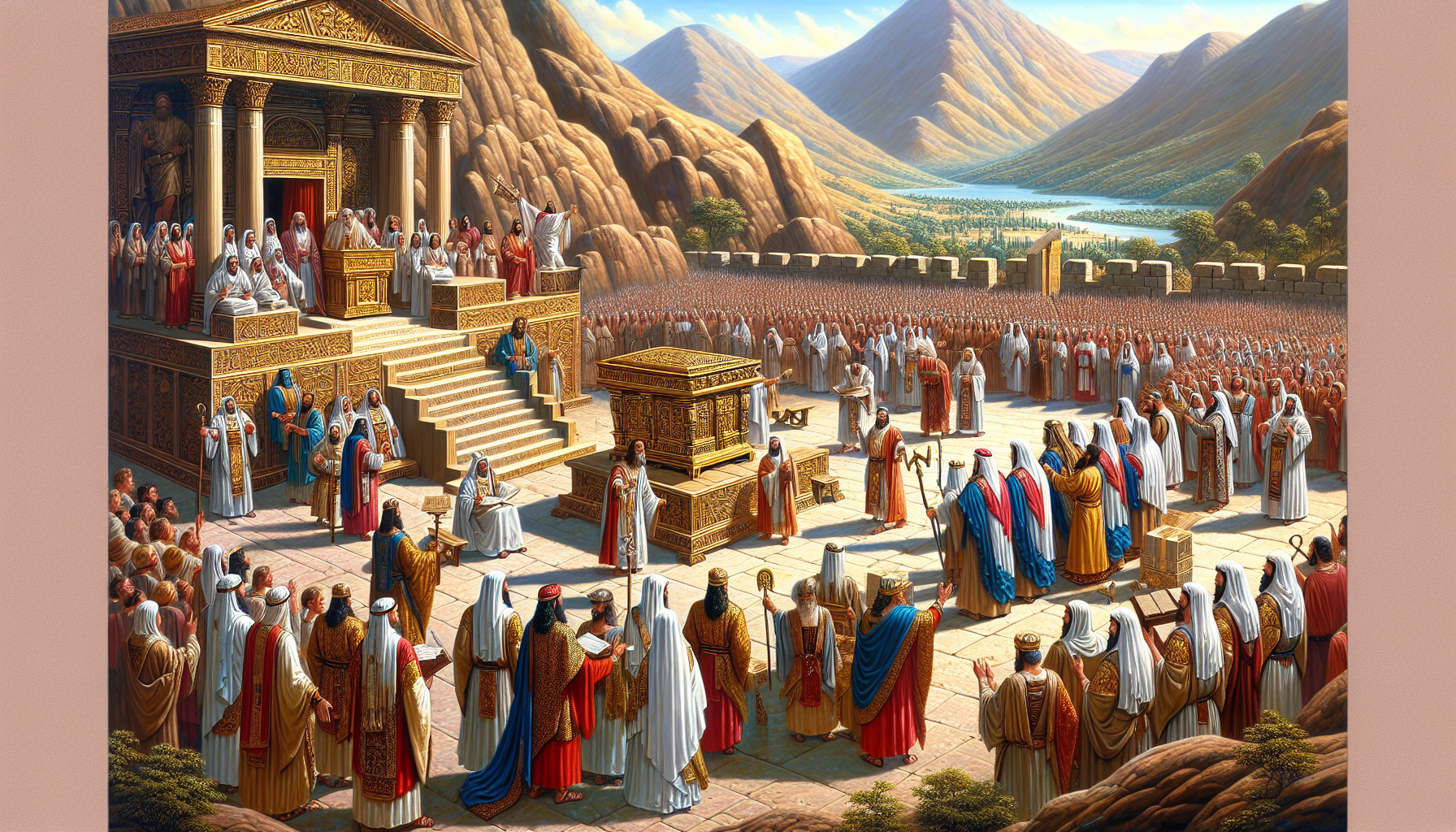
The twenty-fourth chapter of 1 Chronicles is a record of organization, not narrative. It names no battles, records no prophecy, and recounts no dramatic encounter with the Lord. What it does is lay out how the descendants of Aaron were divided into twenty-four courses for service in the house of God. The chapter opens by naming the sons of Aaron: Nadab, Abihu, Eleazar, and Ithamar. But Nadab and Abihu died before their father and had no children, so Eleazar and Ithamar carried the priestly office. That is all the chapter says about them—no explanation of why they died, no reference to Leviticus, only the fact that they were gone and the work passed to their brothers.
David did not act alone. He worked with Zadok, who was of the sons of Eleazar, and with Ahimelech, who was of the sons of Ithamar. Together they divided the priests according to their service. When they counted the men, they found that the sons of Eleazar were more numerous: sixteen heads of fathers' houses against eight from Ithamar. The division was not based on human preference or political advantage. They cast lots, one group alongside the other, because there were princes of the sanctuary and princes of God among both lines. The lot was the method, and the lot was final.
A scribe named Shemaiah, son of Nethanel, from the Levites, wrote down the results. He recorded them in the presence of the king, the princes, Zadok the priest, Ahimelech the son of Abiathar, and the heads of the fathers' houses of the priests and the Levites. One father's house was taken for Eleazar, and one for Ithamar, turn by turn. The scribe's presence and the witnesses make clear that this was a public, official act, not a private arrangement.
The lots themselves are then listed in order. The first lot fell to Jehoiarib, the second to Jedaiah, the third to Harim, the fourth to Seorim, the fifth to Malchijah, the sixth to Mijamin, the seventh to Hakkoz, the eighth to Abijah, the ninth to Jeshua, the tenth to Shecaniah, the eleventh to Eliashib, the twelfth to Jakim, the thirteenth to Huppah, the fourteenth to Jeshebeab, the fifteenth to Bilgah, the sixteenth to Immer, the seventeenth to Hezir, the eighteenth to Happizzez, the nineteenth to Pethahiah, the twentieth to Jehezkel, the one and twentieth to Jachin, the two and twentieth to Gamul, the three and twentieth to Delaiah, the four and twentieth to Maaziah.
Twenty-four names. Twenty-four courses. The chapter gives no further description of what each course did, only that this was their ordering in their service, to come into the house of the Lord according to the ordinance given through Aaron their father, as the Lord, the God of Israel, had commanded him. The system was not David's invention; it was the application of an existing command to a larger body of priests.
The chapter then turns to the rest of the sons of Levi who were not priests. It lists the descendants of Amram, Izhar, Hebron, and Uzziel, the sons of Kohath, and then the sons of Merari. The names come in a steady sequence: Shubael, Jehdeiah, Isshiah, Shelomoth, Jahath, Jeriah, Amariah, Jahaziel, Jekameam, Micah, Shamir, Isshiah, Zechariah. Then from Merari: Mahli, Mushi, Jaaziah, Beno, Shoham, Zaccur, Ibri, Eleazar who had no sons, Kish and Jerahmeel, and the sons of Mushi: Mahli, Eder, and Jerimoth.
These Levites were listed after their fathers' houses, just as the priests had been. And they likewise cast lots in the presence of David the king, Zadok, Ahimelech, and the heads of the fathers' houses of the priests and of the Levites. The chapter ends with a brief note that the fathers' houses of the chief were treated the same as those of his younger brother. No rank or age gave one house priority over another; the lot governed all equally.
The chapter does not explain why David undertook this organization at this particular moment. It does not describe the temple that would eventually stand, nor does it record any prayer or speech from David. The focus stays on the names, the lots, and the witnesses. The priests and Levites were divided into fixed courses, and those courses determined who served and when. The system would outlast David and continue through the generations that followed, until the temple itself was gone.
What remains is the structure. Twenty-four priestly courses, a scribal record, and a king who did not treat the service of the house of God as something that could be left to chance or personal arrangement. The lot was cast, the names were written, and the work was set in order.