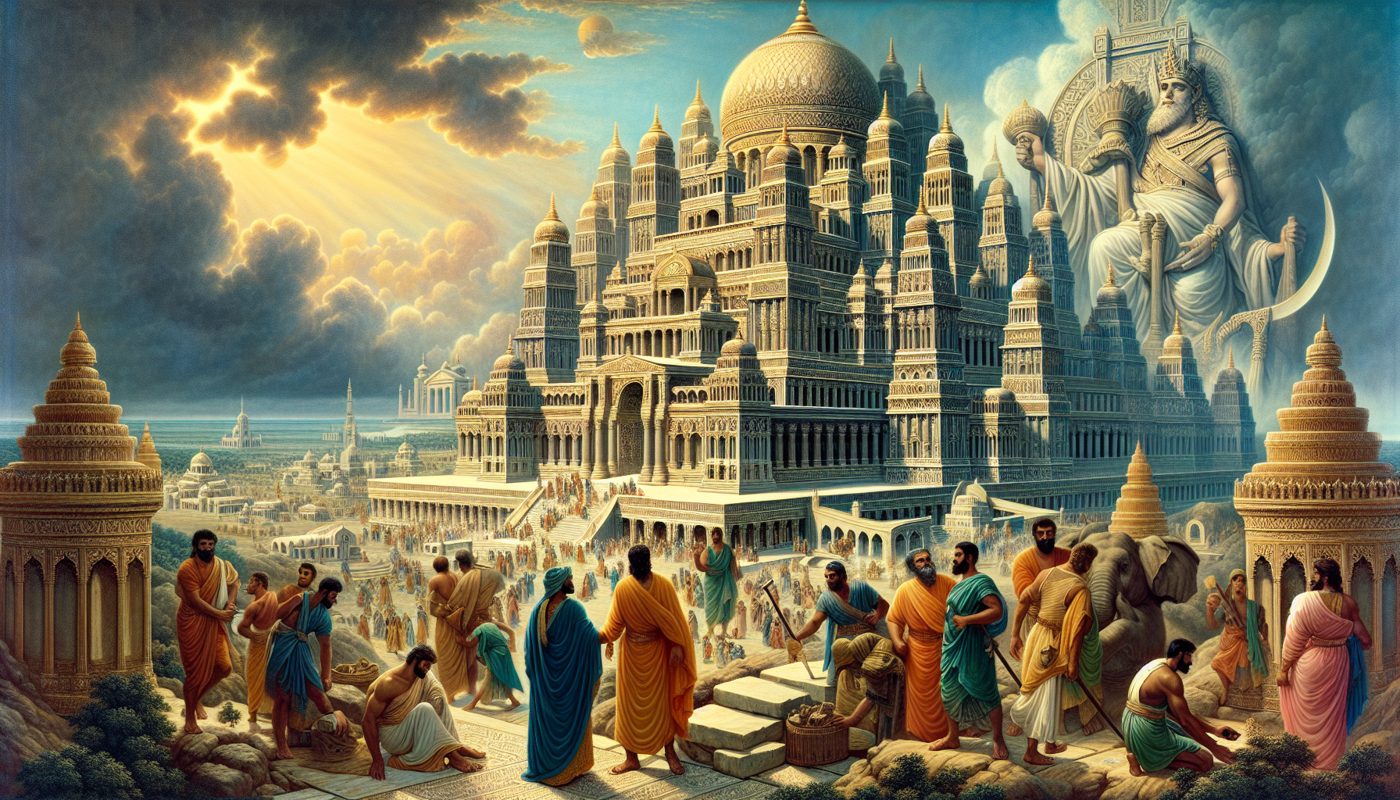
The chapter opens with a number that stops the reader: Solomon spent thirteen years building his own house. That is more than twice the time given to the house of the Lord in the previous chapter. The text does not moralize about this, but the length itself presses the question of proportion. The king built a complex, not a single structure, and the first hall described is the House of the Forest of Lebanon, named for the cedar brought from those mountains. Its dimensions—one hundred cubits long, fifty wide, thirty high—made it larger than the Temple porch. Four rows of cedar pillars carried the roof, and windows were set in three ranks, facing each other. The work was systematic, measured, and deliberate.
Beyond that hall stood a porch of pillars, fifty by thirty cubits, with a threshold and a porch before it. Then came the Porch of Judgment, where Solomon would sit to hear cases, and it was paneled with cedar from floor to floor. His own dwelling was built on the same pattern, and so was the house for Pharaoh’s daughter, his wife. The text does not explain why her house merited a separate mention, but it records the fact plainly. All these buildings were constructed with costly hewn stone, cut to measure and sawed on both sides, from foundation to coping. The foundation stones themselves were massive—ten cubits and eight cubits—and above them were more hewn stone and cedar. The great court around the palace had three courses of stone and one of cedar beams, just like the inner court of the Lord’s house and its porch.
Then the narrative shifts from stone and cedar to bronze. Solomon sent for Hiram of Tyre, a craftsman whose mother was a widow from the tribe of Naphtali and whose father had been a Tyrian bronze worker. The text says Hiram was filled with wisdom, understanding, and skill to work all works in bronze. He came and did all the bronze work for the Temple. The first items were two pillars, each eighteen cubits high and twelve cubits around. He cast two capitals of molten bronze, five cubits high each, and decorated them with nets of checker-work and wreaths of chain-work. On top of the capitals he placed lily-work, four cubits high, and around the belly of each capital he set two hundred pomegranates in rows. When the pillars were finished, he set them up at the porch of the Temple. He named the right pillar Jachin and the left pillar Boaz. The lily-work on top completed them.
Next came the molten sea, a great bronze basin ten cubits from brim to brim, round, five cubits high, and thirty cubits in circumference. Under the brim were two rows of knops, cast as part of the basin. It stood on twelve oxen, three facing each direction, with their hind parts turned inward. The basin itself was a handbreadth thick, its brim shaped like the rim of a cup, like a lily flower, and it held two thousand baths. Then Hiram made ten bronze bases, each four cubits long, four cubits wide, and three cubits high. They had panels between ledges, and on the panels were lions, oxen, and cherubim. Above the ledges was a pedestal, and beneath the lions and oxen were wreaths of hanging work. Each base had four bronze wheels with axles, and undersetters at the corners. The wheels were cast like chariot wheels, with axletrees, felloes, spokes, and naves all of bronze. On the top of each base was a round compass half a cubit high, and the stays and panels were graved with cherubim, lions, and palm trees, with wreaths around them. All ten bases were cast in one mold, one measure, one form.
Hiram also made ten bronze lavers, each holding forty baths, and set one laver on each base. He placed five bases on the right side of the Temple and five on the left. The sea he set on the right side of the house, eastward, toward the south. Then he made the pots, shovels, and basins. The text sums up his work: the two pillars, the two bowls of the capitals, the two networks, the four hundred pomegranates, the ten bases, the ten lavers, the one sea, the twelve oxen, and the pots, shovels, and basins. All these vessels were of burnished bronze. They were cast in the plain of the Jordan, in clay ground between Succoth and Zarethan. The bronze was so abundant that Solomon left the vessels unweighed; the weight could not be found out.
Finally, Solomon made the vessels for the house of the Lord out of gold: the golden altar, the table for the showbread, the ten lampstands of pure gold, five on the right and five on the left before the inner sanctuary, along with the flowers, lamps, tongs, cups, snuffers, basins, spoons, and firepans, all of pure gold. Even the hinges for the doors of the most holy place and for the doors of the Temple were of gold. When all the work was finished, Solomon brought in the things his father David had dedicated—the silver, the gold, and the vessels—and placed them in the treasuries of the Lord’s house.
The chapter does not pause to admire the beauty or to draw a lesson. It simply records what was built, what was cast, and what was dedicated. The bronze pillars have names. The sea stands on oxen. The bases carry lions and cherubim. The gold is pure. The weight of the bronze is beyond calculation. The work is finished. That is the weight of the chapter: not a sermon on wisdom, but a catalog of what wisdom, skill, and resources produced in that generation.
Comments
Comments 0
Read the discussion and add your voice.
Members only
Sign in to join the conversation
We keep comments tied to real accounts so the discussion stays clean and trustworthy.
No comments yet. Be the first to add one.