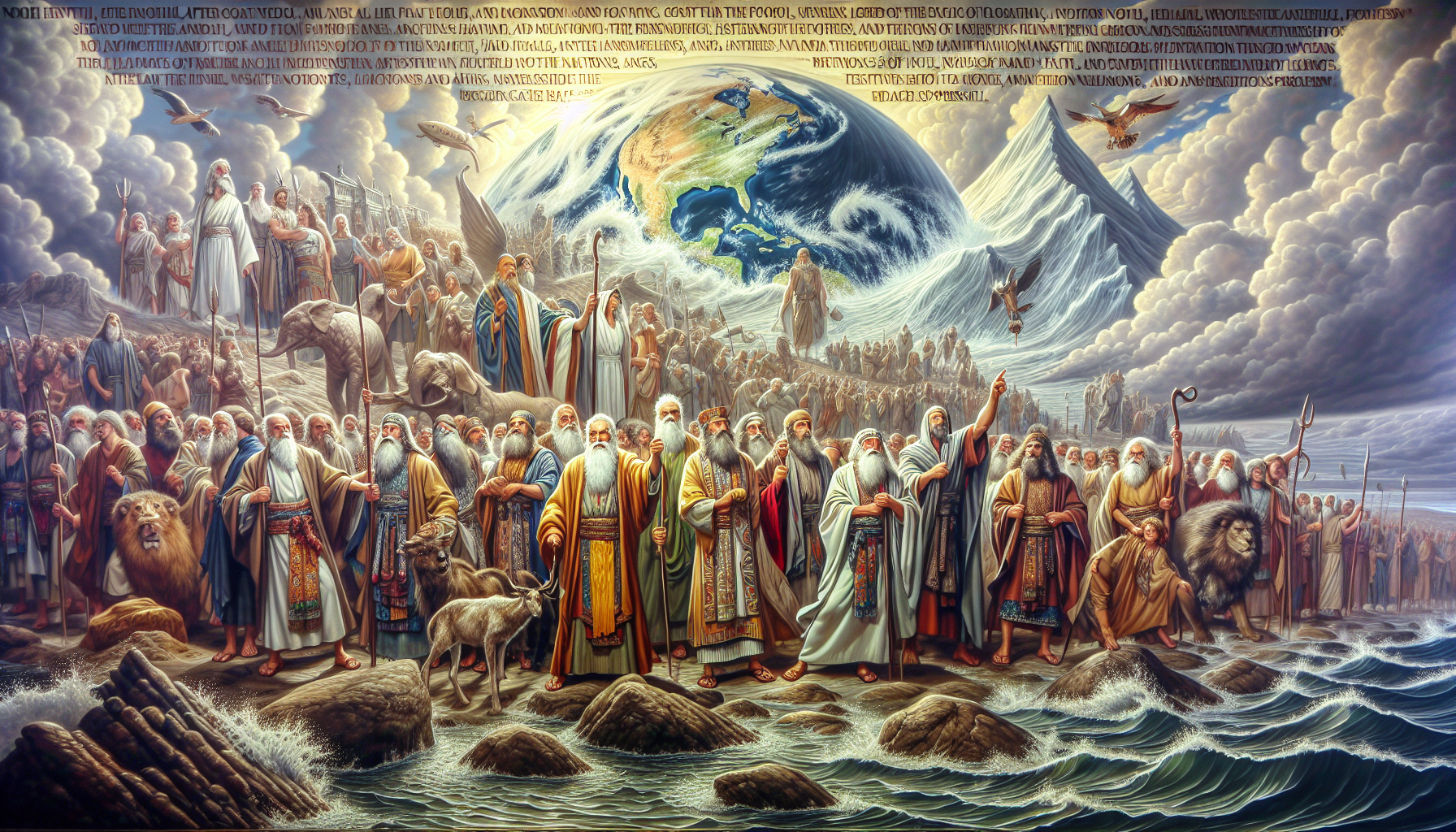
Genesis 10 is a table of nations, not a story with plot and dialogue. The chapter moves methodically through the three sons of Noah—Shem, Ham, and Japheth—and lists their descendants by name, family, language, and territory. The narrator twice summarizes the pattern: “by their families, by their languages, in their lands, by their nations.” The flood has ended, and the earth is being repopulated through these genealogical lines.
The chapter opens with Japheth, whose sons include Gomer, Magog, Madai, Javan, Tubal, Meshech, and Tiras. From these come the peoples of the coastlands and the north. The sons of Gomer branch into Ashkenaz, Riphath, and Togarmah. The sons of Javan produce Elishah, Tarshish, Kittim, and Dodanim. The text says that from these the “isles of the nations” were divided, each according to its own tongue and family.
Ham’s line begins with Cush, Mizraim, Put, and Canaan. The sons of Cush are Seba, Havilah, Sabtah, Raamah, and Sabteca. From Raamah come Sheba and Dedan. But the chapter pauses on one descendant of Cush: Nimrod. He is described as a “mighty one on the earth” and a “mighty hunter before the Lord.” The narrator adds that a saying arose: “Like Nimrod a mighty hunter before the Lord.”
Nimrod’s kingdom began in Shinar, with Babel, Erech, Accad, and Calneh. Then he went into Assyria and built Nineveh, Rehoboth-Ir, Calah, and Resen—described as the great city. This is the only figure in the chapter who receives more than a name. The text does not explain why he is called a mighty hunter or what his hunting meant, but his name is tied to the first cities after the flood.
Mizraim, the second son of Ham, fathered the Ludim, Anamim, Lehabim, Naphtuhim, Pathrusim, Casluhim (from whom the Philistines came), and Caphtorim. Canaan, Ham’s fourth son, fathered Sidon his firstborn, Heth, and then a list of peoples: the Jebusite, Amorite, Girgashite, Hivite, Arkite, Sinite, Arvadite, Zemarite, and Hamathite. The text notes that later the families of the Canaanites spread abroad.
The border of the Canaanites is then given: from Sidon toward Gerar as far as Gaza, then toward Sodom, Gomorrah, Admah, and Zeboiim as far as Lasha. This is the only territorial boundary drawn in the chapter, and it matches the land that will later be associated with the inhabitants of Canaan. The chapter closes the section on Ham with the same formula: “by their families, by their tongues, in their lands, in their nations.”
Shem is introduced as the father of all the children of Eber and the elder brother of Japheth. His sons are Elam, Asshur, Arpachshad, Lud, and Aram. The sons of Aram are Uz, Hul, Gether, and Mash. Arpachshad fathered Shelah, and Shelah fathered Eber. Eber had two sons: Peleg, because “in his days the earth was divided,” and Joktan.
Joktan fathered thirteen sons: Almodad, Sheleph, Hazarmaveth, Jerah, Hadoram, Uzal, Diklah, Obal, Abimael, Sheba, Ophir, Havilah, and Jobab. Their dwelling is described as from Mesha toward Sephar, the mountain of the east. The chapter then closes the section on Shem with the same formula used for Ham: “by their families, by their tongues, in their lands, by their nations.”
The final verse of the chapter sums up the whole: “These are the families of the sons of Noah, according to their generations, in their nations. From these the nations spread abroad on the earth after the flood.” The chapter does not evaluate any of these peoples or assign moral weight. It simply records the branching of humanity from three men into a world of many languages, lands, and families.
The chapter does not explain how the division of languages happened—that will come in Genesis 11. It does not tell stories about any of these descendants except Nimrod. It does not describe migrations or conflicts. It is a deliberately structured list, and its purpose seems to be to show that all the nations of the known world trace back to Noah’s sons. The repetition of the phrase “after their families, after their tongues, in their lands, in their nations” gives the chapter a formal, almost census-like tone.
Reading Genesis 10 as a simple record of names and territories keeps the focus where the chapter puts it: on the spread of humanity across the earth after the flood, not on moral lessons or dramatic scenes. The chapter is a foundation, not a narrative.