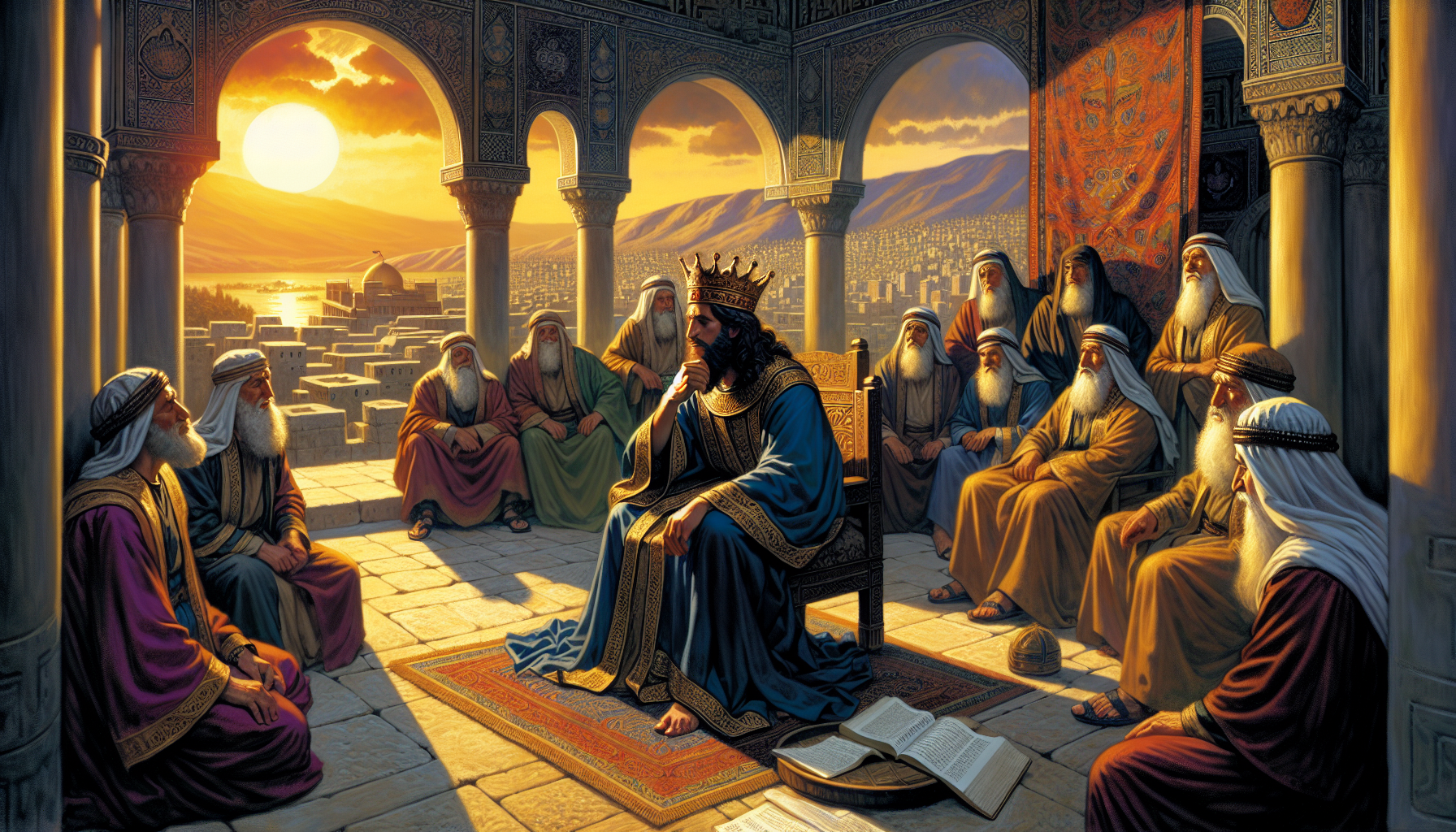
The chapter opens with a question from David that carries the weight of a promise made long before he took the throne. He asks whether anyone remains from the house of Saul, not to settle a score but to show kindness for Jonathan's sake. The phrasing is deliberate: David wants to show the kindness of God, not merely a political courtesy. The question hangs in the air of the court, and the answer comes from a man named Ziba, a servant who had belonged to Saul's household.
Ziba is summoned before the king, and David confirms his identity directly. Then David presses the question again, making clear that the kindness he intends is not a casual favor but an act rooted in covenant loyalty. Ziba answers that Jonathan still has a son, but he is lame in both feet. That detail is not offered as a sob story; it is a plain fact about the only surviving descendant of David's closest friend.
David asks where this son is, and Ziba tells him: Lo-debar, in the house of Machir son of Ammiel. The name Lo-debar carries no symbolic explanation in the text. It is simply a location, a place of obscurity where a crippled prince had been living out of sight. David does not hesitate. He sends men to fetch Mephibosheth from that house and bring him to Jerusalem.
When Mephibosheth arrives, he falls on his face before David and does obeisance. The posture is not theatrical; it is the expected response of a subject before a king, especially one who might have reason to fear the new dynasty. David speaks his name, and Mephibosheth answers, identifying himself as the king's servant. There is no grand reunion speech, only the raw tension of a man who knows he belongs to a fallen house.
David tells him not to fear. The reason is not David's generosity in the abstract but the covenant with Jonathan. David will restore to Mephibosheth all the land that belonged to Saul his grandfather, and he will eat at the king's table continually. The promise is concrete: land and a place at the royal table, not charity from a distance but proximity and provision.
Mephibosheth's response is striking. He does not thank David or praise his mercy. He bows again and asks what his king sees in such a dead dog as himself. The phrase is not self-pity; it is the language of a man who knows his position. He is the grandson of the king David replaced, and he is physically disabled. By any political calculation, he should be a nonentity or a threat. David's kindness defies that logic.
David then calls Ziba back and gives him a direct command. All the property that belonged to Saul and his house is now given to Mephibosheth, Jonathan's son. Ziba and his sons and servants are to work the land for Mephibosheth and bring in the harvest so that Mephibosheth's household has bread. But Mephibosheth himself will eat at David's table always. The chapter notes that Ziba had fifteen sons and twenty servants, a detail that underscores the scale of the estate being transferred.
Ziba accepts the command without argument. He says he will do everything the king commands. The narrator then repeats the central fact: Mephibosheth will eat at David's table as one of the king's sons. That is the status David gives him, not a pension but a place in the royal household.
The chapter closes with two final details. Mephibosheth had a young son named Mica, and everyone living in Ziba's house became servants to Mephibosheth. Then the last verse returns to the physical fact that marked his life: he was lame in both his feet. That disability is not healed, not mentioned again as a problem. It simply remains, and David's kindness does not depend on removing it.
The entire chapter moves on a single axis: a king who remembers a covenant and acts on it. There is no political maneuvering, no hidden agenda, no grand moralizing. David asks, finds, restores, and provides. Mephibosheth receives what he never asked for and could not have demanded. The kindness of God, as David called it, takes the shape of land, a table, and a place among the king's sons.