The chapter opens with a command that sounds reckless: cast your bread upon the waters, and you will find it after many days. The Preacher does not explain the metaphor. He does not soften it. He simply states that the act of giving—giving a portion to seven, even to eight—is the proper response to a future you cannot see. The evil that may come upon the earth is real, but the instruction is not to hoard against it. The instruction is to release what you have before you know whether you will need it.
The logic of the chapter is built on a hard truth: you do not know what is coming. If the clouds are full of rain, they empty themselves on the earth. If a tree falls to the south or the north, there it lies. These are not parables. They are statements of fact about a world that runs on causes and effects you cannot control. The Preacher does not promise that the rain will be gentle or that the tree will fall in a useful direction. He only says that things happen, and they happen where they happen.
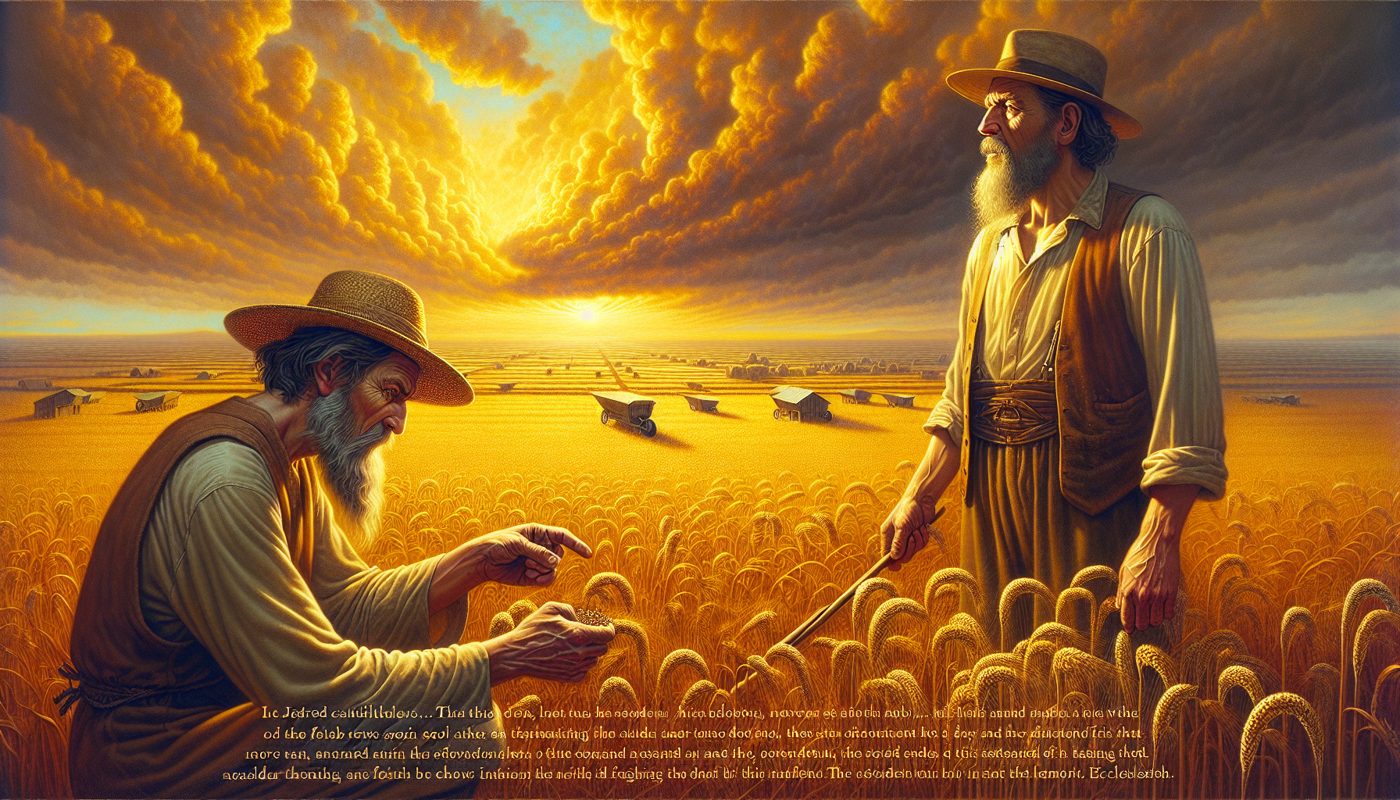
Then comes the verse that cuts the ground out from under hesitation. He who observes the wind will not sow, and he who regards the clouds will not reap. The Preacher is not dismissing prudence. He is exposing the paralysis that comes from waiting for perfect conditions. If you wait until the wind is exactly right, you will never put seed in the ground. If you wait until the sky is perfectly clear, you will never cut the harvest. The farmer who demands certainty before he acts will have neither sowing nor reaping.
The Preacher grounds this in a blunt comparison. You do not know the way of the wind. You do not know how bones grow in the womb of a pregnant woman. These are mysteries that belong to God, who does all things. The point is not that you should stop trying to understand. The point is that your ignorance of how things work is not a reason to stop working. You act because the work is yours, and the outcome belongs to the Lord.
The morning and the evening both get the same instruction: sow your seed in the morning, and in the evening do not withhold your hand. The Preacher is not describing a single day of planting. He is describing a rhythm of persistent action. You do not know which sowing will prosper, whether this one or that one, or whether both will be equally good. So you sow both times. You do not pick one and abandon the other. You spread the labor across the hours because you do not know which hour will bear fruit.
The chapter then turns sharply toward joy. Light is sweet, and it is pleasant for the eyes to see the sun. If a man lives many years, let him rejoice in them all. But the Preacher does not let the joy stand alone. He adds immediately: let him remember the days of darkness, for they shall be many. This is not a downer. It is a reality check that keeps joy from becoming naive. The days of darkness are coming, and they will be many. All that comes is vanity. The joy is real, but it is not permanent, and knowing that is part of what makes it meaningful.
The Preacher addresses the young man directly. Rejoice in your youth. Let your heart cheer you. Walk in the ways of your heart and in the sight of your eyes. But then he adds the weight: know that for all these things God will bring you into judgment. The instruction is not to suppress the joy of youth. It is to hold it with the awareness that you are accountable for how you live it. Remove sorrow from your heart and put away evil from your flesh, because youth and the dawn of life are vanity. They pass. They do not last. The window for action and joy is narrow, and it closes.
The chapter does not end with a promise that the harvest will be abundant or that the bread will return. It ends with a command to act anyway, to rejoice anyway, and to remember that the darkness is real and the judgment is real. The Preacher is not selling optimism. He is describing a life lived in the face of uncertainty, where the only thing you can control is whether you sow in the morning and whether you withhold your hand in the evening. The rest belongs to God.
The force of the chapter is not in a moral lesson about faith. It is in the structure of the argument: you do not know, so you act. You do not know, so you give. You do not know, so you rejoice while you can. The Preacher does not tell you to ignore the wind or the clouds. He tells you to stop letting them stop you. The farmer who waits for the perfect moment will have empty fields. The one who sows anyway will have a harvest that may or may not come, but at least he will have sown.
Comments
Comments 0
Read the discussion and add your voice.
Members only
Sign in to join the conversation
We keep comments tied to real accounts so the discussion stays clean and trustworthy.
No comments yet. Be the first to add one.