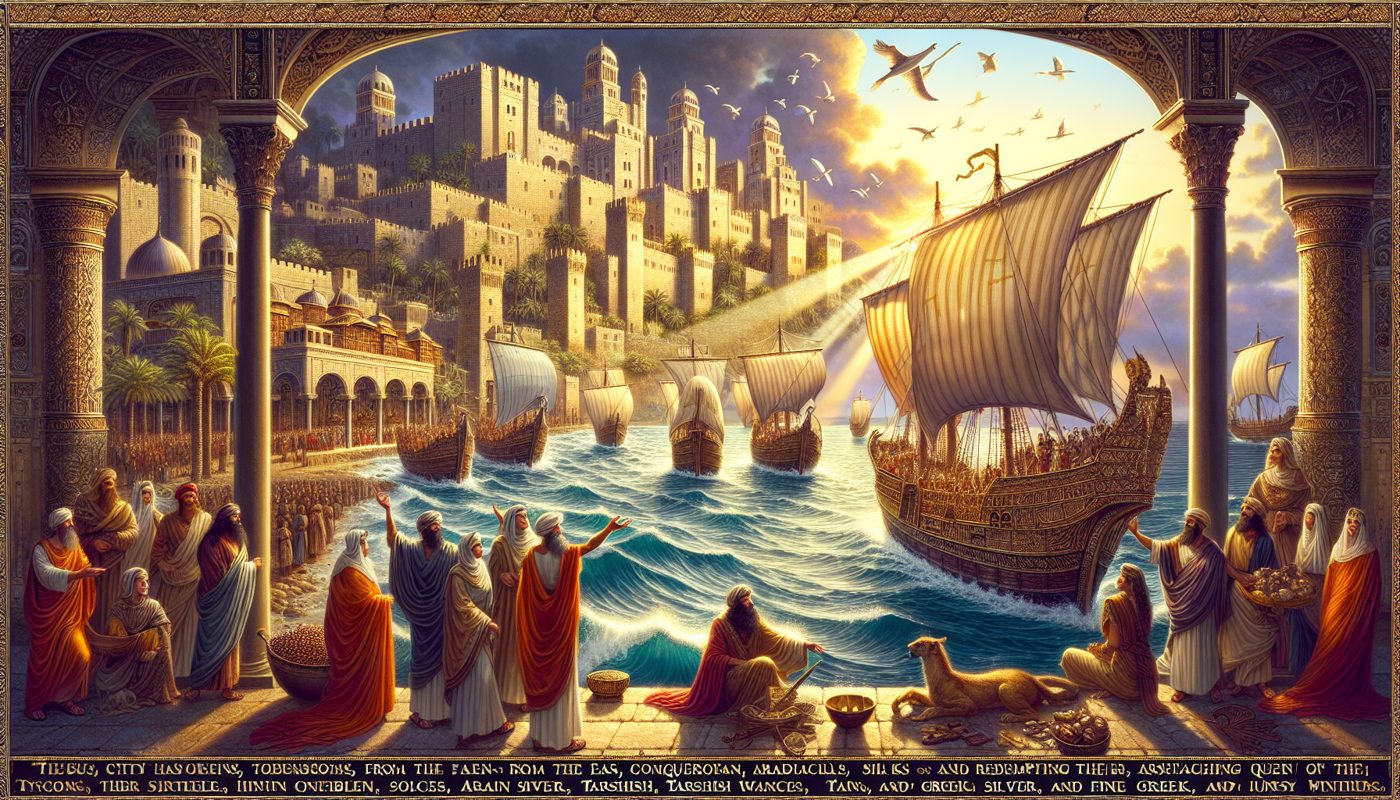
The burden of Tyre arrives without warning. Isaiah calls the ships of Tarshish to howl, because the city is laid waste—no house left, no harbor to enter. The report comes from the land of Kittim, and the coast falls silent. The merchants of Sidon, who once replenished Tyre with goods, are told to be still. The sea itself speaks, claiming it has neither travailed nor brought forth, as if the city it once carried was never born.
Tyre's revenue came from the great waters—the seed of the Shihor, the harvest of the Nile. She was the mart of nations, the place where every kingdom came to trade. But now the Lord of hosts has purposed something against her. The question is asked plainly: Who has done this against Tyre, the bestower of crowns, whose merchants were princes, whose traffickers were the honorable of the earth? The answer is given without evasion. The Lord of hosts purposed it, to stain the pride of all glory, to bring into contempt all the honorable of the earth.
The Lord stretched out his hand over the sea. He shook the kingdoms. He gave commandment concerning Canaan, to destroy its strongholds. Tyre, the joyous city whose antiquity was ancient, whose feet carried her far off to sojourn, is told she will no longer rejoice. She is called an oppressed virgin daughter of Sidon. She is told to arise and pass over to Kittim, but even there she will have no rest.
The chapter points to the land of the Chaldeans as a reference point. That people was not; the Assyrian founded it for those who dwell in the wilderness. They set up their towers, overthrew the palaces, made the city a ruin. The same fate is coming to Tyre. The ships of Tarshish are told again to howl, because their stronghold is laid waste.
Then the timeline appears. Tyre will be forgotten for seventy years, according to the days of one king. After those seventy years, the Lord will visit Tyre. But the description of what follows is not a simple restoration. Tyre will return to her hire and play the harlot with all the kingdoms of the world upon the face of the earth. The language is deliberately uncomfortable. The city that once traded in silks and spices will trade again, but the profit will not be hoarded.
The chapter ends with an unexpected turn. Her merchandise and her hire will be holiness to the Lord. It will not be treasured or laid up. Instead, her merchandise will be for those who dwell before the Lord, to eat sufficiently and for durable clothing. The same wealth that once fed Tyre's pride will feed the people of God. The harlot's song—take a harp, go about the city, sing many songs so that you may be remembered—becomes the strange prelude to a consecrated commerce.
There is no moral drawn in the text. No explanation of how Tyre's repentance works or whether the city itself changes. The chapter simply records the decree: seventy years of forgetting, then a return to trade, and finally the consecration of that trade to the Lord. The pride of Tyre is stained, but the city is not erased. It is repurposed.
The ships of Tarshish howl at the beginning and again at the end. The merchants who once walked as princes are brought low. But the Lord who stretched out his hand over the sea is the same Lord who visits Tyre after seventy years. The judgment is severe, but the final word is not destruction. It is a strange kind of holiness, attached to the very commerce that once defined the city's arrogance.
Comments
Comments 0
Read the discussion and add your voice.
Members only
Sign in to join the conversation
We keep comments tied to real accounts so the discussion stays clean and trustworthy.
No comments yet. Be the first to add one.