**The Song of All Creation**
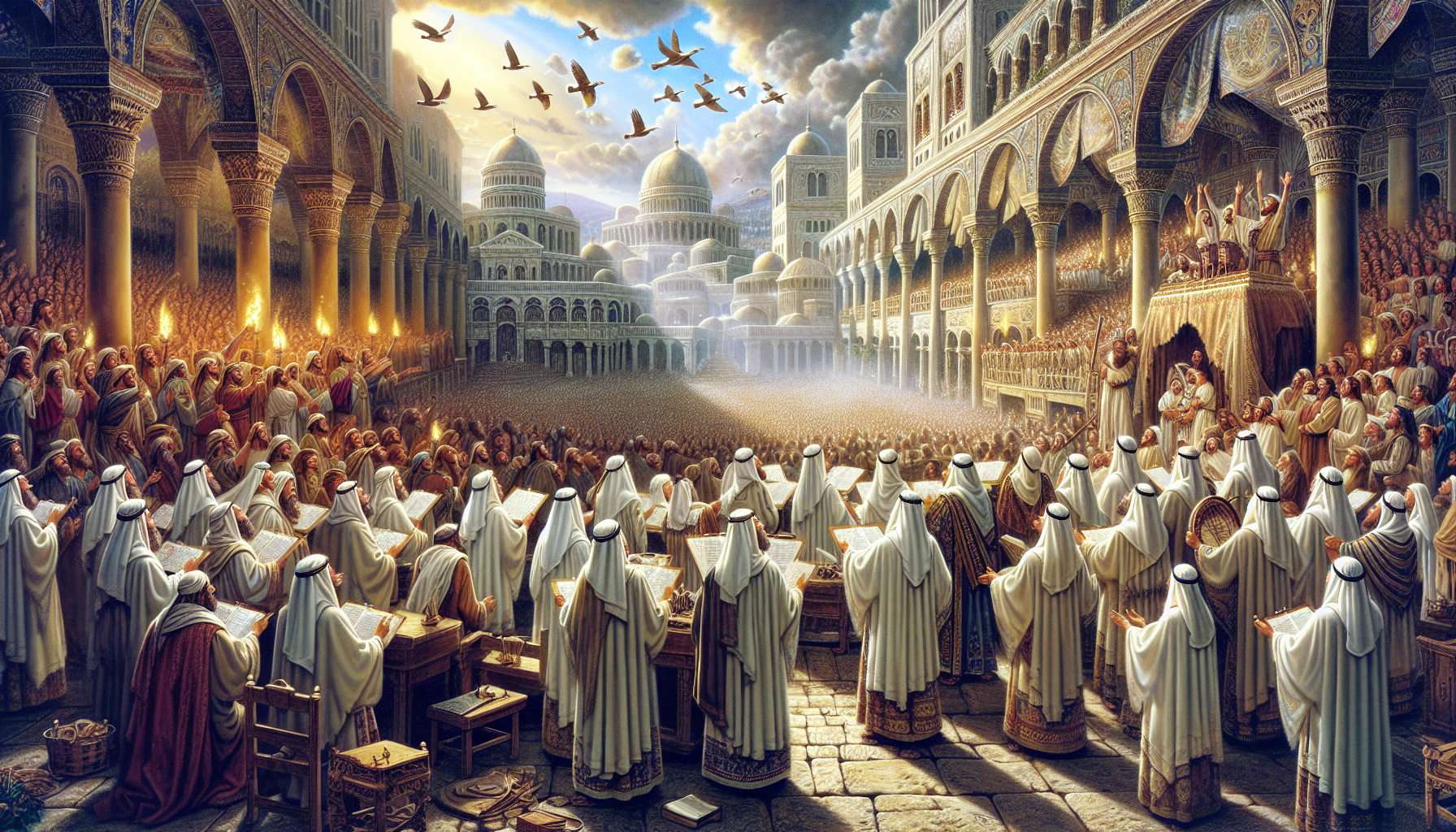
In the days when King David ruled over Israel with a heart full of praise, the people of God gathered in Jerusalem to celebrate the majesty of the Lord. The air was thick with the scent of burning incense, and the sound of harps and lyres filled the courts of the tabernacle. The Levites stood in their white robes, their voices rising in harmony as they sang a new song—a song not born of human wisdom but inspired by the Spirit of the Almighty.
*"Oh, sing to the Lord a new song! Sing to the Lord, all the earth!"*
The words of the psalmist echoed through the streets, reaching even the shepherds in the distant hills, who paused in their labor to lift their eyes toward Zion. The earth itself seemed to tremble with the weight of the proclamation. The cedars of Lebanon swayed as if in worship, and the waves of the Great Sea roared in response. For the Lord was not a god confined to stone and wood, nor was He like the idols of the nations—silent and powerless. No, the Lord was the Maker of heaven and earth, the One who spoke and worlds came into being.
*"Declare His glory among the nations, His wonders among all peoples!"*
A merchant from Tyre, passing through Jerusalem with his caravan of spices, heard the song and stopped in wonder. He had heard tales of Israel’s God, but now he beheld the living faith of His people. The Levites did not sing for themselves alone—they sang for all nations, for every tribe and tongue. The merchant bowed his head, his heart stirring with a strange longing. Could it be that this God was the true God, the one his own ancestors had sought in vain?
Meanwhile, in the courts of the tabernacle, the priests raised their hands, their voices growing louder.
*"For the Lord is great and greatly to be praised; He is to be feared above all gods!"*
The idols of the Philistines, the golden calves of the neighboring kingdoms—they were nothing but the work of men’s hands. They could not see, nor hear, nor breathe. But the Lord? He rode upon the clouds. He commanded the dawn and painted the sky with stars. The nations would one day see—they would all come to know that He alone was God.
As the song continued, a hush fell over the assembly. The psalmist’s voice rose in triumphant declaration:
*"Let the heavens rejoice, and let the earth be glad; let the sea roar, and all its fullness!"*
And as if in answer, thunder rolled in the distance. The ground beneath their feet seemed to hum with divine energy. The people fell to their knees, their faces to the ground, for they felt the presence of the Holy One among them. Even the animals in the fields ceased their grazing, their heads lifting as though sensing something beyond human understanding.
*"He is coming,"* whispered an old prophet in the crowd, his eyes alight with vision. *"He is coming to judge the earth with righteousness, and the peoples with His truth."*
The song ended, but the echo of it lingered in the hearts of all who heard. That day, Jerusalem was not just a city of stone and mortar—it was a beacon of divine truth, a foretaste of the day when every knee would bow and every tongue confess that the Lord reigns.
And so the people departed, carrying the song with them—into their homes, into the marketplace, into the farthest corners of the earth. For the Lord had put a new song in their mouths, a hymn of praise that would resound through the ages, until the whole creation itself would sing in one glorious chorus:
*"The Lord reigns! Let the earth rejoice!"*