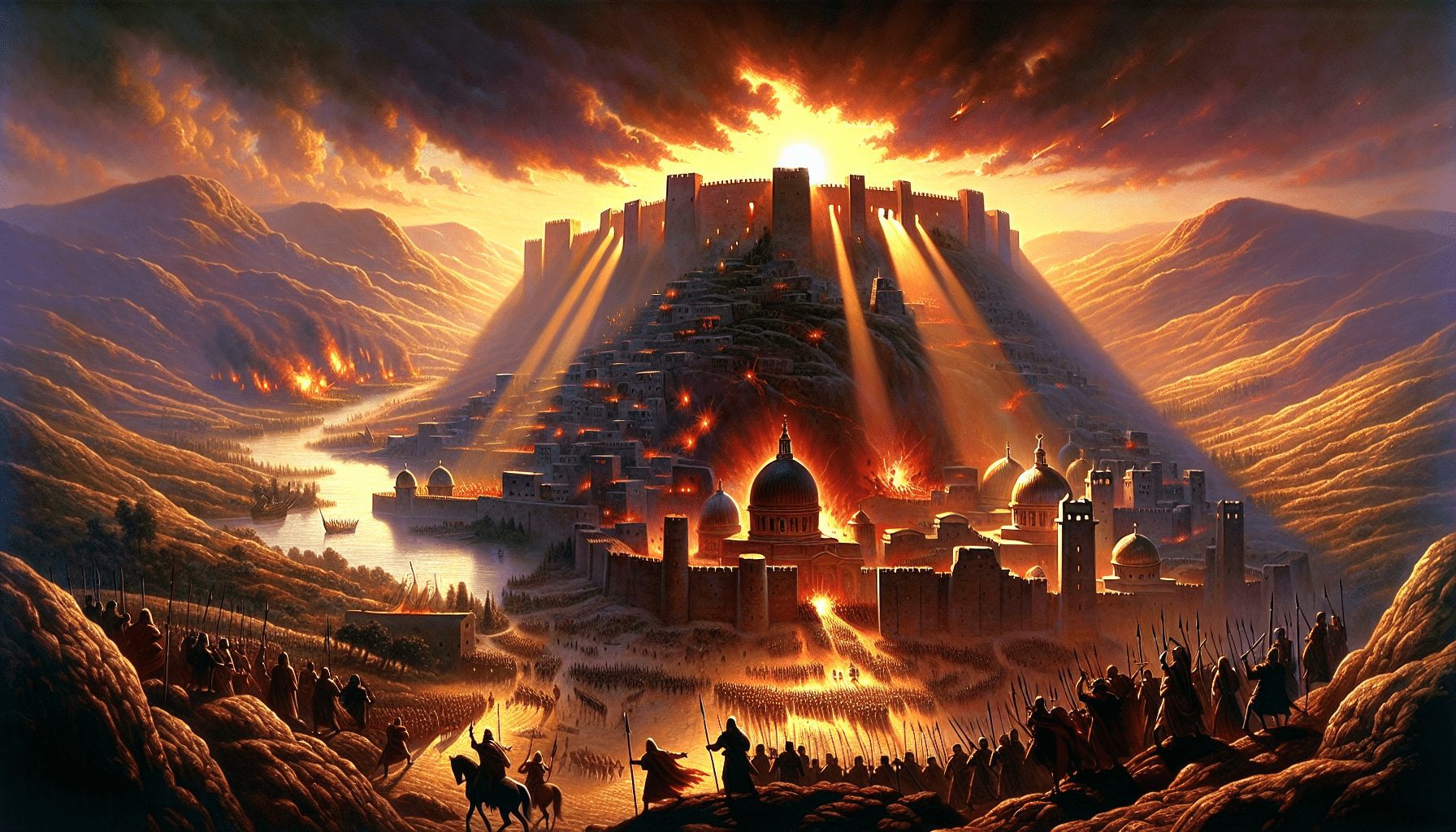
The chapter opens with a blunt announcement: a day of the Lord is coming, and the spoil of Jerusalem will be divided right inside the city. This is not a distant warning. The Lord himself says he will gather all nations against Jerusalem for battle. The city will be taken, houses rifled, women ravished, and half the population will go into captivity. But a residue will remain, not cut off from the city entirely. The siege is total, and the defeat looks final.
Then the Lord goes forth to fight against those nations, as he fought in the day of battle. The comparison is not elaborated—no specific past battle is named—but the point is clear: the Lord knows how to fight, and he will do it again. His feet stand that day on the Mount of Olives, east of Jerusalem. The mountain splits in two, cleft east to west, forming a very great valley. Half the mountain shifts north, half south. The geography of the region is violently remade at the Lord’s arrival.
The people flee through that valley, which reaches to Azel. They flee as they fled from the earthquake in the days of Uzziah king of Judah. And then the Lord comes, and all the holy ones with him. The flight is not a rout of the enemy but a retreat of the city’s inhabitants before the Lord’s appearing. The day itself is strange: no light, the bright ones withdraw. It is one day known only to the Lord, neither day nor night, but at evening time there will be light.
Living waters flow out from Jerusalem in that day. Half go toward the eastern sea, half toward the western sea. The flow does not stop for summer or winter. This is not a seasonal stream but a permanent, life-giving current issuing from the city. The land is transformed from a place of siege and captivity into a source of water that reaches both seas.
The Lord becomes King over all the earth. On that day, the Lord is one, and his name is one. The fractured worship of many gods and many nations ends. The whole earth acknowledges a single king and a single name. The land itself is flattened like the Arabah, from Geba to Rimmon south of Jerusalem. Jerusalem is lifted up and dwells in her place, defined by specific gates and towers: Benjamin’s gate, the first gate, the corner gate, the tower of Hananel, the king’s wine-presses. The city is no longer vulnerable.
Men dwell in Jerusalem, and there is no more curse. The city dwells safely. The curse that had hung over the land from earlier covenants is lifted. Safety is not military vigilance but the direct result of the Lord’s presence and kingship.
The Lord smites the nations that warred against Jerusalem with a specific plague. Their flesh consumes away while they stand on their feet. Their eyes consume away in their sockets. Their tongue consumes away in their mouth. It is a rotting from within, a dissolution that happens while they are still standing. A great tumult from the Lord seizes them: each man grabs his neighbor’s hand, and his hand rises against his neighbor. They turn on each other in panic. Judah also fights at Jerusalem, and the wealth of all the surrounding nations—gold, silver, and apparel in great abundance—is gathered together. Even the beasts of the camps—horses, mules, camels, donkeys—are struck with the same plague.
But not all nations are destroyed. Every one left of the nations that came against Jerusalem will go up year after year to worship the King, the Lord of hosts, and to keep the Feast of Tabernacles. If any family of the earth does not go up to Jerusalem to worship, they receive no rain. Egypt is singled out: if they do not go up, they get the plague that the Lord uses to smite the nations that refuse to keep the Feast of Tabernacles. This is the punishment of Egypt and of all nations that do not go up.
On that day, even the bells of the horses are inscribed with “HOLY UNTO THE LORD.” The pots in the Lord’s house become like the bowls before the altar. Every pot in Jerusalem and in Judah is holy to the Lord of hosts. Those who sacrifice come and take those pots and boil the meat in them. And in that day, there is no longer a Canaanite in the house of the Lord of hosts. The final line does not explain who the Canaanite is or why he is removed—it simply states the fact. The house of the Lord is purified from any foreign presence, and everything, even the common cooking pot, is set apart for the Lord.