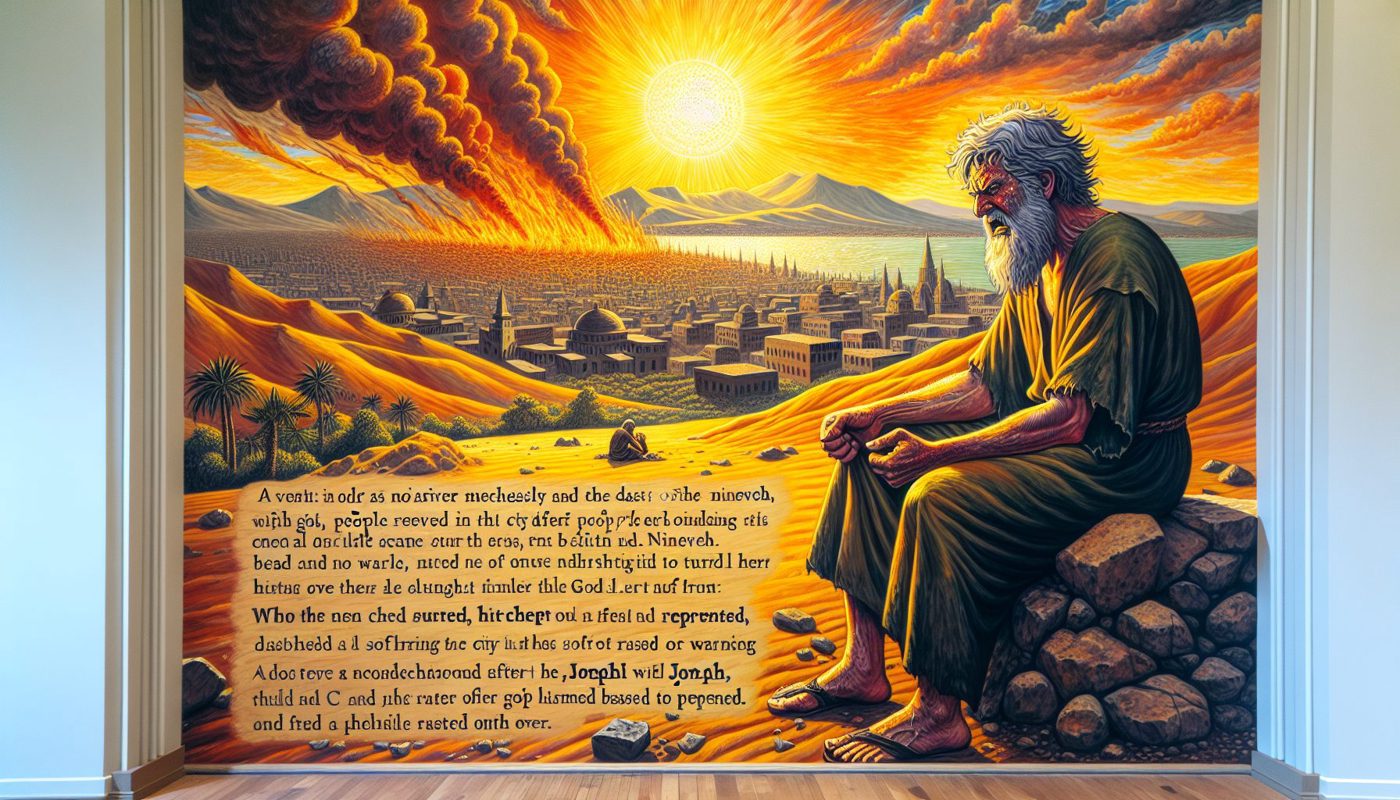
The chapter opens not with a city in ruins but with a prophet in a rage. Jonah is angry, and the text does not soften it. It says his displeasure was extreme. He had preached destruction to Nineveh, the people had repented, and God had relented. Jonah wanted none of it.
He prays, but it is not a prayer of thanksgiving. It is an accusation. He tells the Lord that this is exactly why he fled to Tarshish in the first place. He knew God was gracious, merciful, slow to anger, abundant in lovingkindness, and ready to relent from sending calamity. Jonah says these attributes as if they are a grievance.
Then he asks to die. He says it is better for him to die than to live. His own prophetic word had been overturned by mercy, and he cannot bear it. The Lord responds with a single question: Do you do well to be angry? Jonah does not answer.
He leaves the city and sits on the east side, on a hillside. He builds a crude booth of branches and sits in its shade, waiting to see what will become of Nineveh. He still hopes, apparently, that the judgment might yet fall.
The Lord then prepares a plant—a gourd—to grow up over Jonah and give him extra shade from the sun. The text says it was to deliver him from his evil case, meaning his discomfort or distress. Jonah becomes exceedingly glad because of the plant.
But the next morning, God prepares a worm. It attacks the gourd, and the plant withers. Then God prepares a sultry east wind, and the sun beats on Jonah's head until he faints. Again he wishes to die, saying it is better for him to die than to live.
God asks again: Do you do well to be angry over the gourd? Jonah answers this time. He says he does well to be angry—angry enough to die. He is stubborn in his resentment, even over a plant.
The Lord draws the comparison directly. Jonah had pity on a gourd he did not plant, did not make grow, which came up in a night and perished in a night. Should the Lord not have pity on Nineveh, that great city, with more than 120,000 people who cannot tell their right hand from their left—and also much cattle?
The chapter ends there. There is no reply from Jonah, no resolution, no happy ending. The question hangs over the hillside. The reader is left to sit with it.
The story never says Jonah changed his mind. It does not say he learned his lesson. What it does is expose the raw edge of human resentment against divine mercy, and it lets the Lord have the last word.
Comments
Comments 0
Read the discussion and add your voice.
Members only
Sign in to join the conversation
We keep comments tied to real accounts so the discussion stays clean and trustworthy.
No comments yet. Be the first to add one.