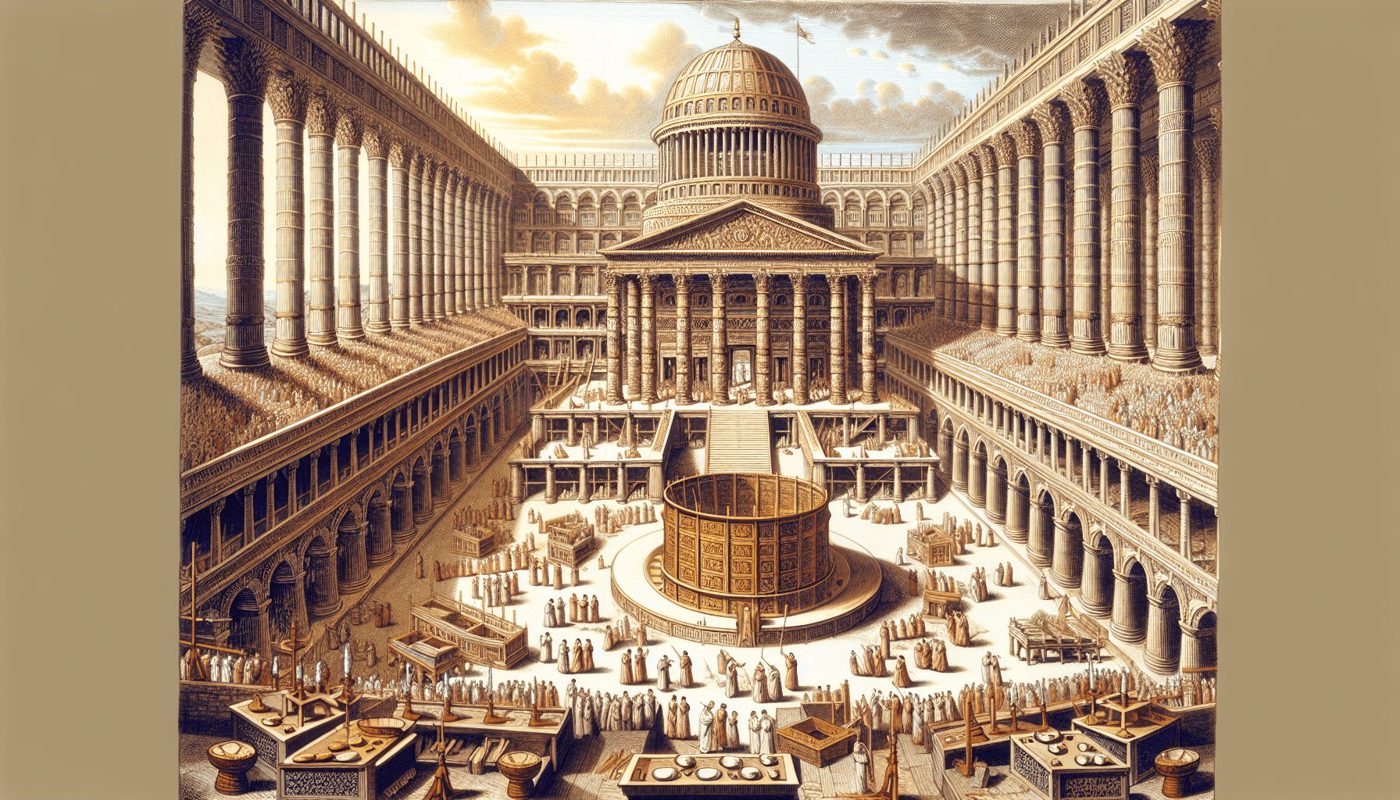
The fourth chapter of 2 Chronicles does not pause to admire the Temple's beauty. It moves through a precise inventory of what was made, how it was shaped, and where it was placed. The altar of brass stood first: twenty cubits long, twenty wide, ten high. That was not a decoration. It was the working surface of atonement, and its size meant the priests could not miss it.
Then came the molten sea. Ten cubits from brim to brim, round, thirty cubits around. It sat on twelve oxen cast in bronze, three facing each direction. The oxen were not ornamental in the modern sense. They carried the basin, and their hind parts faced inward. The brim was shaped like the lip of a cup, like a lily in flower. It held three thousand baths of water. That water was for the priests to wash in, not for spectacle.
Ten smaller lavers of bronze were made, five on the right and five on the left. Those were for washing the burnt offerings. The great sea was for the priests themselves. The chapter does not explain why the distinction mattered. It simply records that the division existed, and the priests worked accordingly.
Inside the house itself, Solomon placed ten golden lampstands, five on each side, made according to the ordinance. Ten tables also, five on each side, and a hundred basins of gold. The gold was not a flourish. It was the material prescribed for the furniture that stood before the Lord.
Huram the craftsman finished the work. He made the pots, the shovels, the basins. He made the two pillars, the bowls on top, the networks of pomegranates—four hundred pomegranates for the two networks, two rows per network. He made the bases and the lavers that sat on them. He made the flesh-hooks and all the vessels of bright brass.
The casting was done in the plain of the Jordan, between Succoth and Zeredah, in clay ground. That detail is not atmospheric. It tells where the metal was poured. The brass was so abundant that its weight could not be calculated. The chapter does not celebrate that fact. It simply states it.
Solomon made all the vessels for the house of God: the golden altar, the tables for the showbread, the lampstands with their lamps of pure gold, the flowers, the tongs, the snuffers, the basins, the spoons, the firepans. All of it gold, and perfect gold.
The inner doors for the most holy place and the doors of the temple itself were gold. The chapter ends there, without summary or sermon. The inventory is the point. Every piece had its place, its material, its function. The house of the Lord was not built on vague reverence. It was built on specific obedience, measured in cubits and weighed in gold.
Comments
Comments 0
Read the discussion and add your voice.
Members only
Sign in to join the conversation
We keep comments tied to real accounts so the discussion stays clean and trustworthy.
No comments yet. Be the first to add one.