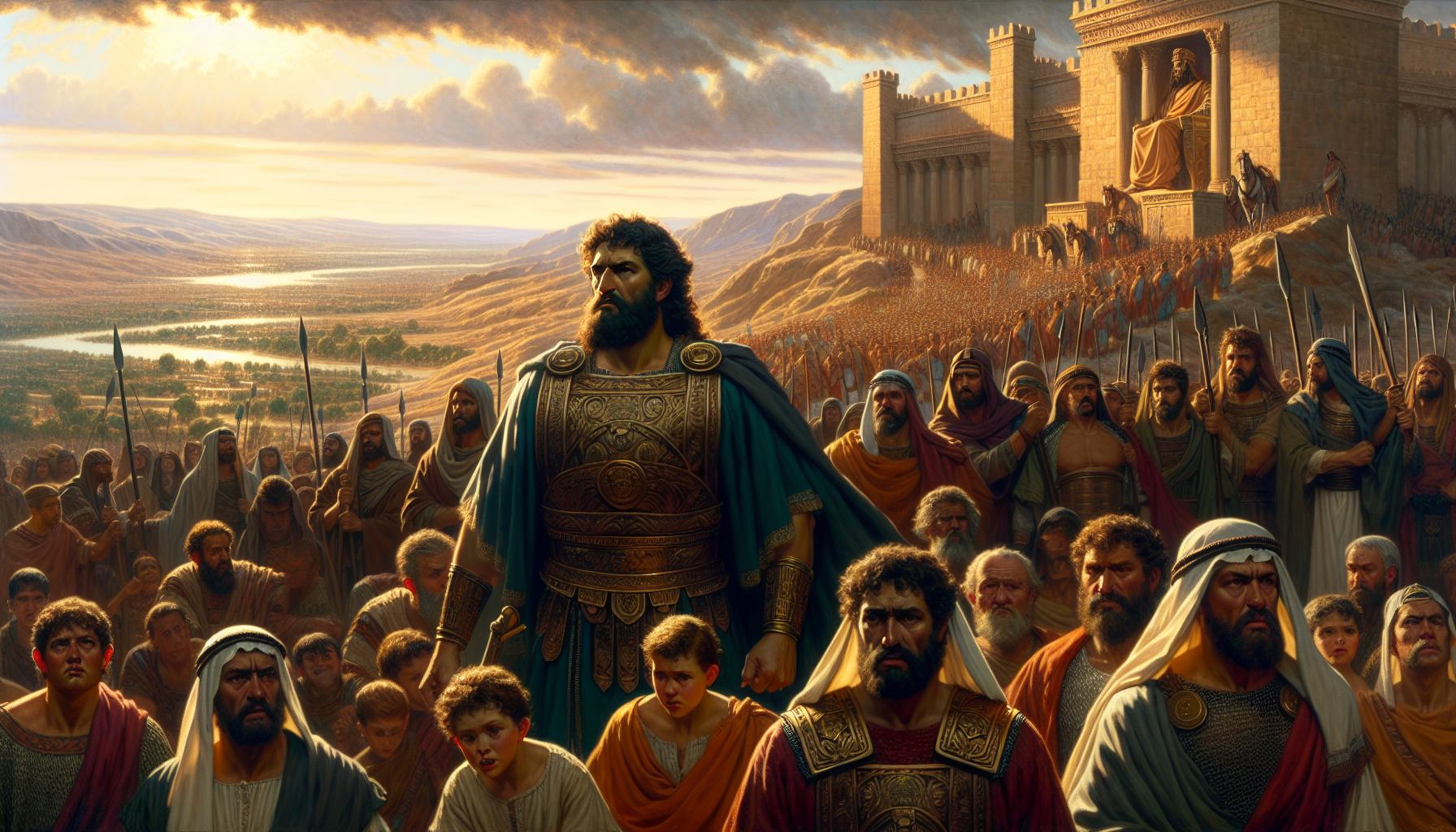
The chapter opens without ceremony. After the establishment of his throne in Jerusalem, David struck the Philistines and subdued them. He took the bridle of the mother city out of their hand. The phrase is compact and final: the Philistines, who had troubled Israel for generations, were no longer a threat to David's rule.
Next came Moab. David measured them with a line, making them lie down on the ground. Two lines he measured for death, one full line to keep alive. The Moabites became servants to David and brought tribute. The text does not explain why David killed two-thirds of the captives; it simply records that he did, and that the survivors served him.
David also struck Hadadezer son of Rehob, king of Zobah, as Hadadezer went to recover his dominion at the River. David took from him seventeen hundred horsemen and twenty thousand footmen. He hamstrung all the chariot horses except enough for a hundred chariots. The action was deliberate: David did not build a chariot force; he limited it.
When the Syrians of Damascus came to help Hadadezer, David struck down twenty-two thousand of them. He then placed garrisons in Syria of Damascus, and the Syrians became his servants and brought tribute. The refrain appears: the Lord gave victory to David wherever he went.
David took the shields of gold that belonged to Hadadezer's servants and brought them to Jerusalem. From Betah and Berothai, cities of Hadadezer, he took a great quantity of bronze. These were not mere spoils; they would later be dedicated to the Lord.
Toi, king of Hamath, heard that David had defeated the entire army of Hadadezer. Toi sent his son Joram to David to greet him and bless him, because Hadadezer had been at war with Toi. Joram brought vessels of silver, gold, and bronze. David dedicated these as well to the Lord, along with the silver and gold he had taken from Syria, Moab, Ammon, Philistia, Amalek, and the spoil of Hadadezer.
David made a name for himself when he returned from striking down eighteen thousand Syrians in the Valley of Salt. He placed garrisons in Edom; all Edom became his servants. Again the text repeats: the Lord gave victory to David wherever he went.
The chapter then shifts from war to administration. David reigned over all Israel and executed justice and righteousness for all his people. His officials are listed: Joab over the army, Jehoshaphat as recorder, Zadok and Ahimelech as priests, Seraiah as scribe, Benaiah over the Cherethites and Pelethites, and David's sons as chief ministers.
The list of officials grounds the military victories in a functioning kingdom. David did not only conquer; he governed. The chapter ends not with a battle but with a court: priests, scribes, and a king who ruled with justice.