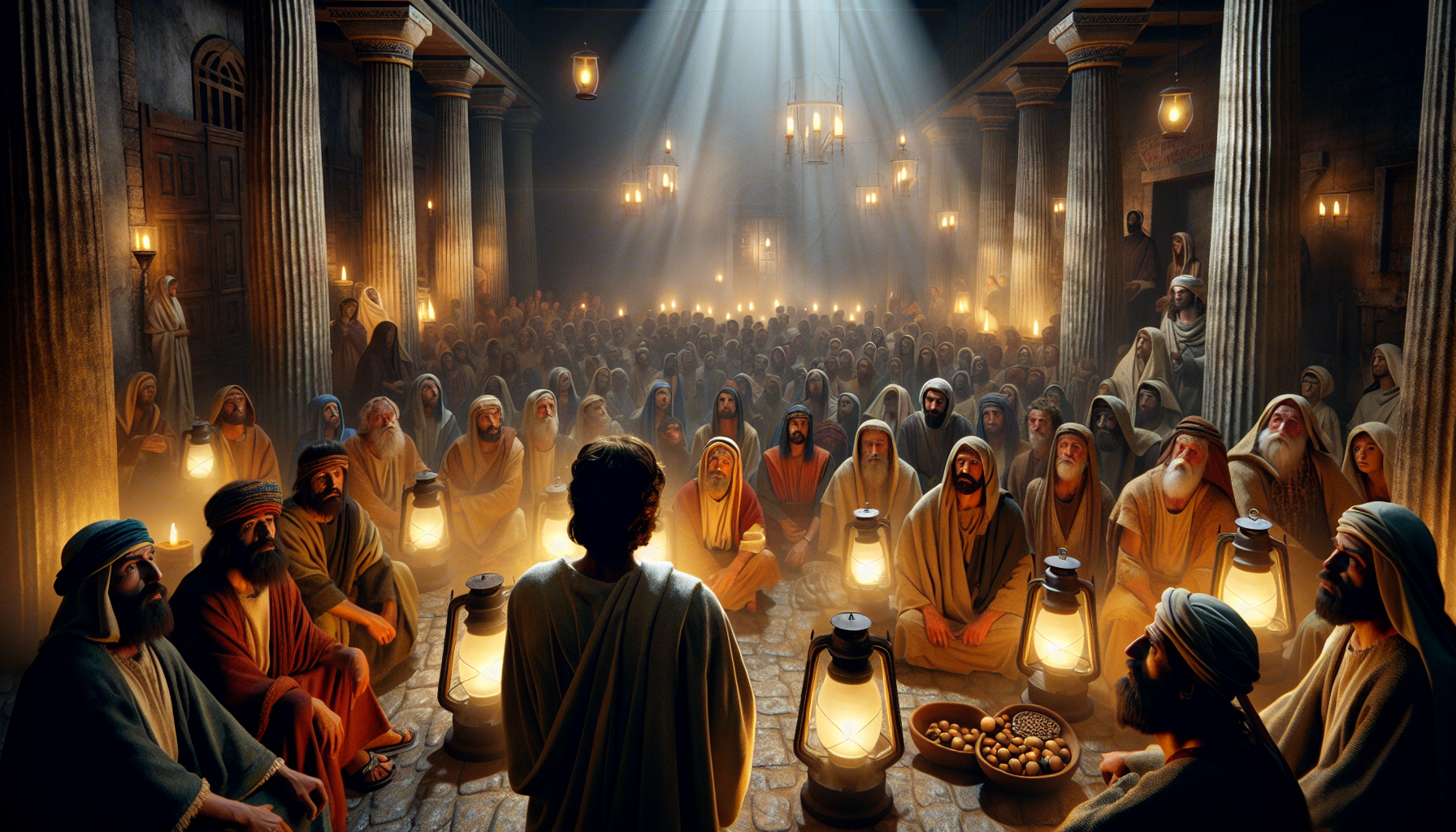
Paul did not arrive in Corinth as a spectacle. He came without polished speeches, without the kind of rhetorical performance that drew crowds in the lecture halls of the empire. He says it plainly: not with excellency of speech or wisdom, but with the testimony of God. That was his opening posture, and he means it as a deliberate choice, not a failure of skill.
He had resolved on a single point of knowledge while among them: Jesus Christ, and Him crucified. That was the whole of his curriculum. Not a mystical system, not a philosophical synthesis, not a set of moral maxims detached from a person. The crucifixion of the Lord of glory was the center, and Paul refused to orbit anything else.
He describes his own presence among them in terms that no ambitious speaker would volunteer: weakness, fear, much trembling. This is not the confidence of a traveling sage. It is the admission of a man who knows that the weight of what he carries cannot be carried by human force. The message itself had to do the work.
His speech and his preaching, he says, were not in persuasive words of wisdom. That is a direct refusal of the methods that made speakers famous in Corinth. Paul did not compete on their terms. He relied instead on a demonstration of the Spirit and of power. The proof was not in the argument but in the effect.
The purpose was clear: that the faith of the Corinthians should not rest on the wisdom of men, but on the power of God. If Paul had won them by eloquence, their faith would have been anchored in the wrong substance. He wanted the foundation to be divine, not human.
Yet Paul does not reject wisdom itself. He speaks wisdom among those who are mature, but it is not the wisdom of this age or of its rulers, who are passing away. He identifies a different kind of wisdom: God's wisdom in a mystery, hidden, foreordained before the ages for the glory of those who belong to Him. This wisdom was not accessible by human inquiry.
The rulers of this age did not know it. If they had, Paul says, they would not have crucified the Lord of glory. Their ignorance was not innocent; it was the blindness of a wisdom that refused to submit to God. The crucifixion itself exposed the limits of their understanding.
What God has prepared for those who love Him is beyond the reach of the senses. No eye has seen it, no ear has heard it, no human heart has conceived it. But Paul does not leave that as a distant promise. He says that God has revealed it to us through the Spirit. The Spirit searches all things, even the deep things of God.
Paul draws a comparison from ordinary human life. No one knows the thoughts of a man except the man's own spirit. In the same way, no one knows the thoughts of God except the Spirit of God. The Corinthians did not receive the spirit of the world, but the Spirit who is from God, so that they might understand the things freely given to them by God.
This is not a matter of human teaching. Paul says he speaks these things in words taught by the Spirit, combining spiritual truths with spiritual words. The natural man does not accept the things of the Spirit of God. They are foolishness to him, and he cannot understand them because they are spiritually discerned.
The spiritual man, by contrast, judges all things, yet he himself is not subject to judgment by any mere human standard. Paul closes with a question from Scripture: Who has known the mind of the Lord so as to instruct Him? The answer is that no one has. But then he adds the astonishing claim: We have the mind of Christ.