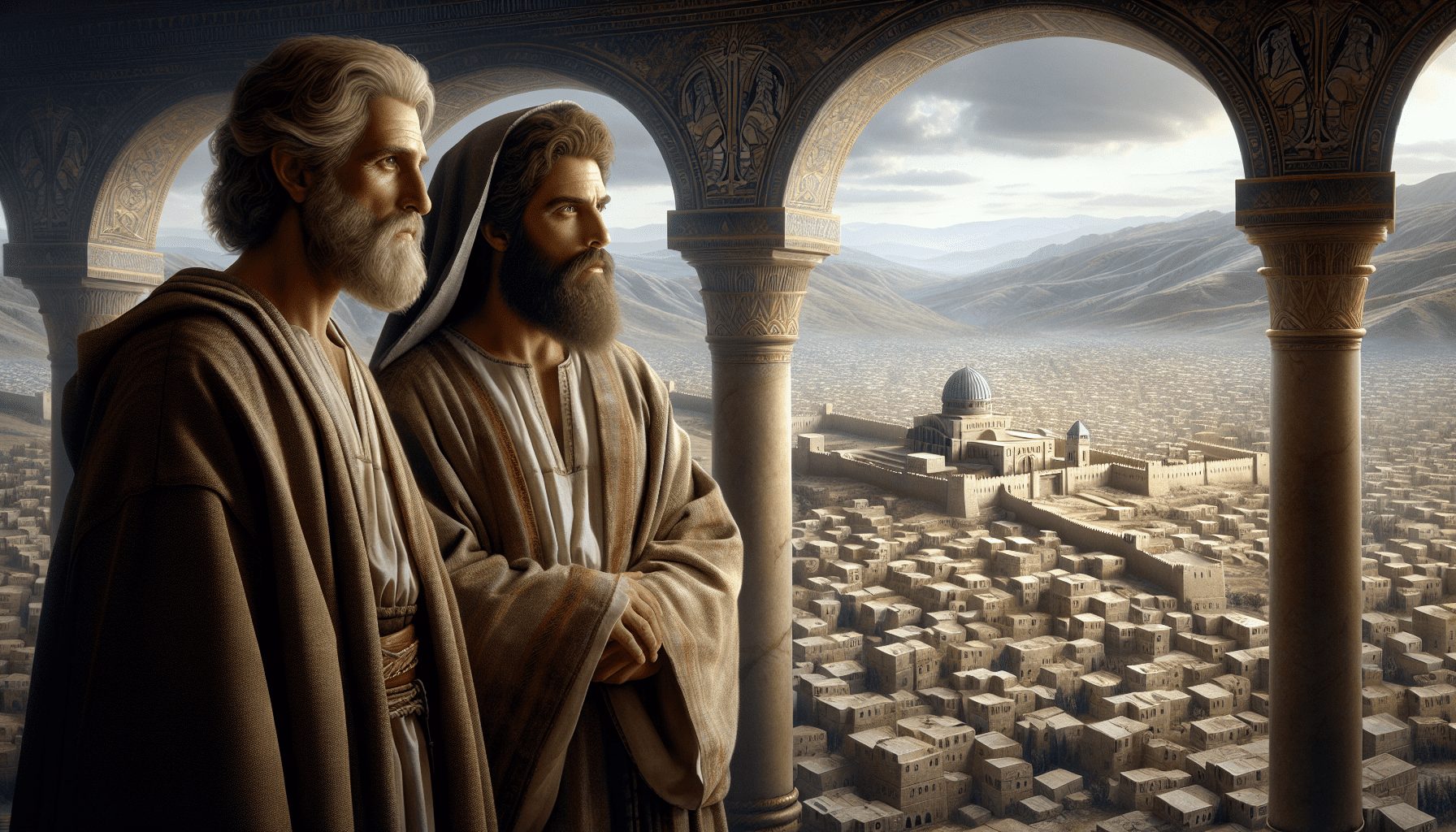
When the seventh month came, the people of Jerusalem gathered as one in the broad place before the Water Gate. They did not come for a festival or a sacrifice. They came to hear the law. They asked Ezra the scribe to bring the book of the law of Moses, which the Lord had commanded Israel. And Ezra, who was also a priest, brought it before the assembly—men, women, and all who could hear with understanding.
Ezra stood on a wooden pulpit built for the occasion. On his right stood Mattithiah, Shema, Anaiah, Uriah, Hilkiah, and Maaseiah. On his left stood Pedaiah, Mishael, Malchijah, Hashum, Hashbaddanah, Zechariah, and Meshullam. When Ezra opened the book in the sight of all the people, the entire assembly stood up. He blessed the Lord, the great God, and all the people answered, “Amen, Amen,” lifting up their hands. Then they bowed their heads and worshiped the Lord with their faces to the ground.
From early morning until midday, Ezra read from the law. The people listened attentively. The Levites—Jeshua, Bani, Sherebiah, Jamin, Akkub, Shabbethai, Hodiah, Maaseiah, Kelita, Azariah, Jozabad, Hanan, and Pelaiah—helped the people understand the reading. They read distinctly and gave the sense, so that the people understood what was read.
As the words of the law sank in, the people began to weep. They heard the commands they had neglected, the covenant they had broken, and the holiness they had ignored. But Nehemiah the governor, Ezra the priest and scribe, and the Levites who taught the people said to them, “This day is holy to the Lord your God; do not mourn or weep.”
Then Nehemiah said, “Go your way, eat the fat, drink the sweet, and send portions to those who have nothing prepared. Do not be grieved, for the joy of the Lord is your strength.” The Levites quieted the people, telling them again that the day was holy and they should not grieve.
So the people went away to eat and drink, to send portions, and to make great mirth. They rejoiced because they had understood the words that were declared to them. The weeping turned to celebration, not because the law was easy, but because they had heard it clearly and knew what the Lord required.
On the second day, the heads of fathers’ houses, the priests, and the Levites gathered again to Ezra to give attention to the words of the law. As they studied, they found written that the Lord had commanded through Moses that the children of Israel should dwell in booths during the feast of the seventh month. They were to proclaim in all their cities and in Jerusalem that the people should go to the hill country and bring olive branches, wild olive branches, myrtle branches, palm branches, and branches of thick trees to make booths.
The people went out, brought branches, and made booths on their roofs, in their courtyards, in the courts of the house of God, in the broad place of the Water Gate, and in the broad place of the Gate of Ephraim. All the assembly of those who had returned from captivity made booths and lived in them. Since the days of Joshua son of Nun, the children of Israel had not done this. And there was very great gladness.
Day by day, from the first day to the last, Ezra read from the book of the law of God. They kept the feast for seven days, and on the eighth day they held a solemn assembly, according to the ordinance. The law was not merely read; it was heard, understood, and obeyed. The people did not return to their homes unchanged.