Bible Story
Shrewd Manager and Rich Man: Eternal Lessons on Wealth
**The Parable of the Shrewd Manager and the Rich Man and Lazarus** In the days when Jesus walked the earth, He often taught His disciples and the crowds through parables—stories that carried deep spiritual truths. One day, as He sat...
**The Parable of the Shrewd Manager and the Rich Man and Lazarus**
In the days when Jesus walked the earth, He often taught His disciples and the crowds through parables—stories that carried deep spiritual truths. One day, as He sat surrounded by His followers, He began to tell them a story that would challenge their understanding of wealth, responsibility, and eternity.
---
**The Parable of the Shrewd Manager**
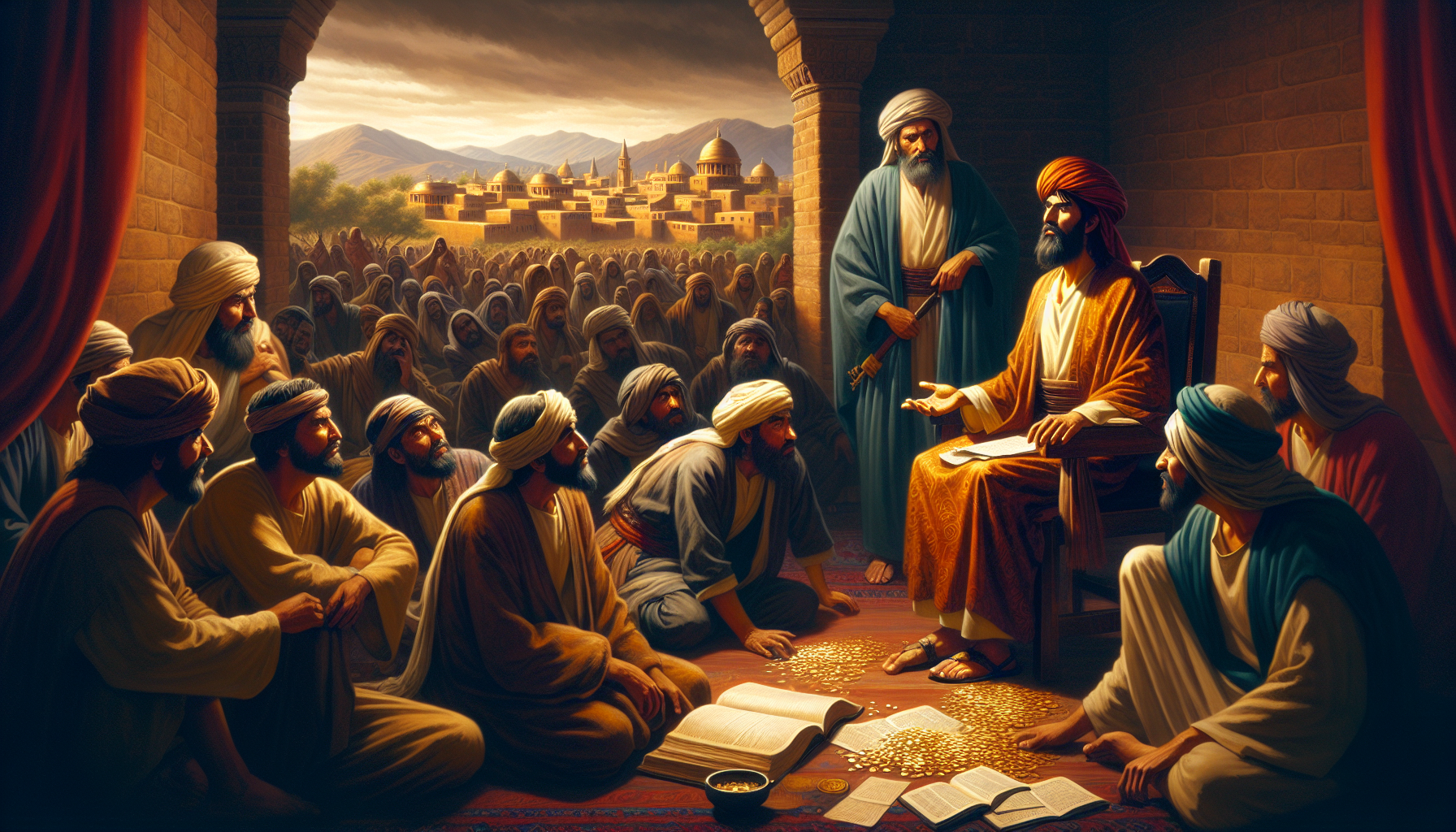
There was a rich man who owned vast estates and employed many servants. Among them was a manager who oversaw his master’s affairs. This manager was entrusted with great responsibility, but over time, he grew careless and wasteful. Word of his mismanagement reached the rich man, who summoned him and said, “What is this I hear about you? Give me an account of your management, for you can no longer be my steward.”
The manager was filled with dread. He thought to himself, *What shall I do now? My master is taking away my position. I am not strong enough to dig, and I am too ashamed to beg.* Then an idea came to him—a plan to secure his future. He called in each of his master’s debtors and spoke to them privately.
To the first, he asked, “How much do you owe my master?” The man replied, “A hundred measures of olive oil.” The manager said, “Take your bill, sit down quickly, and write fifty.” To another, he asked, “And how much do you owe?” The man answered, “A hundred measures of wheat.” The manager said, “Take your bill and write eighty.”
By reducing their debts, the manager ensured that these debtors would look favorably upon him. When the rich man discovered what had happened, he was astonished. Though the manager had acted dishonestly, the master commended him for his shrewdness. “For the people of this world,” Jesus explained, “are more shrewd in dealing with their own kind than are the people of the light.”
Jesus continued, “I tell you, use worldly wealth to gain friends for yourselves, so that when it is gone, you will be welcomed into eternal dwellings. Whoever can be trusted with very little can also be trusted with much, and whoever is dishonest with very little will also be dishonest with much. So if you have not been trustworthy in handling worldly wealth, who will trust you with true riches? And if you have not been trustworthy with someone else’s property, who will give you property of your own?”
He concluded, “No servant can serve two masters. Either he will hate the one and love the other, or he will be devoted to the one and despise the other. You cannot serve both God and money.”
---
**The Rich Man and Lazarus**
As the crowd listened intently, Jesus told them another story, one that revealed the eternal consequences of how we live our lives.
There was a rich man who lived in luxury every day. He wore fine linen and purple garments, the clothing of kings, and feasted sumptuously on the finest foods. At his gate lay a poor man named Lazarus, covered with sores and longing to eat even the crumbs that fell from the rich man’s table. Dogs came and licked his wounds, but no one showed him mercy.
In time, both men died. Lazarus was carried by the angels to Abraham’s side, a place of comfort and peace. The rich man, however, was buried and found himself in torment in Hades. He looked up and saw Abraham far away, with Lazarus by his side. In anguish, he cried out, “Father Abraham, have pity on me! Send Lazarus to dip the tip of his finger in water and cool my tongue, for I am in agony in this fire.”
But Abraham replied, “Son, remember that in your lifetime you received your good things, while Lazarus received bad things. But now he is comforted here, and you are in agony. And besides all this, a great chasm has been fixed between us and you, so that those who want to go from here to you cannot, nor can anyone cross over from there to us.”
The rich man pleaded, “Then I beg you, Father Abraham, send Lazarus to my father’s house, for I have five brothers. Let him warn them, so that they will not also come to this place of torment.”
Abraham answered, “They have Moses and the Prophets; let them listen to them.”
“No, Father Abraham,” the rich man insisted, “but if someone from the dead goes to them, they will repent.”
Abraham said to him, “If they do not listen to Moses and the Prophets, they will not be convinced even if someone rises from the dead.”
---
**The Lesson of the Stories**
Jesus’ words hung in the air, heavy with meaning. The stories were not merely about wealth and poverty but about the heart’s posture toward God and others. The shrewd manager, though dishonest, had used his resources to secure his future. Jesus urged His listeners to use their earthly wealth for eternal purposes, to be faithful stewards of what God had entrusted to them.
The story of the rich man and Lazarus revealed the eternal consequences of neglecting the poor and living for self. The rich man had ignored Lazarus in life, and in death, he found himself separated from God’s presence. His plea for his brothers showed a glimmer of concern, but Abraham’s response underscored the sufficiency of God’s Word to lead people to repentance.
As the crowd dispersed, many were left pondering Jesus’ words. They understood that wealth was not evil in itself, but it could become a snare if it took the place of God in their hearts. They were reminded that true riches were found in faithfulness to God and compassion for others.
And so, Jesus’ teachings echoed through the hearts of His listeners, calling them to live not for the fleeting pleasures of this world but for the eternal joy of the kingdom of God.