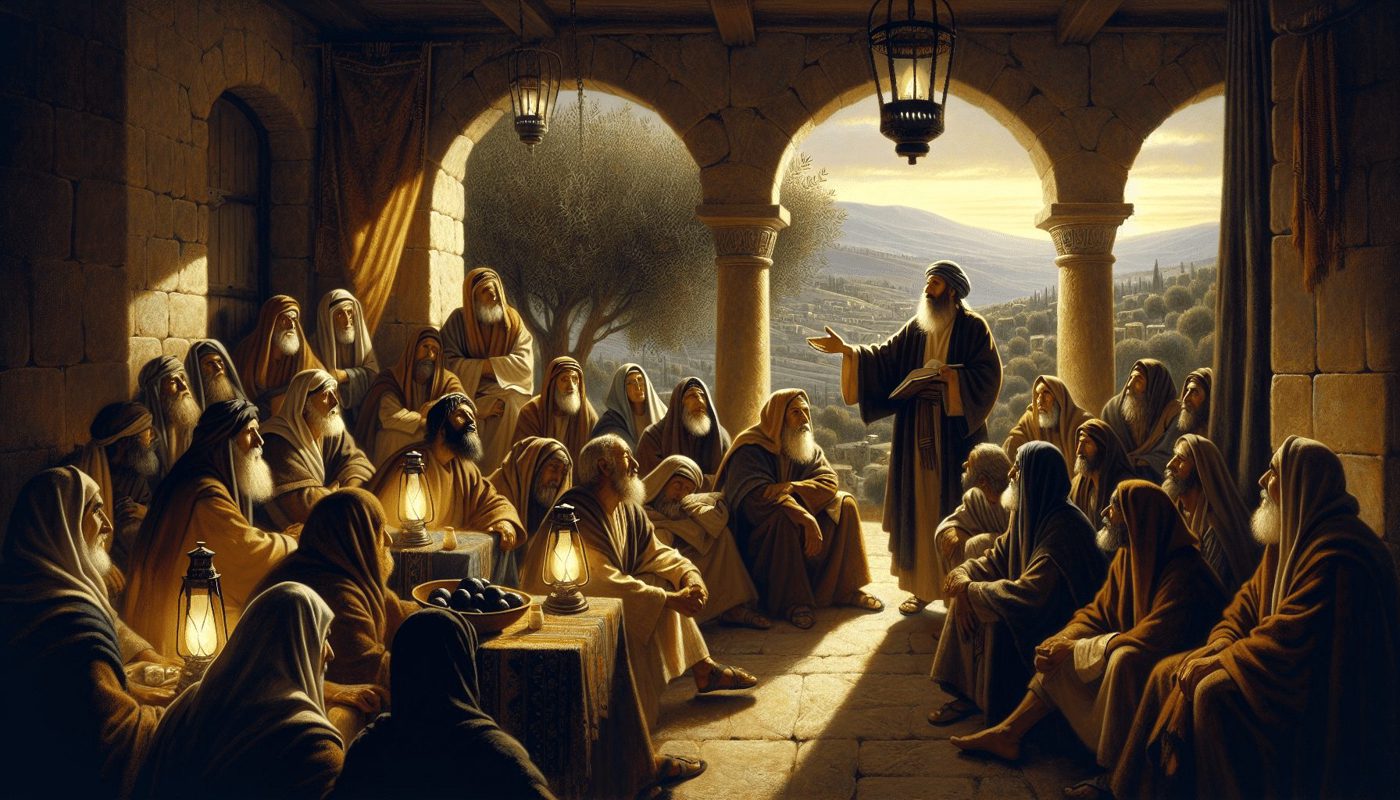
Peter writes his second letter to the same believers he addressed before, and he says plainly that his purpose is to stir up their sincere mind by way of reminder. He does not claim to bring new revelation. He calls them to remember the words spoken by the holy prophets and the commandment of the Lord and Savior delivered through the apostles. The foundation is already laid; the danger is that they will let it slip.
The specific threat Peter names is mockery. In the last days, he says, mockers will come, walking after their own lusts. Their mockery has a fixed form: they ask, “Where is the promise of his coming?” They point out that since the fathers fell asleep, everything continues exactly as it has from the beginning of creation. The delay, they imply, proves the promise empty.
Peter answers that these mockers willfully forget something. They ignore that the heavens existed long ago and that the earth was formed out of water and through water by the word of God. That same word brought the flood, and the world that then existed perished. The present heavens and earth, Peter writes, are stored up for fire, reserved for the day of judgment and destruction of ungodly men. The mockers are not clever skeptics; they are people who refuse to remember what the word of God has already done.
Peter then gives the believers a different way to measure time. One day with the Lord is as a thousand years, and a thousand years as one day. The Lord is not slow in keeping his promise, as some count slowness. He is patient, not wanting any to perish but all to come to repentance. The delay is not failure; it is mercy.
But the day of the Lord will come. Peter describes it with concrete terms: it will come like a thief. The heavens will pass away with a great noise. The elements will be dissolved with fervent heat. The earth and everything made on it will be burned up. There is no vague spiritualizing here. Peter means a real dissolution of the physical order.
He turns the coming destruction into a question of conduct. Seeing that all these things are to be dissolved, what kind of people ought they to be? His answer: holy living and godliness. They are to look for and earnestly desire the coming of the day of God, the day that will set the heavens on fire and melt the elements. The coming judgment is not something to dread for those who belong to the Lord; it is something to long for.
Peter does not leave them with only destruction. He points to a promise: according to his promise, they look for new heavens and a new earth, where righteousness dwells. The burning is not the end. It is the clearing of the ground for something that cannot be corrupted.
Because they look for these things, Peter commands them to give diligence to be found in peace, without spot and blameless in the Lord’s sight. He tells them to count the Lord’s patience as salvation. He then mentions Paul, calling him their beloved brother, and notes that Paul wrote to them about these same matters according to the wisdom given to him. Peter acknowledges that some things in Paul’s letters are hard to understand, and that ignorant and unstable people twist them, as they do the other scriptures, to their own destruction.
Peter closes with a warning and an exhortation. Knowing these things beforehand, they must beware of being carried away by the error of the wicked and falling from their own steadfastness. The alternative is not passive waiting. They are to grow in the grace and knowledge of the Lord and Savior Jesus Christ. Peter gives the glory to him, both now and forever.
Comments
Comments 0
Read the discussion and add your voice.
Members only
Sign in to join the conversation
We keep comments tied to real accounts so the discussion stays clean and trustworthy.
No comments yet. Be the first to add one.