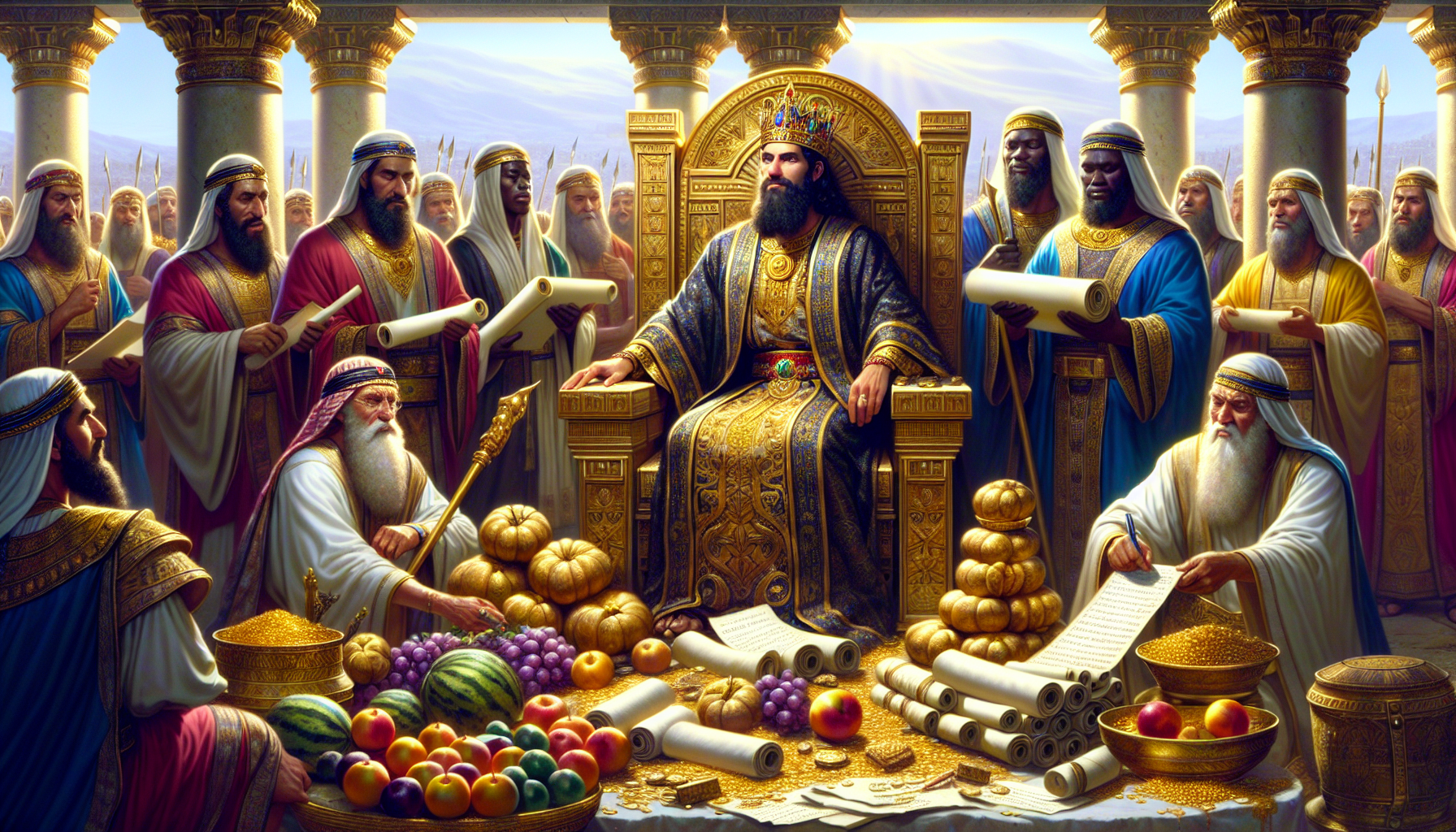
The fourth chapter of 1 Kings does not open with a vision or a prayer. It opens with a list. Solomon was king over all Israel, and the chapter names the men who ran his government: Azariah the son of Zadok as priest, Elihoreph and Ahijah as scribes, Jehoshaphat as recorder, Benaiah over the army, Zadok and Abiathar as priests, Azariah the son of Nathan over the officers, Zabud as chief minister and the king's friend, Ahishar over the household, and Adoniram over the forced labor. These are not ceremonial titles. They are the working machinery of a kingdom that the chapter presents as stable, organized, and fully staffed.
Then the chapter pivots to twelve officers, each responsible for supplying the king's household for one month out of the year. Their names and districts are given in detail: Ben-hur in the hill country of Ephraim, Ben-deker in Makaz and Shaalbim and Beth-shemesh and Elon-beth-hanan, Ben-hesed in Arubboth, Ben-abinadab in the height of Dor, Baana the son of Ahilud in Taanach and Megiddo and Beth-shean, Ben-geber in Ramoth-gilead, Ahinadab in Mahanaim, Ahimaaz in Naphtali, Baana the son of Hushai in Asher and Bealoth, Jehoshaphat in Issachar, Shimei in Benjamin, and Geber in Gilead. The chapter does not explain why each district was drawn that way. It simply records that the system worked.
The chapter also records that two of these officers married Solomon's daughters: Ben-abinadab married Taphath, and Ahimaaz married Basemath. The marriages are stated without commentary. They appear as part of the administrative record, not as a story. The chapter treats them as facts of how the kingdom was held together.
Then the tone shifts. Judah and Israel were as many as the sand by the sea, eating and drinking and making merry. The chapter does not say they were holy or that they kept the law perfectly. It says they were numerous and they feasted. That is the picture: a full land, a full table, and a king whose rule extended from the River to the border of Egypt, with tribute coming in and peace on every side.
The daily provision for Solomon's court is given with specific numbers: thirty measures of fine flour, sixty measures of meal, ten fat oxen, twenty pasture-fed oxen, a hundred sheep, plus deer, gazelles, roebucks, and fattened poultry. The chapter does not moralize about this abundance. It simply records it as the scale of the king's household. The officers supplied it month by month, and nothing was lacking.
Solomon also had forty thousand stalls of horses for his chariots and twelve thousand horsemen. The barley and straw for the horses were brought to the proper places by the same officers, each according to his charge. The chapter does not say whether this was wise or excessive. It reports the numbers as part of the kingdom's operation.
Then the chapter returns to wisdom. God gave Solomon wisdom and understanding in great measure, and a breadth of mind like the sand on the seashore. His wisdom surpassed the wisdom of the east and all the wisdom of Egypt. He was wiser than Ethan the Ezrahite, Heman, Calcol, and Darda. His fame spread through all the surrounding nations.
The chapter specifies what that wisdom produced: three thousand proverbs and one thousand five songs. Solomon spoke about trees, from the cedar of Lebanon to the hyssop growing out of the wall. He spoke about beasts, birds, creeping things, and fish. The chapter does not claim that these works survive or that they were written down in a book that later generations would possess. It simply states that he spoke them.
People came from all nations to hear Solomon's wisdom, including kings of the earth who had heard of it. The chapter does not say that these visitors converted or that they brought lasting alliances. It says they came to hear. The wisdom itself was the draw.
The chapter ends with that note: the fame of Solomon's wisdom had spread, and the world came to listen. The administrative lists, the provisions, the horses, the peace, the proverbs, the songs, the natural knowledge—all of it is presented as the shape of a kingdom that the Lord had blessed with a wise king. The chapter does not argue that this was the highest good. It simply shows what it looked like.