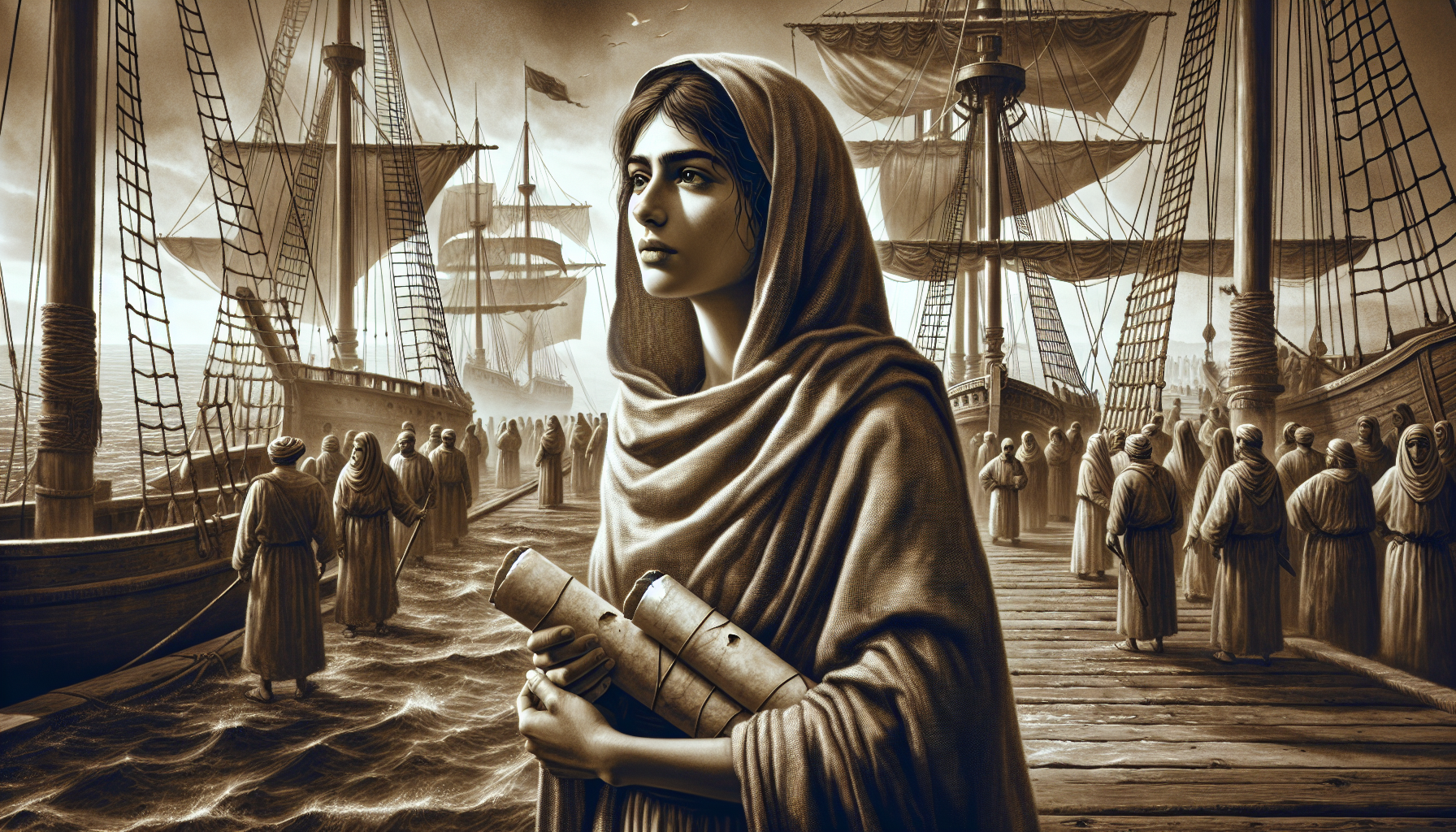
Paul’s final chapter to the Romans does not end with a sermon. It ends with a list. And that list—twenty-six names, a house church, a warning, and a doxology—tells us more about the actual life of the early church than any summary could. The chapter opens with a woman named Phoebe, whom Paul commends to the Roman believers not as a courier but as a servant of the church in Cenchreae. He instructs them to receive her in the Lord, worthily of the saints, and to assist her in whatever matter she may need. The reason is blunt: she herself has been a helper of many, and of Paul himself. Phoebe is not a minor character. She is the one carrying the letter, and Paul makes sure the Romans know she carries his authority with it.
From Phoebe, Paul moves into a dense string of greetings. He names Prisca and Aquila first, his fellow workers in Christ Jesus, who risked their own necks for his life. Paul says not only he but all the churches of the Gentiles give thanks for them. They host a church in their house. That phrase—the church that is in their house—is not decorative. It is the infrastructure of the early movement. Believers met in homes, and the home of Prisca and Aquila was one of those gathering points. Paul then greets Epaenetus, his beloved, the first convert in Asia. Then Mary, who labored much among the Romans. Then Andronicus and Junias, his kinsmen and fellow prisoners, who are notable among the apostles and were in Christ before Paul himself. The list is not sentimental. It is a map of real relationships, real risks, and real work.
Paul continues naming names: Ampliatus, Urbanus, Stachys, Apelles, the household of Aristobulus, Herodion his kinsman, the household of Narcissus, Tryphaena and Tryphosa who labor in the Lord, Persis who labored much, Rufus the chosen in the Lord and his mother (whom Paul calls his own mother), Asyncritus, Phlegon, Hermes, Patrobas, Hermas, and the brothers with them, Philologus and Julia, Nereus and his sister, Olympas, and all the saints with them. These are not filler names. They are people who worked, suffered, and hosted. Paul tells the Romans to greet one another with a holy kiss, and he adds that all the churches of Christ greet them. The chapter is crowded with real bodies.
Then the tone shifts. Paul issues a warning. He beseeches the Romans to mark those who cause divisions and occasions of stumbling, contrary to the doctrine they learned, and to turn away from them. He does not name the offenders. He describes them: they serve not the Lord Christ but their own belly, and by smooth and fair speech they beguile the hearts of the innocent. Paul does not offer a debate strategy. He tells the church to recognize the pattern and withdraw. The warning is short, direct, and unadorned. The Romans already know the doctrine. What they need is the discipline to spot those who undermine it.
Paul follows the warning with praise. Their obedience has become known to all men, and he rejoices over them. But he does not leave them complacent. He wants them wise toward what is good and simple toward what is evil. Then he gives a promise: the God of peace will soon bruise Satan under their feet. The language is violent and hopeful. The grace of the Lord Jesus Christ is with them.
Paul then adds greetings from his companions. Timothy, his fellow worker. Lucius, Jason, and Sosipater, his kinsmen. Then Tertius, the scribe who actually wrote the letter, inserts his own greeting. Paul does not write with his own hand; Tertius does the physical work, and he salutes the Romans in the Lord. Then Gaius, Paul’s host and host of the whole church, greets them. Erastus, the treasurer of the city, greets them. And Quartus the brother. The letter is not Paul’s alone. It comes from a network of people who housed him, wrote for him, and worked alongside him.
The chapter closes with a doxology. Paul ascribes glory to the one who is able to establish them according to his gospel and the preaching of Jesus Christ, according to the revelation of the mystery kept silent through eternal times but now manifested and made known to all nations for obedience of faith. The doxology is not a calm benediction. It is a theological anchor. The mystery was hidden. Now it is public. The command of the eternal God has been made known. And to the only wise God, through Jesus Christ, be glory forever. Amen.
Romans 16 is not an afterthought. It is the chapter that shows what Paul’s theology looks like when it hits the ground: a woman carrying a letter, a couple who risked their necks, a house church, a scribe, a city treasurer, a list of laborers, a warning against smooth talkers, and a doxology that ties the whole thing to the eternal plan of God. The chapter does not preach. It names names.