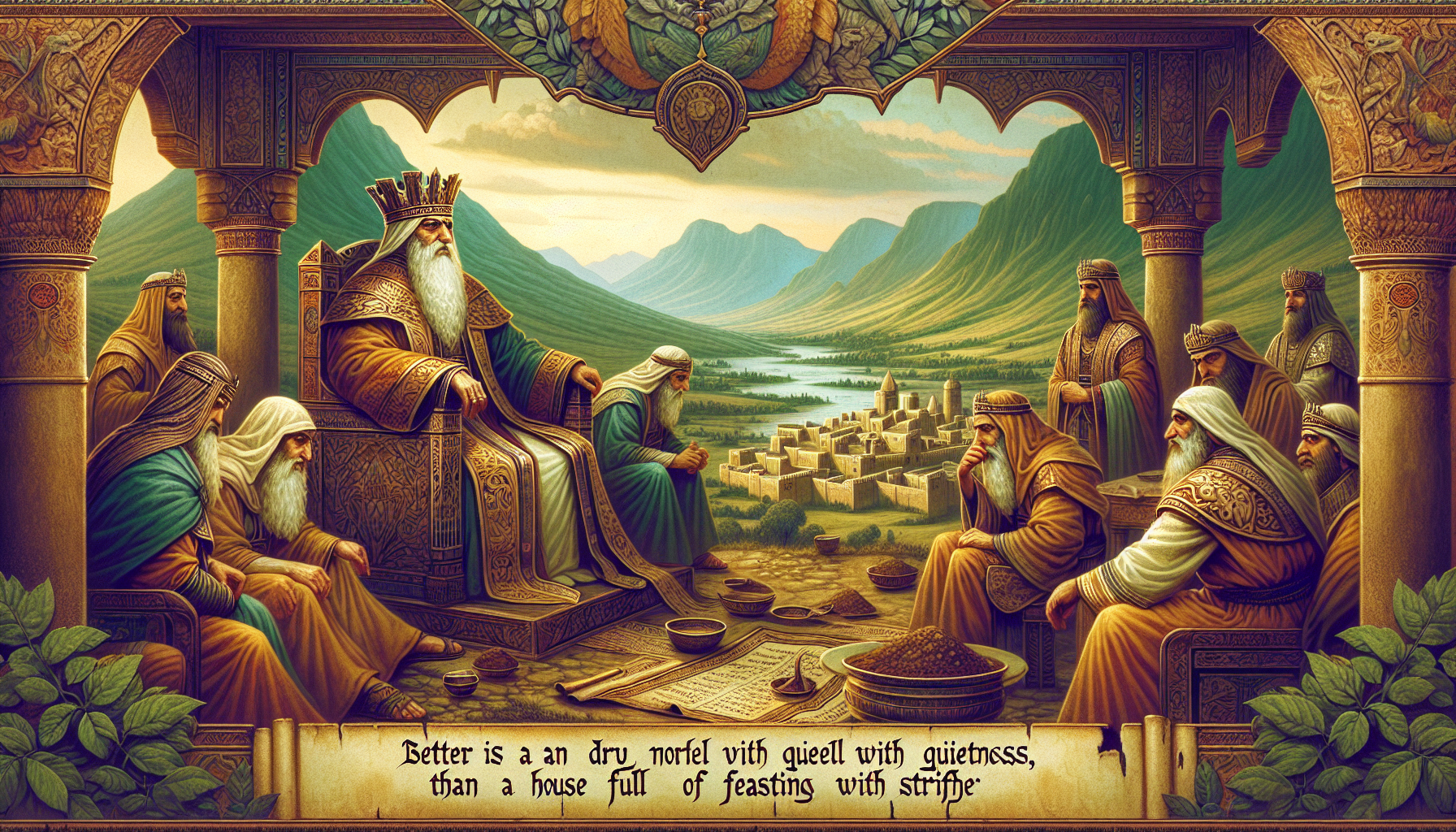
The book of Proverbs 17 opens with a direct claim about what is better: a dry morsel eaten in quietness, rather than a house full of feasting where strife lives. The verse does not romanticize poverty or dismiss abundance. It simply names the cost of conflict. A full table means nothing if the people around it are at war. The quiet morsel is not a metaphor for deprivation but for peace that does not need to be purchased with noise or resentment.
The chapter then moves to a second saying that is easy to overlook but cuts sharply into the first. A servant who deals wisely will rule over a son who causes shame, and will share the inheritance among the brothers. This is not a story about a specific family. It is a principle that overturns the assumption that blood alone determines honor. The wise servant displaces the foolish son. The inheritance is not guaranteed by birth but by conduct. The Lord does not honor lineage that produces shame.
The third verse anchors the whole chapter in a theological claim: the refining pot is for silver, the furnace for gold, but the Lord tests the hearts. This is not a general statement about suffering. It is a specific claim about how the Lord works. He does not test with fire or metal. He tests the inner life. The heart is the crucible. The chapter will spend the rest of its verses showing what the Lord finds when He tests: pride, bribery, mockery, strife, love, silence, and folly.
Verses 4 and 5 draw a line between the evil-doer and the mocker. The evil-doer listens to wicked lips. The liar gives ear to a mischievous tongue. The one who mocks the poor reproaches his Maker. The one who is glad at calamity will not go unpunished. These are not warnings about bad company in a general sense. They are about what a person chooses to hear and what a person chooses to despise. The Lord is the Maker of the poor. To mock them is to mock Him. To celebrate disaster is to invite judgment.
Verse 6 offers a counterweight: children's children are the crown of old men, and the glory of children are their fathers. This is not sentimental. It is structural. Honor runs in both directions. The old are crowned by their grandchildren. The children are glorified by their fathers. When either direction breaks, the whole structure weakens. The chapter does not explain how to fix it. It simply states what the crown and the glory are.
Verse 7 introduces a political edge: excellent speech does not suit a fool, and lying lips do not suit a prince. The fool cannot carry noble words. The prince cannot carry lies. The mismatch is not just awkward. It is a violation of order. The chapter does not say what happens when a prince lies, but the implication is clear: the prince who lies is no longer a prince in the way the Lord defines it.
Verse 8 is blunt about bribery: a bribe is like a precious stone in the eyes of the one who has it. Wherever it turns, it prospers. The verse does not condemn or commend. It simply describes how the bribe looks to the one holding it. It shines. It works. But verse 23 will return to this: a wicked man takes a bribe from the bosom to pervert the ways of justice. The bribe prospers in the short view. In the Lord's view, it is wickedness.
Verses 9 through 14 form a dense cluster about conflict and its sources. Covering a transgression seeks love. Harping on a matter separates close friends. A rebuke goes deeper into a person of understanding than a hundred stripes into a fool. An evil man seeks only rebellion, so a cruel messenger is sent against him. Meeting a bear robbed of her cubs is safer than meeting a fool in his folly. Rewarding evil for good means evil will not leave that house. The beginning of strife is like letting out water. The command is direct: leave off contention before there is quarreling. Once the water is out, you cannot gather it again.
Verse 15 is a judicial statement: justifying the wicked and condemning the righteous are both an abomination to the Lord. The chapter does not allow for a middle ground. The judge who lets the guilty go free and the judge who punishes the innocent are equally hateful to God. This is not about mercy versus justice. It is about inversion. The Lord abominates the inversion of right and wrong.
Verse 16 asks a question that hangs in the air: why is there a price in the hand of a fool to buy wisdom, since he has no understanding? The fool has the means but not the capacity. Wisdom cannot be purchased. It requires a heart that can receive it. The fool's money is useless because the fool himself is not ready.
Verse 17 is one of the most quoted lines in the chapter: a friend loves at all times, and a brother is born for adversity. The verse does not say that a brother is always a friend. It says that brotherhood is designed for hard times. The friend loves consistently. The brother shows up when trouble comes. Both are needed. Neither is automatic.
Verses 18 through 28 continue the pattern: the man without understanding strikes hands and becomes a guarantor for his neighbor. The one who loves strife loves transgression. The one who raises a high gate seeks destruction. The wayward heart finds no good. The perverse tongue falls into mischief. The father of a fool has no joy. A cheerful heart is good medicine, but a broken spirit dries up the bones. The wicked man takes a bribe to pervert justice. Wisdom is before the face of the understanding, but the fool's eyes are at the ends of the earth. A foolish son is grief to his father and bitterness to his mother. Punishing the righteous is not good, nor is striking the noble for their uprightness. The one who spares his words has knowledge. The cool-spirited man is a man of understanding. Even a fool, when he keeps silent, is counted wise. When he shuts his lips, he is considered prudent.
The chapter ends where it began: with the value of restraint. The dry morsel and the quiet tongue belong together. The fool who says nothing looks wise. The wise servant inherits. The Lord tests the heart. The chapter does not offer a system. It offers observations that cut in multiple directions. The reader is left to measure his own silence, his own speech, his own bribery, and his own strife against the plain words of the text.