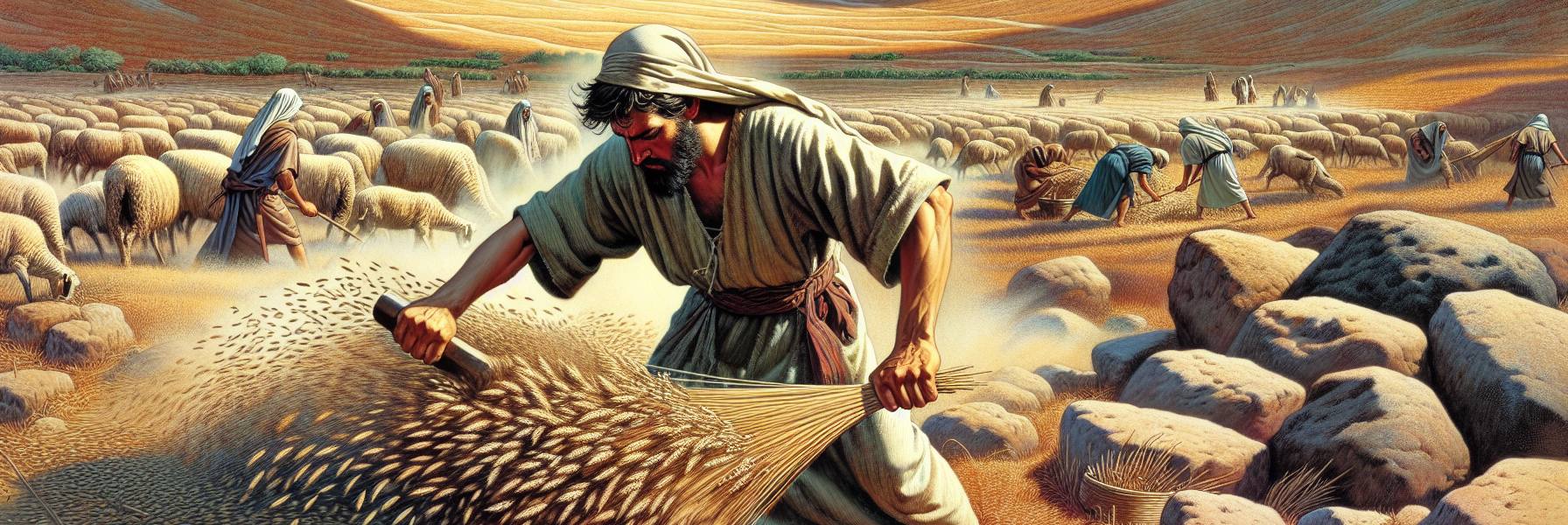

The heat had settled into the stones of the wadi, a thick, woolen blanket that made the air above the ground shimmer. Jamin wiped his forearm across his brow, the grit from the morning’s threshing leaving a muddy streak. He worked alone today, his brother Reuben having taken the flock to the higher slopes where scant tufts of grass clung to life. The rhythm of the flail was hypnotic: the solid *thump* of the grain heads, the whisper of the chaff drifting sideways on a listless breeze.
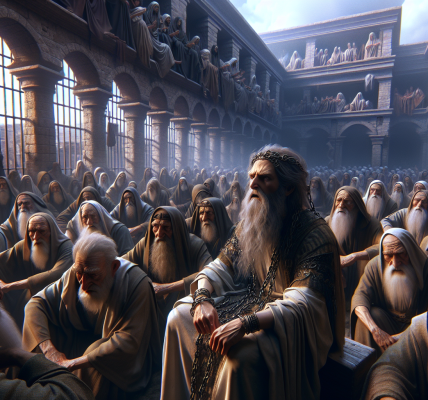
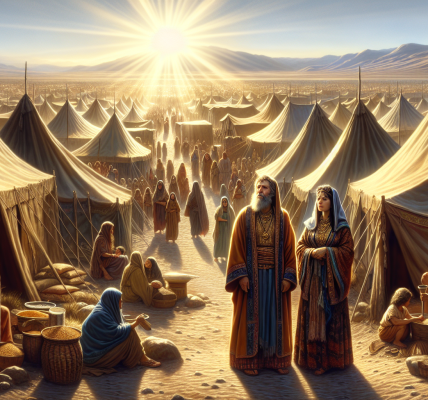
His mind, free from conversation, wandered back to the words. They weren’t just words anymore; they had become a texture in their lives, a new pattern woven into the old fabric of survival. “You shall not spread a false report,” the voice of Moses had echoed, strained yet firm, in the gathering before the mountain. Jamin remembered the tightness in his chest. Last season, a whispered accusation from Shimon the potter about a missing kid goat had soured the air between their families for weeks. It was only found later, tangled in a thornbush, but the bitterness lingered, a thin sediment in the water of their community. The law felt like a cleansing rain on that memory.
A shadow fell across the threshing floor. It was old Nahshon, leaning heavily on his staff, his face a roadmap of deep ravines. He didn’t speak, just watched for a moment, his eyes pale like sun-bleached pebbles. Jamin stopped, leaning on his flail. “Peace to you, Nahshon.”
“And to you, Jamin.” The old man’s voice was a dry rustle. “Your brother’s donkey wandered into my plot again. Nosed over a line of leeks.”
A year ago, a spark of defensiveness would have flared in Jamin’s gut. *Your fence is rotten, old man.* But the words that came to him now were different, shaped by the new teaching. “You shall not follow the many to do evil, nor shall you bear witness in a dispute to side with the many so as to pervert justice.” It wasn’t about crowds. It was about the easy path, the convenient siding with kin against the outsider. Nahshon was alone, his sons lost to a fever in Egypt.
“I am sorry for it,” Jamin said, and the apology felt like a stone lifted. “I will come at sundown and repair your fence where it is weak. And from the first yield of our garden, you will have leeks.”
Nahshon studied him, then gave a slow, nearly imperceptible nod. “The fence behind the fig tree. It is weak there.” He turned and shuffled away, his shadow merging back into the stark landscape. Justice, Jamin was learning, was sometimes a quiet thing, a repaired fence instead of a heated argument.
The sun climbed, punishing and bright. He thought of the other command, the one about the Sabbath of the land. “Six years you shall sow your land and gather in its yield, but the seventh you shall let it rest and lie fallow.” His father, had he lived to see this wilderness, would have scoffed. The very idea of deliberately not working a plot, of letting the weeds and the wild animals take it? It seemed like madness, a recipe for hunger. But Moses had spoken of trust. That the sixth year would bring a blessing so great it would cover the seventh. It was a law woven with faith, a rhythm not of human anxiety, but of divine provision. Jamin looked at his own small, terraced plot clinging to the hillside. Could he do it? Could he watch it go wild and believe?
Later, as the molten sun bled into the western hills, Jamin made his way to Nahshon’s plot. The work was simple: securing a few loosened stones, weaving new withes into the brittle old barrier. As he worked, he heard a faint rustle in the dry brush beyond the field. A flash of tawny fur—a fox, perhaps. And he remembered another injunction, one that had struck him as peculiarly gentle. “If you meet your enemy’s ox or his donkey going astray, you shall bring it back to him.” It was a law that acknowledged a harsh reality—enemies existed—but refused to let cruelty to a beast be the currency of that feud. It forced a strange, inconvenient kindness. It created a pause where vengeance might have leapt.
Walking home in the violet twilight, the first stars pricking the vast dome above, the pieces began to fit together for Jamin in a way they hadn’t during the proclamation. This was not merely a list of rules. It was the blueprint for a different kind of people. A people where the poor could eat from the edges of a field and the forgotten corners of the vineyard, not as charity, but as a right. A people where truth mattered more than convenience, where the cycle of the earth was respected, where even an enemy’s suffering animal was your responsibility. It was a covenant of carefulness, a call to be mindful in a world that rewarded ruthlessness.
He reached his tent. The smell of Reuben’s lentil stew greeted him. His brother looked up from stirring the pot. “Nahshon found you, then?”
“He did. The fence is mended.”
Reuben grunted, not unkindly. “The old man worries over every leaf.”
“He is alone,” Jamin said simply, washing his hands in the basin. The water was cool. “And we are not.”
The words hung in the tent, mingling with the woodsmoke and the scent of herbs. They were more than a statement of fact. They were, Jamin understood, the very heart of the law. It was all about understanding what it meant to be “not alone”—to be a people bound not just by blood, but by a solemn, careful, and fiercely practical kindness, etched not on scrolls alone, but on the fences they mended, the fields they left fallow, and the stray donkeys they led home. It was a long road to becoming such a people. But under the vast and watchful sky, it felt, for the first time, like a road that led somewhere worth reaching.