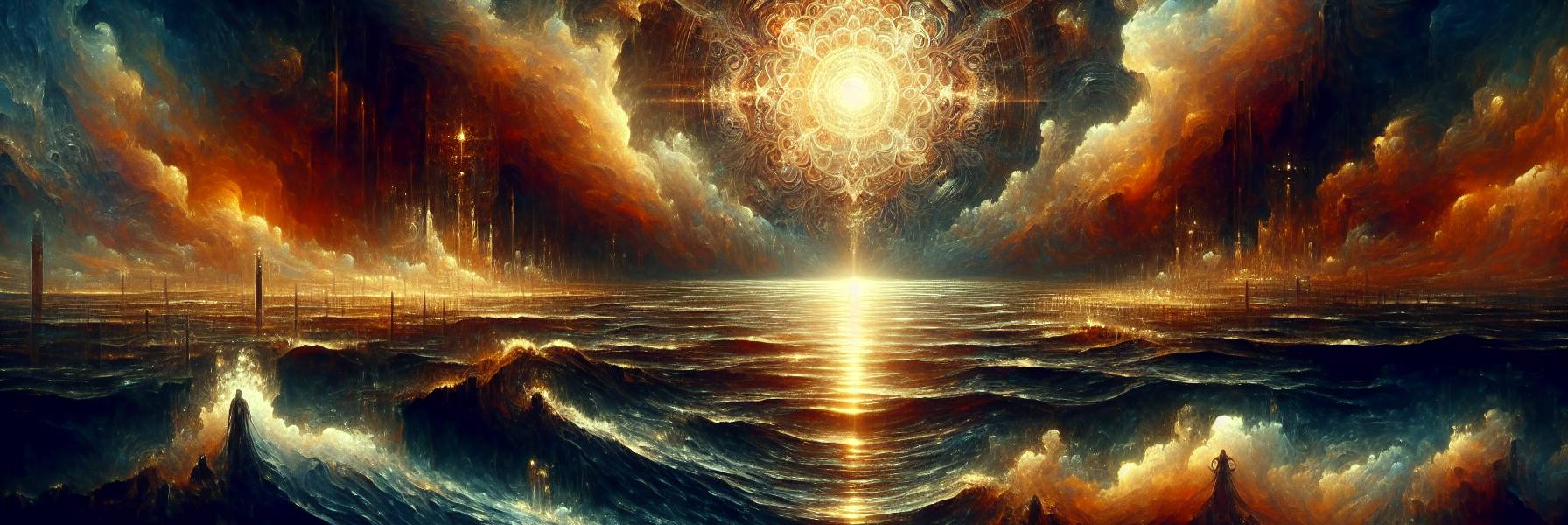

The air had changed. It wasn’t a change you could see, but you felt it in your chest, a pressure like before a storm that never breaks. The usual murmur of prayers, the distant echoes of celestial choirs—all of it had fallen into a profound and watchful silence. Then I saw them, not with my earthly eyes, but with the kind of sight that bypasses the flesh and brands itself directly upon the soul.
It was a sea, but not of water. A great, shifting expanse of something like glass, yet not brittle. It had the depth of fused crystal, shot through with faint, moving colors like the memory of fire. And it was mingled with fire itself—not a destructive blaze, but a gentle, pervasive glow that seemed to rise from within it. Standing upon this impossible shore, or perhaps within it, were those who had gotten the victory. Not over flesh and blood, you understand, but over the beast, and his image, and the number of his name. They didn’t look triumphant in a warlike way. There was a stillness about them, a weariness that was also a profound rest. Their faces held the quiet of a long, hard journey’s end.
Each one held a harp of God. Simple things, carved from a wood that shone with a soft, inner light. And then, as if one breath moved through them all, they sang. It wasn’t a song for grand halls; it was the song of the delivered, low and sure and woven from the fabric of their witness. It was the song of Moses, the servant of God. You could hear the crashing Red Sea in it, the dust of the desert, the weary trust of a people led by cloud and fire. And it was the song of the Lamb. That melody held a different timbre—the sound of nails, the silence of a tomb, the dawn-light of an empty garden. The words rose, clear and heavy with truth:
“Great and marvellous are thy works, Lord God Almighty; just and true are thy ways, thou King of saints. Who shall not fear thee, O Lord, and glorify thy name? for thou only art holy: for all nations shall come and worship before thee; for thy judgments are made manifest.”
The song didn’t echo. It was absorbed by the glassy sea, which shimmered in resonance. As the final note faded into that attentive silence, the atmosphere tightened further. At the far edge of the vision, where the fiery glass met a sky the colour of dark bronze, the temple of the tabernacle of the testimony in heaven was opened. Not the outer courts, but the innermost place itself.
And out of that unbearable sanctity came the seven angels. They were clothed in pure light, which took the form of linen, clean and white, and their chests were girded with golden bands of office, broad and ancient. One of the four living creatures—the one with the face like a lion, I think—moved then. It was a solemn, deliberate motion. He gave to each of the seven angels a vial, a broad, shallow bowl of wrath. Not the hot, impulsive wrath of man, but the cold, settled, and utterly necessary wrath of the Eternal. The vials were full of it, shimmering with a terrible, transparent potency.
The temple immediately filled with smoke from the glory of God, and from His power. It was a dense, majestic smoke, like that which filled Solomon’s temple so long ago, a sign of a presence too intense to be looked upon. No one, not the angels upon the sea, not the living creatures, not any being in heaven, was able to enter into the temple until the seven plagues of the seven angels were fulfilled. It was a closed door. A sealed process. An action had been set in motion from the very heart of holiness itself, and nothing could interrupt its terrible, perfect course.
The angels took their stations. They did not speak. They simply stood, holding the bowls, their faces set like flint toward the earth that lay somewhere below, beyond the vision. The sea of glass reflected their still forms, the fire within it burning a little brighter, a little hotter. The song was over. The singers stood in silence, their harps still. The only sound was the low, almost imperceptible hum of the fulfilled wrath of God, waiting in the bowls of gold. And in that endless moment, you understood the dreadful mercy of it all—that the One who is love itself must also be the end of all that hates love. The final things had truly begun.