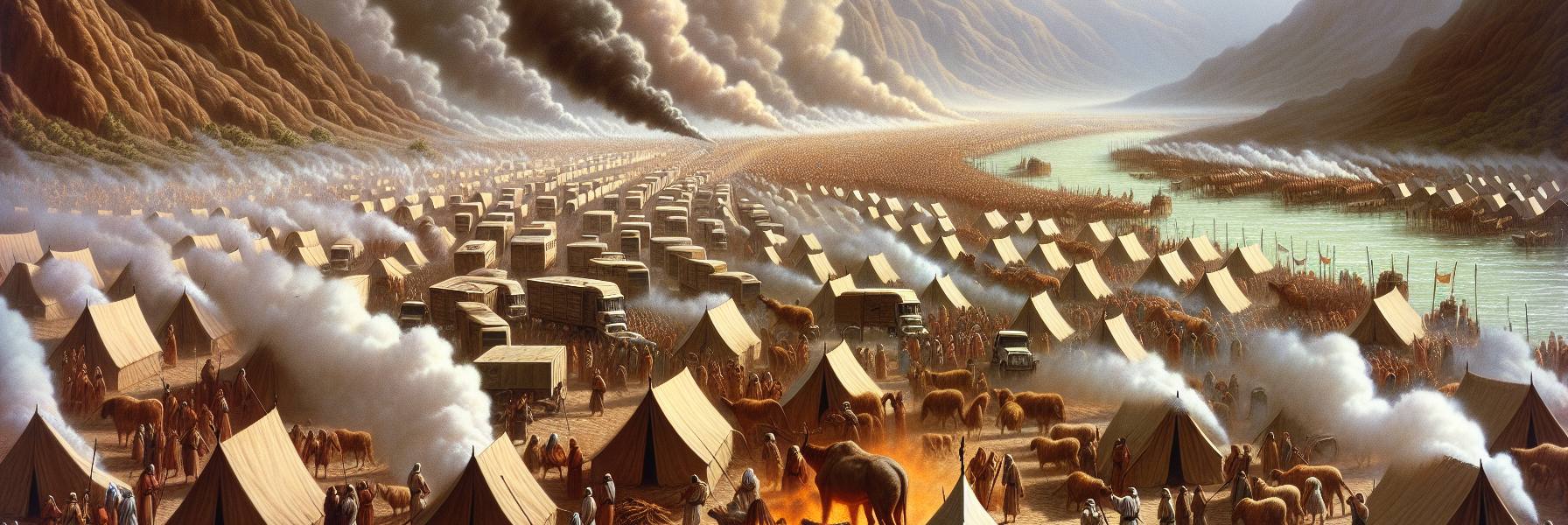

The air over the camp at Shittim was thick with dust and expectation. For three days, Joshua’s instructions had echoed through the tribes: prepare, consecrate yourselves, watch. Now, on the morning of the fourth day, the immense camp stirred like a single, waking creature. Cookfires were stamped out, tents collapsed with a sound like great sighs, and the lowing of herds blended with the shouts of mothers and the clatter of gear. The dust, always present, rose in earnest now, a tawny cloud marking the movement of thousands.
Joshua stood a little apart, watching. The weight of it all—the promise, the people, the memory of Moses—sat on his shoulders not as a burden, but as a sobering mantle. The Jordan lay ahead, a green-brown serpent marking the threshold of everything. It was harvest season, the time of the barley, and the river would be swollen, fat with the melt from the distant Hermon ranges, its banks spilling over, its current strong and silent where it wasn’t churning.
He called the officers, their faces set and serious. “Pass through the camp,” he told them, his voice carrying without strain. “Command the people: when you see the priests of the Levites carrying the Ark of the Covenant, you are to set out from your place and follow it. But you must keep a distance between you and it. A good space, about two thousand cubits. Do not come close. This is so you may know the way you are to go, for you have not passed this way before.”
It was a practical instruction, but the theology of it hummed beneath the surface. The Ark was not a talisman. It was the terrifying, merciful sign of God’s own presence. You did not crowd it. You followed. The way would be made clear not by a map, but by following the presence itself.
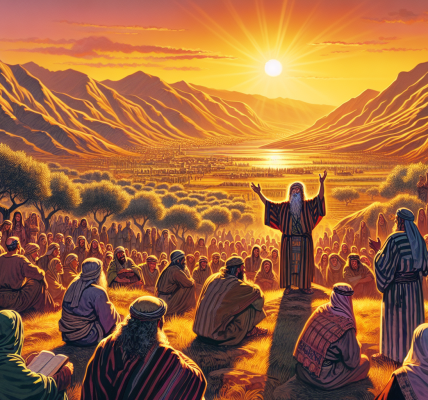
Later, as the sun climbed, Joshua gathered the people. “Come here,” he said, “and listen to the words of the Lord your God.” The crowd stilled, the only sounds the shift of feet and the distant cry of a hawk. “By this you shall know that the living God is among you, and that he will without fail drive out from before you the Canaanites… Behold, the Ark of the Covenant of the Lord of all the earth is about to pass before you into the Jordan.”
He paused, letting the immensity of the claim settle. The Lord of *all the earth*. This wasn’t a local deity for a local river. This was the sovereign of creation approaching one of its waterways.
“Now,” Joshua continued, his gaze sweeping over them, “take twelve men from the tribes of Israel, one from each tribe. And when the soles of the feet of the priests bearing the Ark rest in the waters of the Jordan, the waters of the Jordan shall be cut off from flowing, and the waters coming down from above shall stand in one heap.”
There was no fanfare after that. The chosen priests, their faces grave, lifted the sacred poles onto their shoulders. The Ark, acacia wood overlaid with gold, gleamed dully in the morning light. The cherubim on its mercy seat seemed to watch the path ahead. Then they began to walk.
A space opened around them, a bubble of reverence. Then, with a rumble that was more felt than heard, the multitude began to move. They kept their distance, a vast, living ribbon trailing behind that small, central point of divine focus. The dust was incredible, coating throats and garments, but no one complained. Eyes were fixed ahead, on the Ark, and on the ribbon of green that marked the Jordan’s course.
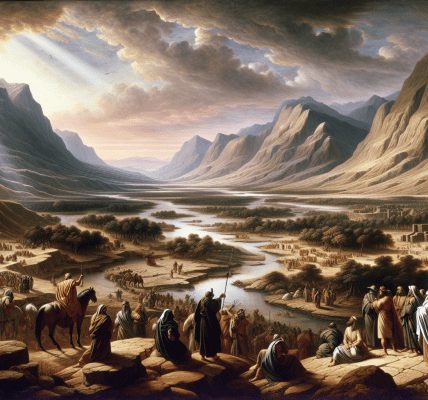
From a slight rise, Joshua watched the procession. He could see the precise moment the priests, their steps never faltering, reached the brink of the water. The Jordan was indeed at flood stage, swirling angrily, its banks lost in a sprawl of marshy overflow. The feet of the lead priests touched the wet, reedy edge. Then they stepped into the flow.
The miracle did not announce itself with a crash. It happened upstream, out of sight. But its effect was immediate. One moment the priests were wading into a strong current, the water rising to their ankles, then their shins. The next, the flow around them simply… slackened. It fell away. The water downstream, past where they stood, began to drain southward toward the Salt Sea, gurgling and diminishing. But the water from the north, from upstream, ceased to arrive. It was as if a giant, unseen dam had been thrown across the river at the distant city of Adam, near Zarethan. The waters piled up there, a clear, glassy wall growing higher and higher, leaving the riverbed exposed for miles.
The priests carrying the Ark walked forward, now into mud, then onto damp stones, and finally onto the dry, cracked bed of the Jordan itself. They walked to the very center of the river’s course and stopped, planting their feet firmly on the ground that had, moments before, been hidden under tons of rushing water. The Ark rested there, in the middle of the dry Jordan, a silent, monumental testimony.
And the people crossed. It wasn’t a sprint; it was a solemn, awe-filled migration. Families with children, herdsmen with skittish flocks, old men and women who remembered Egypt—they all walked down the bank and onto the river floor. They passed by the Ark, that silent, golden presence holding the tablets of the law, the jar of manna, Aaron’s rod. The air in the riverbed was cool and smelt of fish and wet clay. Children pointed at the stranded fish flapping in shrinking pools, at the water-smooth stones. But the adults mostly looked ahead, or glanced with holy fear at the Ark and the priests who stood unmoving beside it.
They were walking on a path that had no right to exist. They were walking between walls of water held back by a word. They were walking into the promise, dry-shod. It took a long time. All day, the procession continued, a nation moving house through a divinely carved corridor. And through it all, the priests stood firm, their muscles aching, their shoulders burning under the weight, but their resolve as solid as the ground beneath them.
Finally, the last straggler, the last bleating goat, came up the far bank into the land of Canaan. Only then did Joshua, from the western shore, give the signal. The priests, stiff and weary, lifted the Ark once more. The moment their feet touched the far bank, as if held in breathless suspension just for this, the wall of water upstream gave way. With a roar that made the people turn and gasp, the Jordan returned to its course, filling its banks to overflowing once again, as if it had never been disturbed.
That night, the camp on the plains of Jericho was quieter than usual. The talk was hushed. The awe was too deep for celebration. They had passed over. Not by their own power, not by clever engineering, but by following the presence of God into an impossible path. The river had been no obstacle. It had been an altar. And on it, their old identity as a wandering people had been buried in the water’s return. They were here. The Lord of all the earth had brought them home.