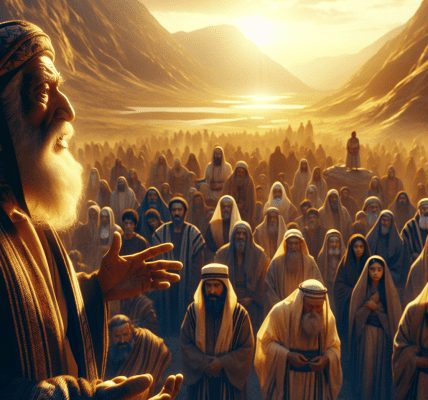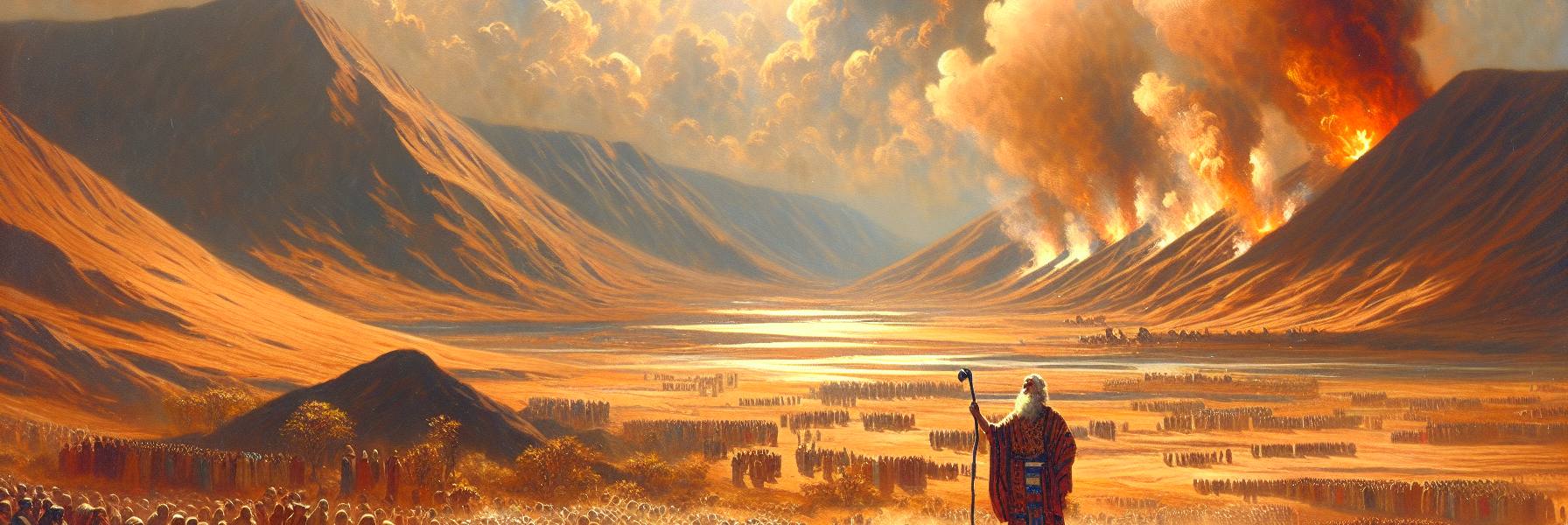

The air on the plains of Moab held a different kind of heat. It wasn’t the searing, dry blast of the wilderness wanderings, nor was it the oppressive, memory-laden stillness of Egypt. This was a thick, expectant heat, heavy with the scent of dust and crushed grass from the gathering of so many people. Moses felt it press against his old skin as he stood on the makeshift platform, the sea of faces before him bleached pale by the relentless sun.
He cleared his throat, a sound like stone grinding on stone. The murmuring stilled. These were not the same people. The ones who had stood trembling at the foot of the mountain—their parents, their aunts and uncles—were mostly dust now, their rebellion swallowed by the desert sands. But the mountain, and what happened there, was now their story too. He had to make them see it, feel it, own it.
“Hear, O Israel,” he began, his voice gaining strength from a deep, familiar well, “the statutes and rules that I speak in your hearing today. You must learn them. You must be careful to do them.” He paused, letting his eyes travel over the young mothers with infants on their hips, the broad-shouldered men who had known only wilderness, the old ones whose eyes still held the ghost of Egyptian brick pits. “The Lord our God made a covenant with us at Horeb. Not with our fathers alone. With us. With all of us who are alive here today.”
He saw skepticism in some of the younger faces. A covenant made at a mountain they’d never seen? A voice they’d never heard? He needed to make it real.
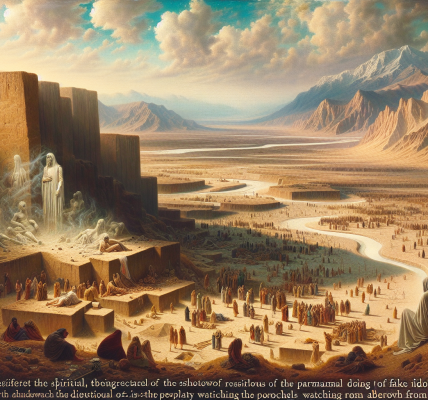
“You were not there,” he said, leaning forward, “but I will tell you of the day. I stood between you and the Lord. The mountain burned with fire to the very heart of heaven, wrapped in darkness, cloud, and deep gloom. And the Lord spoke to you out of the midst of the fire. You heard the sound of words, but saw no form; there was only a voice.”
He closed his eyes for a moment, and the present heat of Moab fell away. He was back in the chilling, electric cold of that divine tempest. The memory was not a polished picture; it was a chaos of sensation—the acrid smell of lightning-scorched rock, the terrifying silence between the peals of thunder, the way his own heart had hammered against his ribs like a trapped bird.
“And He declared to you His covenant,” Moses continued, his voice dropping, compelling them to lean in. “The Ten Words, which He commanded you to perform. And He wrote them on two tablets of stone. And I was afraid,” he confessed, the admission surprising some. “I was utterly terrified by the fire and the fury. And you, you said to me, ‘Behold, the Lord our God has shown us His glory and His greatness, and we have heard His voice out of the midst of the fire. This day we have seen that God can speak with man, and yet he lives. But now, why should we die? This great fire will consume us; if we hear the voice of the Lord our God any more, we shall surely die. You go near, Moses, and hear all that the Lord our God will say, and speak to us all that He tells you, and we will hear and do it.’”
He mimicked their trembling plea, his old hands coming up in a gesture of desperate warding-off. The recollection was so vivid that a ripple of uneasy recognition went through the crowd. They could imagine it. They could feel the ancestral fear in their own bones.
“And the Lord heard your words,” Moses said, his tone shifting, becoming grave with the weight of a divine sorrow. “And He said to me, ‘I have heard the words of this people. They are right in all they have spoken. Oh, that they had such a heart as this always, to fear me and to keep my commandments, that it might go well with them and with their descendants forever.’”
He let that hang in the air—the heartbreaking divine wish for a permanence of faith that they, he knew, would struggle to maintain.
Then, he began to speak the words themselves, not as a dry recitation, but as a proclamation, painting each one with the brush of lived experience.
“You shall have no other gods before me.” He said it slowly, and in his mind’s eye he saw not just golden calves, but the anxious clutching at the security of Egypt, the hidden amulets from pagan tribes, the future temptation of fertile land-gods. “Did some god lead you out of iron furnace of Egypt? Did some other power fight for you in the desert? No. It was His voice, in the fire.”
“You shall not make a carved image…” His voice grew stern, his gaze sweeping the camp. “You heard a voice. You saw no form. Remember that. To fix Him in silver or wood is to forget the fire, to shrink Him down to something you can control. It is a lie. And it leads to worshiping the work of your own hands, which is just another way of worshiping yourselves.”
On he went, through the sanctity of His name—not a tool for curses or cheap oaths; through the Sabbath—a gift of rest so profound it even touched the ox and the slave, a permanent memorial of their deliverance from a land that knew no rest. He lingered on the command to honor father and mother, linking it directly to the longevity of their hold on this good land they were about to enter. It was not mere etiquette; it was the mortar between the stones of society.
The final commands he delivered like a series of hammer blows, each one a foundation stone for a just community. “You shall not murder. You shall not commit adultery. You shall not steal. You shall not bear false witness. You shall not covet…”
Here, he paused, his eyes keen. “Not just the wife, but the house, the field, the servant. The restless desire for what is your neighbor’s—that is the quiet poison. It is the seed of all the others. Guard your hearts.”
When he finished, the air seemed to vibrate. He hadn’t just listed rules. He had rebuilt the mountain around them, with all its terror and majesty, and planted the covenant in the fresh-turned soil of their new future.
“These words the Lord spoke to all your assembly,” he said, his strength finally waning, leaving him hoarse. “With a loud voice, out of the fire, the cloud, and the deep darkness. And He added no more. He wrote them on two tablets of stone and gave them to me.”
Moses fell silent, looking at them. The sun was lower now, casting long, deep shadows across the plains. The heat was breaking. In the quiet, he hoped they could still hear the echo of the fire, and understand that the awesome voice that shook the mountain was the same voice that now called them, not to a life of fear, but to a life. A chosen, difficult, holy life. A life of walking with the God of the fire, who had brought them all, the fearful and the faithful, to the very edge of promise.