
The chroniclers would record it as the time of the establishing. Years later, old men by the gate, their beards gone white, would speak of those days not with the wild-eyed wonder of Saul’s time, but with a settled, deep-chested satisfaction. It was when the land finally drew a full breath after holding it for generations.
David’s rule, once a precarious thing clinging to the highlands of Judah, had taken root. Jerusalem, his captured fortress, was no longer just a stronghold; the sounds from the new courtyards were the sounds of masons and scribes, the scrape of saws on cedar from Tyre, the murmur of envoys in half-a-dozen tongues. And from this new heart, a strength flowed outwards.
It began with the Philistines, those ancient tormentors from the coastal plain. They had tested him, probing the new kingdom’s borders. David met them not with a desperate defense, but with a king’s offended stride. He took Metheg-ammah, the bridle of the mother-city, as the men called it. It wasn’t just a town he seized; it was the symbol of their control, the bit and rein they’d used to guide Israel’s neck. He took it, and the message was plain. The bridle was now in his hand.
Then he turned east, toward the wide, arid lands beyond the Jordan. Moab had been a refuge once, when he fled Saul. Now, politics had shifted like desert sands. The old debt was forgotten. The army went out, and the fight was fierce and brutal in the rocky valleys. Afterward, they brought the Moabite prisoners before the king. David lay them on the ground. With a length of cord, he measured. Two lengths for the sword, one length for life. It was a terrible, arithmetic mercy. The chroniclers wrote it down without flourish. Moab served David, and their tribute came in heavy, coarse sacks of silver and the fine wool of their flocks.
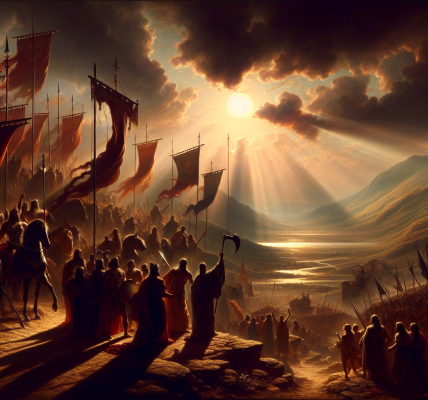
The great test came from the north. Hadadezer, son of Rehob, king of Zobah far up near the Euphrates, was stretching his own hand southward, seeking to reclaim the river trade routes. He was a man of chariots and ambition. David met him on the field, and the God of the mountains proved stronger than the god of the plains. A thousand chariots, seven hundred horsemen, twenty thousand foot—the numbers were staggering, the spoil even more so. David hamstrung most of the chariot horses, a practical, grim decision. They were useless in the hills of Judah, and he would not be tempted to trust in their strength. Only enough for a hundred light chariots were kept.
Then, like a ripple from a stone thrown in a distant pond, help came from Damascus, Arameans rushing to Hadadezer’s aid. David, his men still weary from the first battle, turned and struck them too. Twenty-two thousand fell. He put garrisons in Aram-Damascus, and the Arameans, those proud merchants and fighters, became servants. Their tribute came: bronze in great gleaming ingots, and the delicate beaten-work of their artisans. The Lord, the scribes noted carefully, gave victory to David wherever he went.
He took the golden shields carried by Hadadezer’s officers and brought them to Jerusalem. Later, from the plunder of the captured towns—Betah and Berothai—he dedicated a vast fortune of bronze. Solomon, years hence, would use it. The boy would see it not as plunder, but as raw material for the Sea and the pillars. His father saw it as a down-payment on a promise.
Tou, king of Hamath, heard of the shattering of his old rival Hadadezer. He sent his own son, Joram, south. The procession was a careful piece of statecraft: vessels of silver, gold, and bronze. They were not tribute, but gifts from one king to another, a recognition. David dedicated these, too, to the Lord, adding them to the growing sacred treasury. It was a quiet, profound moment. The fame of Israel’s God was spreading where the ark had never traveled.
On the edges of the salt sea, in the salt-crusted valleys, the Edomites watched. They saw the Philistines cowed, the Arameans broken, the Moabites measured. Perhaps they thought their barren red forts were safe. David, with Joab’s grim efficiency, proved otherwise. He struck Edom, left garrisons throughout all of it. Everywhere, they became subject to him. The chronicle simply states it. The Lord preserved David wherever he went.
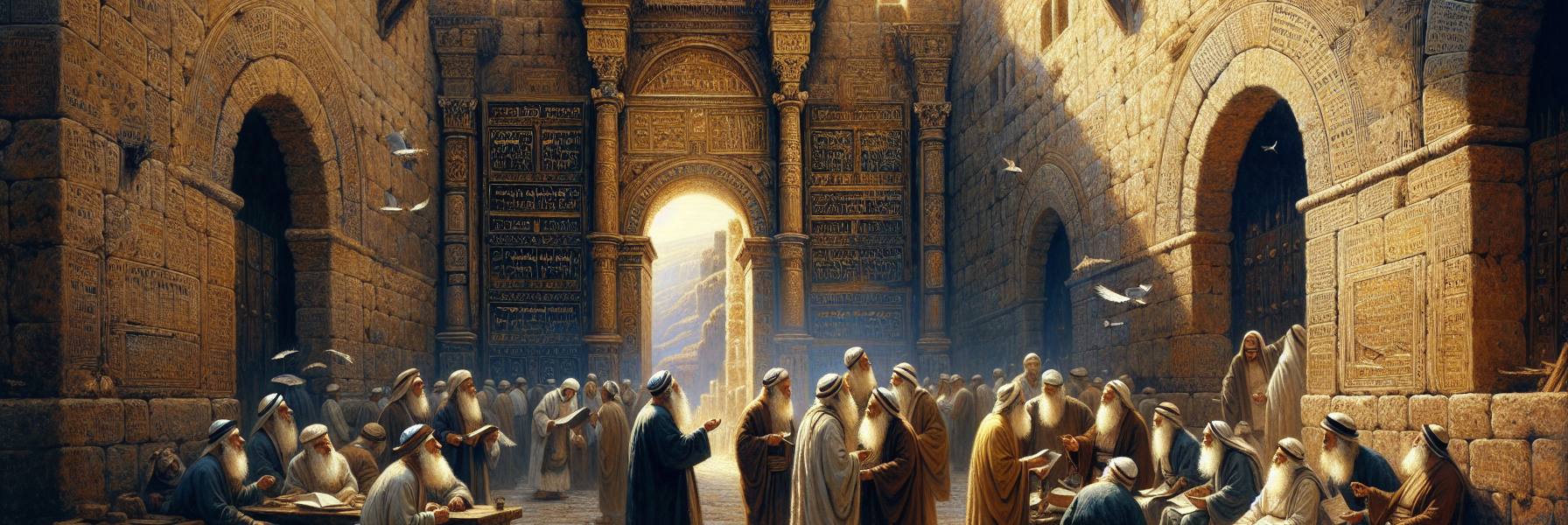
He reigned. He administered justice. The names of his officials are listed like a roll-call of this new, stable world: Joab over the army; Jehoshaphat, the recorder; Zadok and Ahimelech, priests; Seraiah, the secretary; Benaiah over the Kerethites and Pelethites; David’s sons, priests. The word is jarring—priests. But in those days, before the Temple’s order, it meant something like royal chaplains, intimate with the court.
And the people, from Dan to Beersheba, slept behind doors that were no longer barred in terror. The raids from the coast, the forays from the east, the pressure from the north—all were pushed back, held at bay by a king who fought, the chroniclers insisted, the battles of the Lord. It was not yet peace. But it was, for the first time in living memory, something like a true kingdom. The establishing was complete. The ground was firm. Now, what would he build upon it?