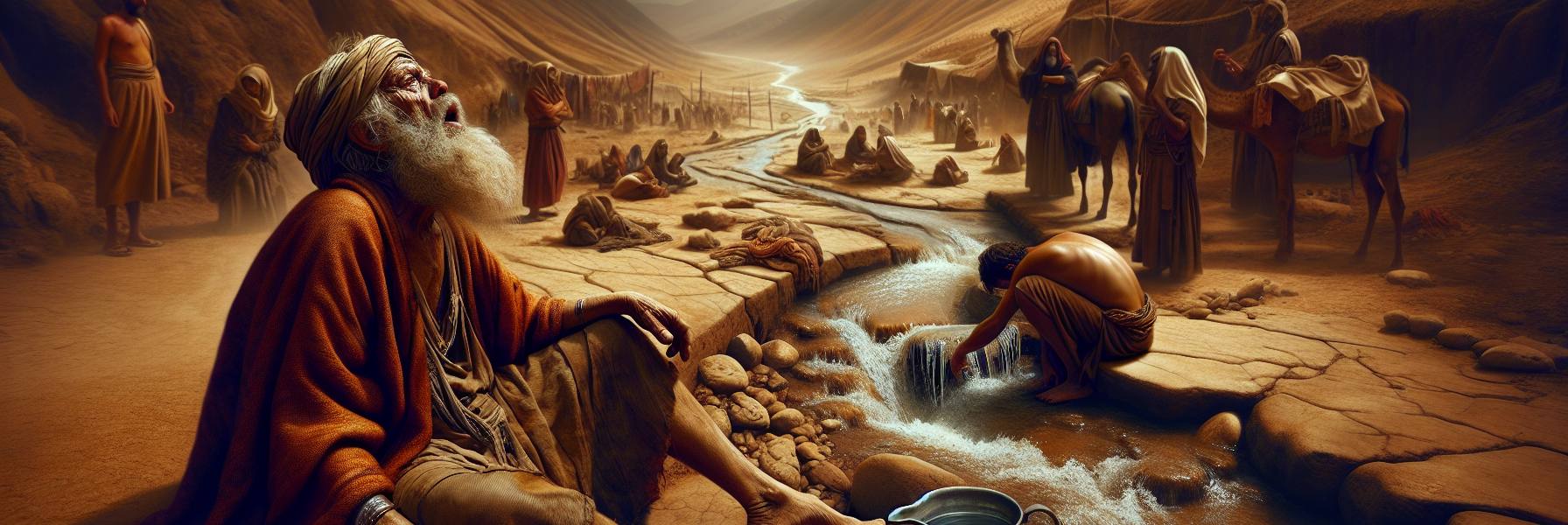

The heat in Mahanaim was a thick, woolen blanket, and it smelled of dust and distant rain that never fell. Eliab, once a singer in the house of the Lord, felt the weight of it in his bones. He sat on a flat stone by a sluggish, muddy stream—a poor cousin to the bright rush of the Jordan—and listened to the ceaseless chatter of the locals, their voices a foreign music. He was a son of Korah, a Levite, and his soul was parched.
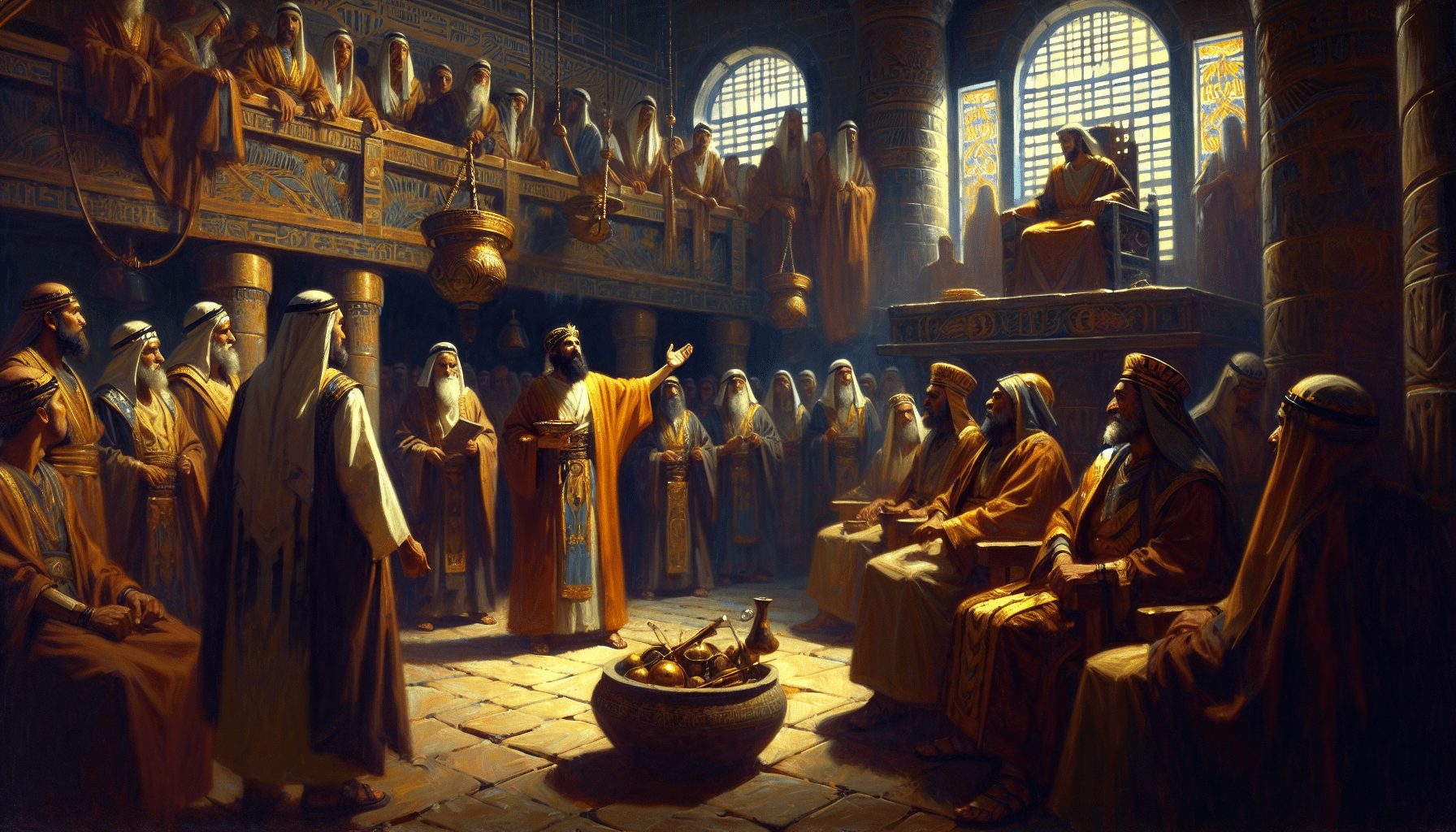
It wasn’t the thirst of the body, though water was scarce enough. It was a deeper drying, a cracking of the spirit. He remembered. That was his curse and his sustenance: memory. He could still feel the cool, polished stone of the Temple courts under his bare feet in the morning cool. He could hear the lowing of the sacrifice, the collective intake of breath before the first note of the shofar, the rustle of thousands of pilgrims like wind through a forest. And then the singing. His singing. The voices of the Levitical choir rising, layered, braided into one mighty torrent of praise, crashing against the Mercy Seat and flowing back over them like a blessing. He had not just sung about the living God; he had felt, in those moments, carried upon the current of His presence.
Here, there was only silence. A silence so loud it rang in his ears. The gods of the Ammonites were stone and wood, empty-eyed and mute.
“As a deer pants for flowing streams,” he whispered to the muddy water, “so pants my soul for you, O God.”
The words came out cracked. They were not a pretty verse here, not a sacred text to be recited. They were the raw, animal truth. A deer, driven down from the high ridges by drought, flanks heaving, tongue swollen, stumbling toward a mirage—that was him. His soul *ached*. It was a physical pain, a hollowed-out space behind his ribs that yearned to be filled with the glory that once was.
He looked up at the hills encircling this eastern exile. They were tawny, jagged, forbidding. His tears, when they came, were hot and private. “My tears have been my food day and night,” he mumbled, tasting salt. It was true. While he ate the coarse bread of strangers, his true sustenance was this grief. And the question, always the question, shouted at him from their curious, pitying glances: “Where is your God?”
He could hear the feast days in Jerusalem as if through a thick wall. The joy was a memory so vivid it was a torment. The processionals, the branches waving, the sheer, unadulterated *thanksgiving*. He had led them. Now he was a ghost of that joy, haunting a foreign land. He had to press his forehead against the sun-warmed rock to steady himself. “Why are you cast down, O my soul?” he asked his own inner darkness. “And why are you in turmoil within me?”
The turmoil was a stormy sea. That was the other memory—not of Zion, but of home in the north, watching the great breakers of the Mediterranean crash against the cliffs of Dan. A voice in his head, the voice of his despair, hissed that all God’s breakers and waves had gone over *him*. That he was drowning in this exile, and the Lord had sent the storm. He was a man swept from the deck of a great ship, choking on saltwater, forgotten.
But then, in the evening, a different rhythm would stir. It was the discipline of a lifetime of worship. The fist of grief would unclench, just a little. He would lift his eyes from the dirt of Mahanaim to the vast, deep purple of the eastern sky, pricked by the first, brave stars. And a smaller, quieter, but stubborn voice would answer the storm.
“Hope in God,” the voice said, a weary but unbent whisper. “For I shall again praise him, my salvation and my God.”
This was the conversation, the argument that spanned his days. By day, the Lord commanded his steadfast love. Eliab could almost sense it, a vast, unseen current moving through the world, even here. And by night, a song was with him—a broken fragment of an old hymn, a melody without words. It was a prayer to the God of his life.
Yet the darkness always returned. The taunt was relentless. “Where is your God?” It was in the brittle laugh of a local chieftain, in the empty socket of an idol on the roadside, in the very ache of his unused singing voice. His bones felt like they were being crushed. The adversaries were not just Ammonite soldiers; they were despair, oblivion, the fear that the connection had been severed forever.
“Why have you forgotten me?” he cried one night into his thin blanket, the words ripped from him. “Why do I go mourning because of the oppression of the enemy?” It felt like a mortal wound, this sense of divine absence.
But the memory was stronger than the moment. The deep called to deep. The abyss of his loneliness was, somehow, answered by the abyss of God’s unfathomable faithfulness. The great waterfalls of Hermon, whose thunder he knew from his youth, whose spray could drench a man standing a mile away—they spoke of a power that was terrifying and glorious. That same power, he knew, was the source of the covenant love that pursued him.
The argument in his soul never reached a neat conclusion. There was no sudden vision, no angelic visitation to end his exile. There was just the daily choice. The cast-down soul, the turmoil, the mocking voice—they were real. But so was the whisper.
One afternoon, watching a hawk circle on a thermal high above the hills, he found the words coming again, fuller this time. “Why are you cast down, O my soul, and why are you in turmoil within me?” He asked it with less desperation now, more like a father chiding a sorrowful child. And the answer came, not as a feeling, but as an act of will, a statement of identity against all present evidence.
“Hope in God.” He said it to the hawk, to the hills, to the hollow space within. “For I shall again praise him, my salvation and my God.”
He was still in Mahanaim. The stream was still muddy. The feast in Zion was still a memory. But he was, and would remain, a singer of the Living God. The song was just very quiet for now, a tune hummed in the dark, waiting for the dawn.