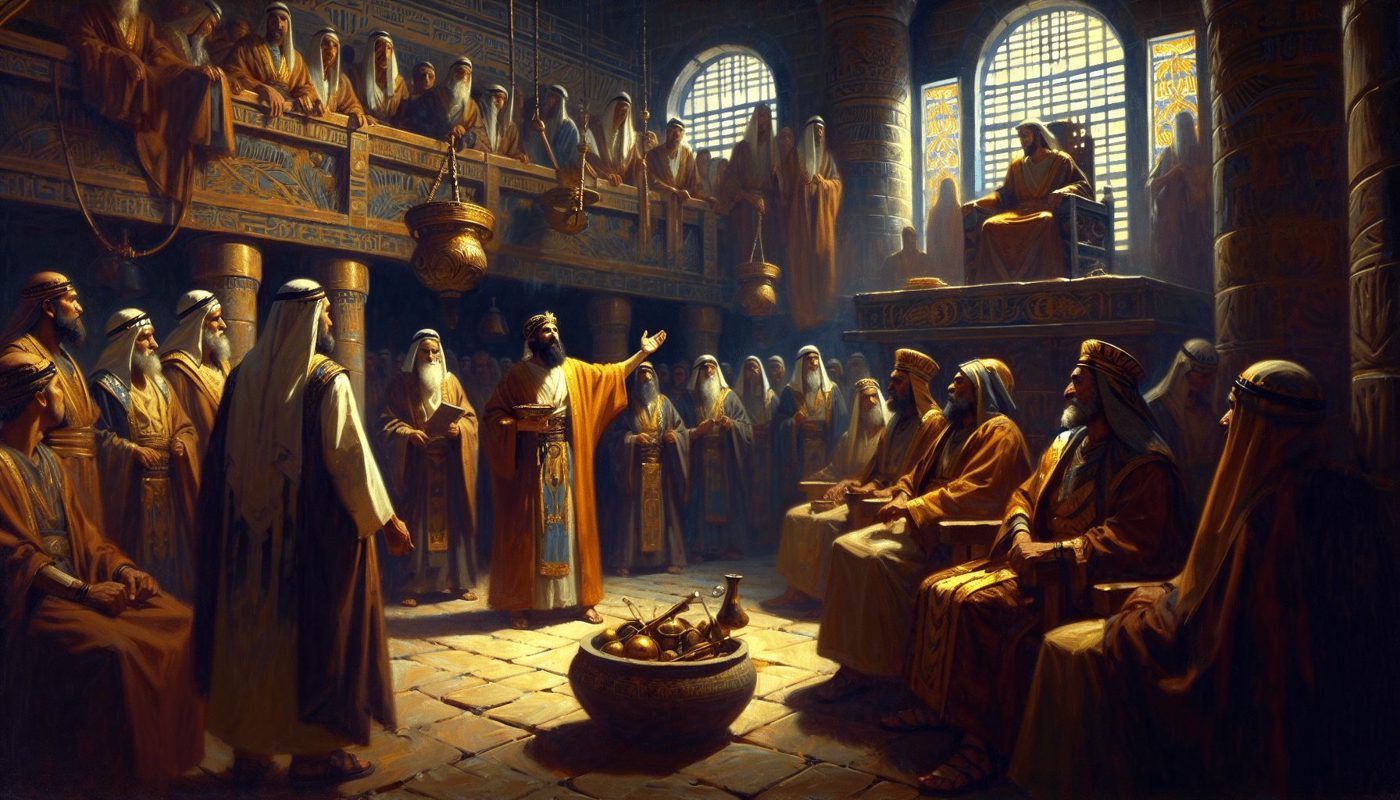
The narrative of Genesis 40 begins with a sudden shift in the court of Egypt. The king’s cupbearer and his baker—two high-ranking officers—commit an offense against Pharaoh, and his wrath is immediate. He places both men under guard in the house of the captain of the guard, the same prison where Joseph is confined. The text does not specify the nature of their crime, only that Pharaoh’s anger was hot against them.
The captain of the guard, Potiphar, assigns Joseph to attend to these two prisoners. Joseph, though bound himself, is put in a position of service. He ministers to the cupbearer and the baker, and they remain in custody for some time. The chapter does not say how long, only that they continued “a season” in the ward.
Then, in one night, both men dream. Each dream is distinct, and each carries its own meaning. The cupbearer and the baker are unsettled. When Joseph comes to them in the morning, he sees their faces are sad. He does not ignore their distress. He asks them directly: “Why look ye so sad today?”
They answer that they have dreamed, and there is no one to interpret. Joseph’s response is immediate and theological. He does not claim the power for himself. He says, “Do not interpretations belong to God?” Then he invites them to tell him the dreams.
The chief cupbearer speaks first. In his dream, a vine with three branches buds, blossoms, and produces ripe grapes. He holds Pharaoh’s cup, presses the grapes into it, and places the cup in Pharaoh’s hand. Joseph interprets: the three branches are three days. Within three days, Pharaoh will lift up the cupbearer’s head and restore him to his office. He will again give the cup into Pharaoh’s hand, just as before.
Joseph then adds a personal plea. He asks the cupbearer to remember him when things go well, to show kindness, and to mention him to Pharaoh so he might be brought out of this house. Joseph explains his situation: he was stolen out of the land of the Hebrews, and he has done nothing to deserve imprisonment.
The chief baker, seeing that the interpretation was favorable, speaks next. In his dream, three baskets of white bread are on his head. The uppermost basket contains all kinds of baked food for Pharaoh, but birds come and eat them out of the basket. Joseph’s interpretation is direct and grim: the three baskets are three days. Within three days, Pharaoh will lift up the baker’s head from off him, hang him on a tree, and the birds will eat his flesh.
On the third day, Pharaoh’s birthday arrives. He makes a feast for all his servants. He lifts up the head of the chief cupbearer and the head of the chief baker—but in two different senses. He restores the cupbearer to his position, and the cup is again placed in Pharaoh’s hand. The baker, however, is hanged, exactly as Joseph had interpreted.
The chapter closes with a quiet, painful note. The chief cupbearer does not remember Joseph. He forgets him. There is no explanation, no excuse. The man who was restored to favor simply does not recall the prisoner who interpreted his dream. Joseph remains in the dungeon, his hope of deliverance deferred.
This chapter is a study in contrasts: the cupbearer’s restoration and the baker’s execution, Joseph’s accurate interpretation and his subsequent neglect. The dreams are fulfilled precisely, but the human response to that fulfillment is failure. The cupbearer forgets. The narrative does not moralize; it simply records the fact. Joseph’s service, his faith, and his gift are all present, but they do not yet produce his freedom.
The chapter ends with Joseph still in prison, his words proven true, but his own deliverance not yet come.
Comments
Comments 0
Read the discussion and add your voice.
Members only
Sign in to join the conversation
We keep comments tied to real accounts so the discussion stays clean and trustworthy.
No comments yet. Be the first to add one.