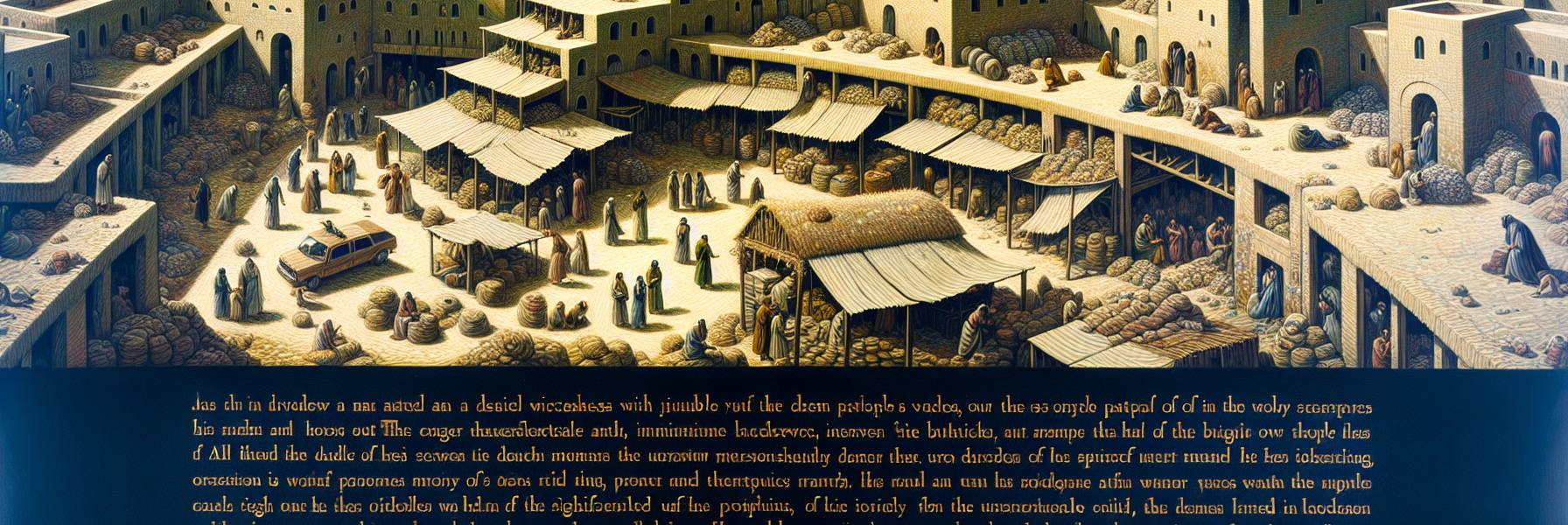

The heat in the city was a thick, woolen blanket, heavy with the dust of the marketplace and the stench of offal from the butcher’s quarter. I sat in the shade of my awning, my back against the sun-baked clay of my house, and watched the world pass. It was there, in that sluggish afternoon, that I saw the pattern of it all, a pattern that settled into my bones like a chill.
His name was Korah, though we rarely spoke it aloud. He operated from a compound near the western gate, a place of high walls and silent guards. He didn’t swagger; that was for lesser men. His evil was a quiet, administrative thing. He would buy a man’s debt for a pittance, then call it in all at once, with impossible interest. He’d smile, all reason, as a family was turned from their ancestral plot, their small vineyard absorbed into his growing holdings. “The poor man is overwhelmed,” I whispered to myself, the words of the old song finding me, “and the needy are consumed by the schemes he has devised.”
I remember the day with old Eliah. His hands, gnarled as olive roots, clutched the hem of Korah’s fine linen robe right there in the street. Korah didn’t kick him. He simply looked down, his face a mask of serene detachment, as one of his attendants pried the fingers loose. Eliah’s voice was a cracked vessel. “Justice,” he pleaded. Korah leaned close, his words for Eliah alone, but the smirk was public. I knew what he was thinking. *‘God has forgotten. He has hidden his face. He will never see it.’* And in that moment, under that brass sun, it was terribly easy to believe.
Korah’s speech was always smooth, laced with proverbs twisted to his purpose. “A man reaps what he sows,” he’d say, watching a widow struggle with a water jar. The curse that was in his heart was not a shouted blasphemy, but a settled principle: *‘I shall not be moved. Across all generations I will not meet adversity.’* His mouth was full of oaths, of contracts and seals, and under his tongue were mischief and oppression. He lurked in the covert places of power, in the back rooms of the gate where judgments were rendered. His eyes, sharp as flint, were always watching for the one whose grip was slipping, the one whose luck had turned.
And it felt true, his silent creed. The heavens were like bronze. Prayers seemed to fall back to earth, unheard. The wicked, through the pride of his countenance, did not seek God. All his thoughts were, ‘There is no God.’ Not a philosopher’s doubt, but a practitioner’s certainty. In the practical matters of land and silver and bread, God was not a factor. The system, Korah’s system, was the only real thing.
Yet, in the quiet of my own house, away from the terror he scattered like seed, a stubborn fire would burn low in my spirit. It wasn’t a shout, but a persistent whisper. I’d think of Eliah’s eyes, not when he begged, but later, when he sat amidst the ruins of his home. There was a resolve there, a depth that Korah’s calculations could never fathom. “You *do* see,” I would argue into the emptiness. “You note mischief and spite. You *behold* it.” The victim committed himself to You. You were the helper of the fatherless, even when You seemed a thousand miles away.
The breaking point came with the widow, Serah. Korah had laid claim to a strip of land that held the tomb of her husband and son. It was a tactic so cruel it stole the breath. He wanted the adjoining orchard, and the tomb was in the way. Legal, of course. Always legal. I saw her walking to the city gate to plead her case, her face ashen, not with fear, but with a grief so vast it had quieted her. The oppressor had said in his heart, ‘He will not require an account.’ He believed God would not call him to answer for this.
That night, the silence changed. It was no longer an absence, but a gathering. A tension, like the air before the first crack of thunder. I wrote then, my stylus scratching on the wax tablet, the words coming not as a plea but as a declaration into the dark: “Arise, O Lord! Lift up Your hand! Do not forget the humble.”
We never saw the fire from heaven. There was no dramatic plague. A man from the king’s court, a cousin of Serah’s husband whom no one remembered, passed through on royal business. He asked questions. Old documents were found in the temple archives, seals that contradicted Korah’s. A magistrate, newly appointed and stiff with integrity, reviewed the case. Korah’s smooth words suddenly sounded slippery, his contracts exploitative. His influence, which seemed an unshakeable mountain, proved to be a house of shifting sand. It did not topple in a day, but it began to crumble. His allies grew quiet. The terror was broken.
They found Korah, months later, in a small, mean house in another town. A sickness of the bowels, the physicians said. He was alone. The kingdom of earth he had built was gone, scattered back to those from whom he had stolen it.
I walked past his old compound once. The high gate stood open, sagging on its hinges. Children played in the dusty courtyard, their shouts echoing off the walls he built to ensure his privacy. The Lord is King forever and ever. The nations have perished out of his land. You have heard the desire of the meek. You strengthen their heart. You cause your ear to hear.
The heat still comes. The poor are still with us. But the pattern I saw that afternoon was a lie. The silence is not vacancy. It is a listening silence. And sometimes, in ways so mundane they look like chance, so subtle they could be missed, the arm that seems idle is revealed to have been at work all along. Justice is not always a shout. Sometimes, it is simply a gate, left open to the sun, where children can play.