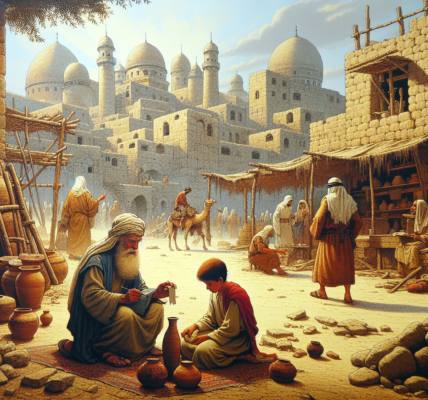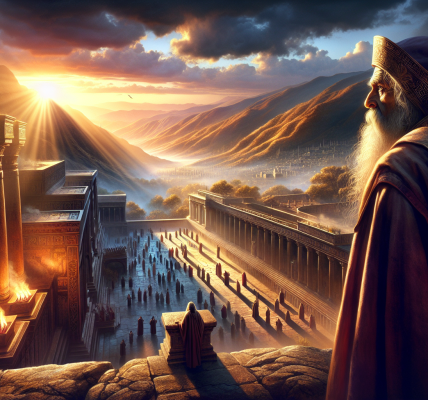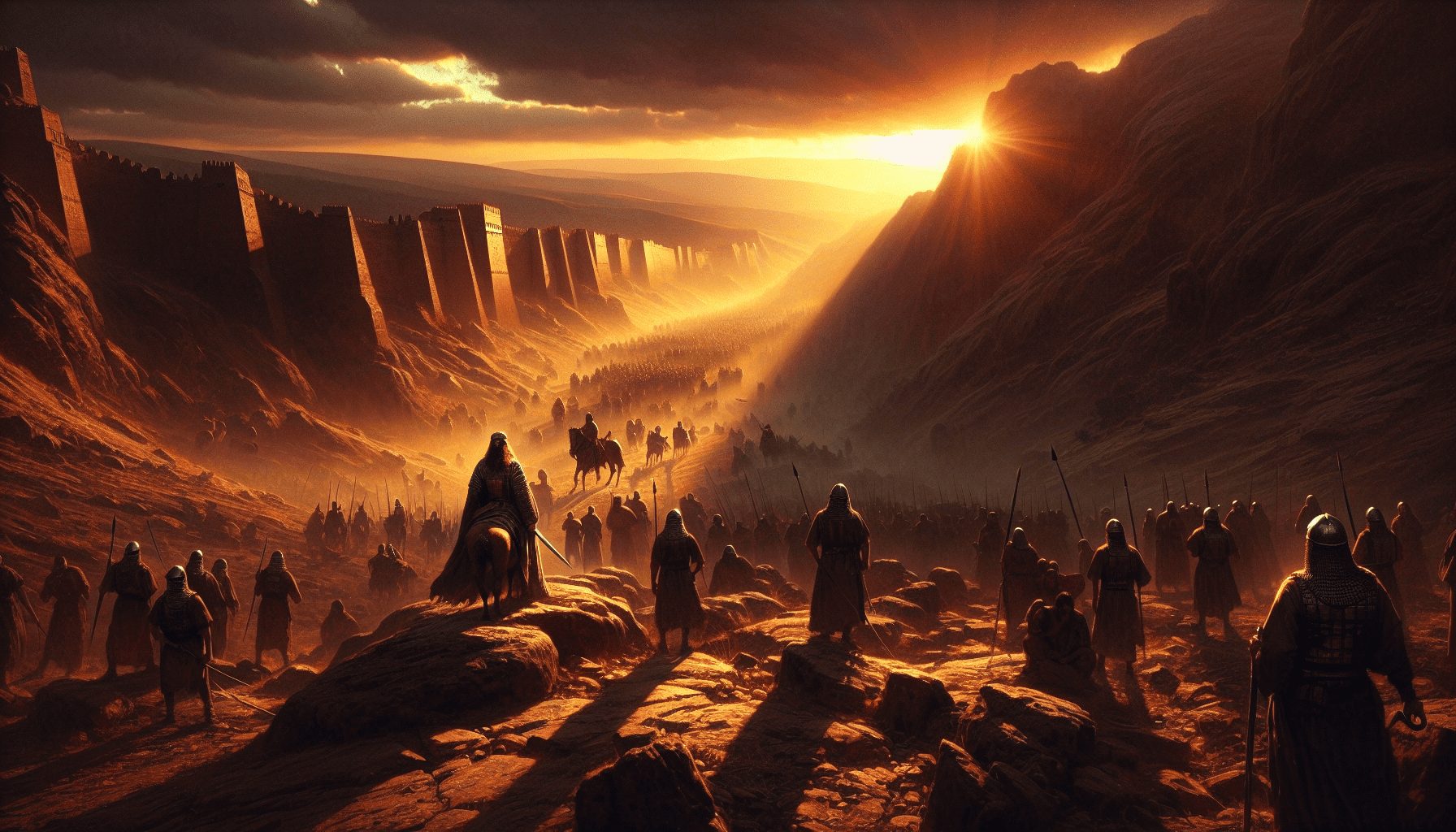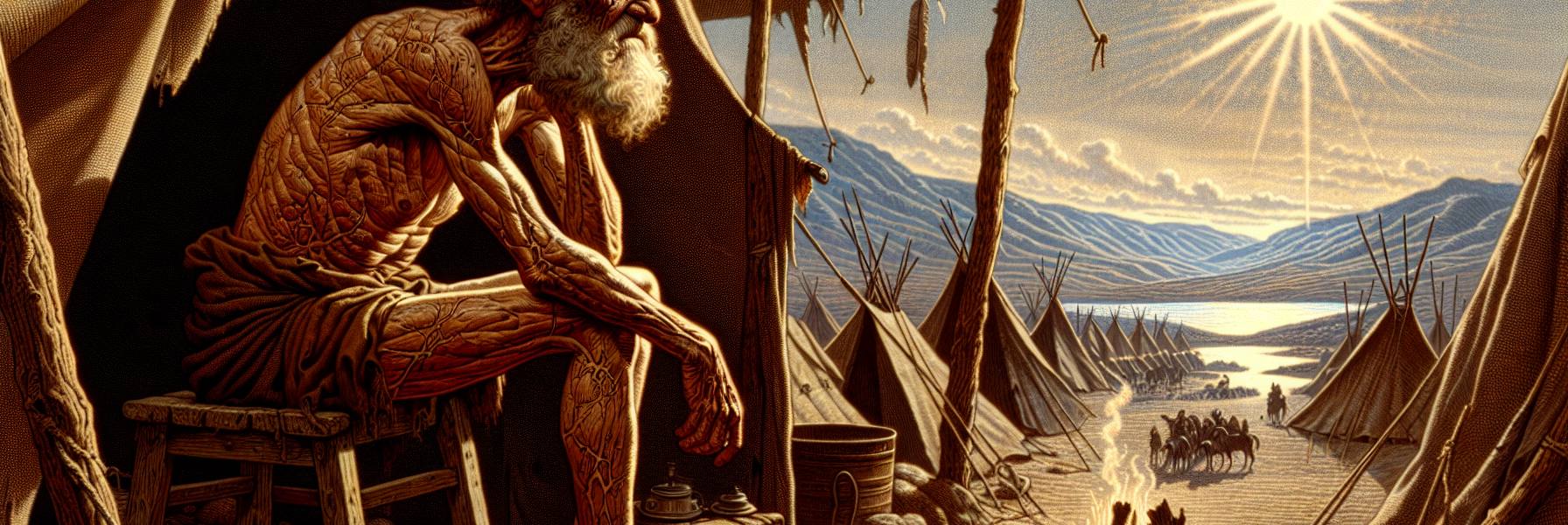

The sun, a weary bronze coin, hung low over the camp at Gilgal. It baked the dust of the courtyard and drew the scent of old canvas and dry earth from the tents. Joshua felt that sun not on his skin, which was leather-tough and mapped with the rivers of countless campaigns, but in his bones. They ached with a deep, settled chill that no fire could touch. He was old, advanced in years. The phrase, once a badge of honor, now sat on him like a worn-out cloak, too heavy to shrug off.
He sat on a stool outside his tent, a scroll spread across his knees, but his eyes were not on the sheepskin. They traced the line of the Jordan, a silver-green thread in the distance, and travelled beyond, into the blue haze of the western hills. Lands he had seen, lands he had only heard named in the commands of Moses. A lifetime of walking, fighting, trusting, and it had all come to this: a vast, trembling moment of *almost*.
The Lord had said to him, “You are old, advanced in years, and very much of the land remains to be possessed.”
It wasn’t a rebuke. It felt more like a gentle, unsettling truth, spoken by a friend who sees the road’s end before you do. The words echoed in the quiet of his spirit. Very much land remained. The coastal plain with its fortified cities, Gaza, Ashdod, Ashkelon—strongholds of the Philistines, a people whose iron chariots were like moving fortresses. The north, from Lebanon all the way to Misrephoth-maim, the domains of the Sidonians. The hills still held pockets of resistance, enclaves of Anakim, those giants whose very stature had once been a terror. The work was unfinished. The promise was secure, but the possession was… incomplete.
A sigh escaped him, a dry rustle of breath. This was the paradox. The Lord was giving Israel all this land, now, by oath and covenant. Yet Joshua’s own hand, the hand that had held the sword at Jericho, would not wield it to take every last parcel. The thought brought not frustration, but a strange, sobering clarity. His task was shifting. It was no longer solely about conquest, but about stewardship. About allocation. About turning a campaign into a home.
He called for Eleazar the priest and for the heads of the tribes. They came, men with faces etched by sun and wind, their authority worn as plainly as their woven mantles. They gathered in the shade of a great terebinth tree, its gnarled roots gripping the earth like ancient veins.
Joshua’s voice, when he spoke, was not the thunder that had shouted down Jericho’s walls. It was thinner, but it carried the weight of decades. “You see how it is with me,” he began, his gaze moving from one leader to another. “I am as Moses was, at the end of his journey. The Lord has kept me alive these many years, as He promised. And now, He Himself has begun to give rest to Israel, to our people, around us.”
He unrolled the scroll further, his fingers tracing the invisible boundaries only faith could see. “Now therefore, divide this land for an inheritance. To the nine tribes and the half-tribe of Manasseh.”
Then he began to speak of what was already done. The lands east of the Jordan, which Moses had allotted to Reuben, Gad, and the other half of Manasseh. He named the places not as a clerk, but as a soldier remembering battlefields: the kingdom of Sihon, the Amorite king who had ruled from Aroer on the rim of the Arnon gorge. He described Gilead, its high meadows good for grazing, and the territory of the Geshurites and Maacathites. He spoke of Bashan, the kingdom of Og, that last of the Rephaim, whose great iron bedstead had become a relic of a vanquished age. Moses had defeated them, Moses had given that good land east of the Jordan to the tribes who wanted it.
But then his voice turned westward, across the river. This was the heart of the promise, the land flowing with milk and honey. And here, his language became a meticulous catalogue of the unconquered. It was a holy realism. “All the inhabitants of the hill country from Lebanon to Misrephoth-maim, all the Sidonians. I myself will drive them out from before the people of Israel.”
The listeners shifted. The declaration was jarring. The Lord Himself would handle what Joshua, in his aging body, could not. The inheritance was certain, even if the work of securing its farthest corners was deferred.
Then came the delineation for the west. He started with the south, Judah’s vast portion, and worked north. But his instructions for the other tribes were interspersed with these curious, persistent footnotes of the unfinished. For the tribe of Ephraim, he noted the Canaanites who dwelt in Gezer, who were not driven out but lived among them to this day. For Manasseh, he named villages like Beth-shean and its dependent settlements, Taanach, Megiddo, Dor—places of strength and chariots of iron where Canaanites stubbornly remained. It was as if the map he was drawing had two layers: one of clear, allotted territories for Israel, and another, fainter layer, of enduring pockets of the old world, like stubborn stains on new cloth.
The meeting lasted until the long shadows of the terebinth tree stretched like dark fingers towards the Jordan. When the leaders departed, their minds buzzing with borders and future settlements, Joshua remained. The scroll was still on his lap. The ache in his bones was still there. But the weight felt different now. It was no longer the weight of a sword, but of a shepherd’s staff. The fighting would continue, for generations perhaps. But the dividing, the planting of roots, the trusting that God would finish what He had sworn to do… that began now, with him, in this quiet evening at Gilgal.
He looked again at the promised land, shrouded in the twilight haze. It was not a picture of perfect peace. It was a living, breathing, complicated reality—a blend of victory granted and challenges lingering, of divine gift and human responsibility. And in that tension, Joshua, old and advanced in years, found the final and most profound act of faith: to apportion the promise, trust the Promise-Giver for the rest, and let the story continue without him.